The alpha, twice a week
That was 2 min.
Get the best new moments in your inbox every Wednesday and Saturday. It's free.
Check your inbox
We sent a link to your address. Click it to finish signing up. Not there in a minute? Look in spam.
or
The Peterman Pod · 2 min · Aug 24, 2026
Broad training may outperform warehouse-specific data
 Sergey Levine
 argues broad training can improve even a warehouse-specific robot because varied tasks build reusable skills.
In this episode
Full analysis- 17:01Robotics needs to prove it can improve through experience4 min
- 25:59Robot experience can help models learn from human videoPro pick 5 min
- 37:14Robots need more reliability than interactive AI tools3 min
- 13:11Robot data must be diverse to drive a capability flywheel4 min
- 39:52Broad training may outperform warehouse-specific data2 min
- 30:58Image-based plans transfer manipulation skills across robots3 min
- 10:19Robotics needs healthy hardware and manufacturing ecosystems3 min
- 22:37A 13-hour coffee run tested long-horizon robot behavior3 min
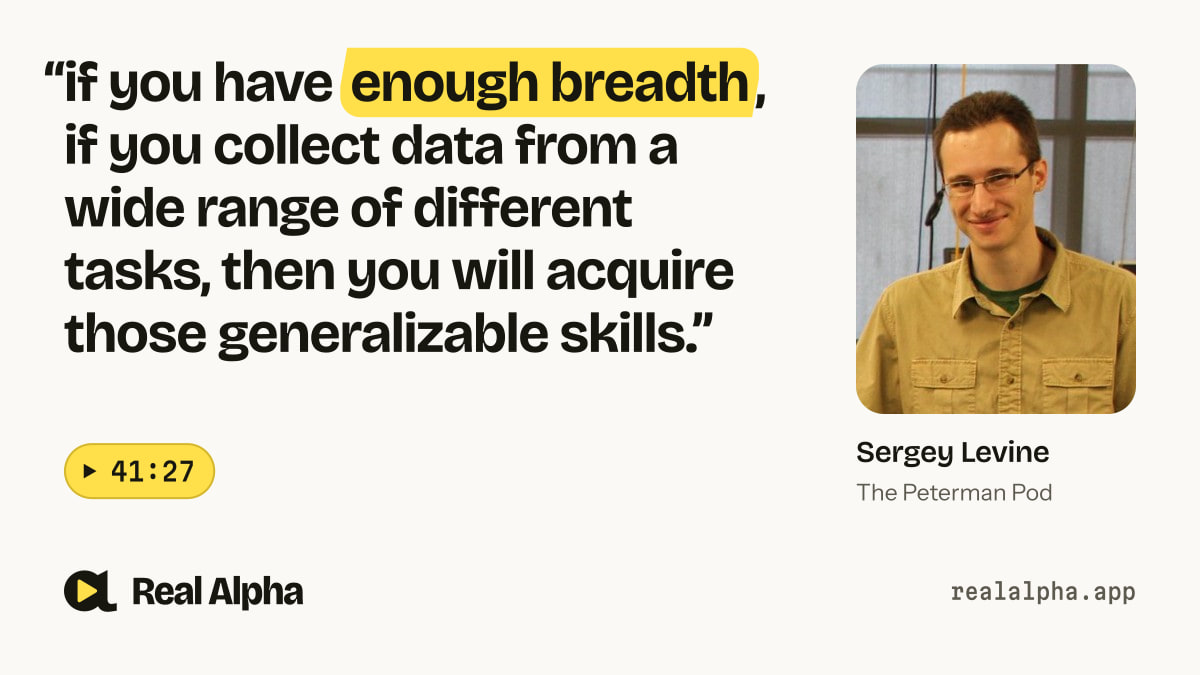
“if you have enough breadth, if you collect data from a wide range of different tasks, then you will acquire those generalizable skills.”
 Sergey Levineat 41:27 · The Peterman Pod
Takeaways
- Foundation-model training draws on a breadth of tasks.
- Levine says breadth can help even warehouse-specific applications.
- This approach runs against task-specific robotics development.
About this segment
Sergey Levine argues broad training can improve even a warehouse-specific robot because varied tasks build reusable skills. He says this clashes with traditional vertical robotics.

Sergey Levine is cofounder of Physical Intelligence and robotics researcher.
Co-founded Physical Intelligence, building a foundation model to bring general-purpose AI into the physical world.

Ryan Peterman, Host · Host, The Peterman Pod
Went from new grad to staff engineer at Instagram in three years.
From “Sergey Levine: Humanoid Robotics Results, Chinese Labs & Future Timelines”, Aug 24, 2026. Watch the full episode
Thanks. We'll look at and fix what's off.
Transcript
Transcribed by machine (Whisper) from the episode’s audio, so a word may be off here and there.
- 39:55
In LLMs, it feels like everyone is doing kind of the same thing. different flavors. In the robotics industry, is everyone doing kind of the same thing? Are there any hot take architectures that are different direction? I actually think that there's a lot more heterogeneity than it might seem. One big dividing line that I think is maybe not as obvious from just kind of looking at the results is the distinction between kind of fully embracing the foundation model ethos, so to speak, versus focusing on specific, like, kind of vertical areas.
- 40:32
And I think this is, like, kind of hard to tease out sometimes, because obviously, like, you know, everyone's going to say, like, oh, I'm doing the thing that LLMs did, like, because, like, that's the cool thing. But, you know, the foundation model ethos fundamentally is something like this, that if you have a particular problem you want to solve, it is better to train a more general model that can use data from a breadth of problems.
- 40:54
And if you do it right, it'll actually be better at the specialized problem you want to solve than a narrow specialist. So, you know, again, to come back to the LM analogy, if you want to do machine translation, don't build a machine translation system. Build a language model that understands all language tasks and then throw it at machine translation. And in robotics, I think that is, like, actually very deeply uncomfortable to people.
- 41:14
Because if someone is actually, like, working on an application, like they're doing, like, warehouse automation, it is very awkward to think like, oh, if I want to do warehouse automation, let me collect data of putting away silverware in kitchens. It just sounds bizarre. But that is the foundation model lesson, that if you have enough breadth, if you collect data from a wide range of different tasks, then you will acquire those generalizable skills.
- 41:38
And if your model is built correctly, it will repurpose those skills for whatever situation it encounters. So I think it is actually true that even if you want to build a warehousing robot, you're better off collecting a breadth of data and will be better at handling all the weird edge cases you might encounter even in that warehouse domain. But this is not something that's easy for people to accept because it's just so like antithetical to the principle of building kind of a traditional vertically integrated robotic system. I noticed this new interesting phenomenon