The alpha, twice a week
That was 3 min.
Get the best new moments in your inbox every Wednesday and Saturday. It's free.
Check your inbox
We sent a link to your address. Click it to finish signing up. Not there in a minute? Look in spam.
or
The Peterman Pod · 3 min · Aug 24, 2026
Robotics needs healthy hardware and manufacturing ecosystems
 Sergey Levine
 says robotics progress depends on supply chains, manufacturing and hardware R&D, not just strong ML labs.
In this episode
Full analysis- 17:01Robotics needs to prove it can improve through experience4 min
- 25:59Robot experience can help models learn from human videoPro pick 5 min
- 37:14Robots need more reliability than interactive AI tools3 min
- 13:11Robot data must be diverse to drive a capability flywheel4 min
- 39:52Broad training may outperform warehouse-specific data2 min
- 30:58Image-based plans transfer manipulation skills across robots3 min
- 10:19Robotics needs healthy hardware and manufacturing ecosystems3 min
- 22:37A 13-hour coffee run tested long-horizon robot behavior3 min
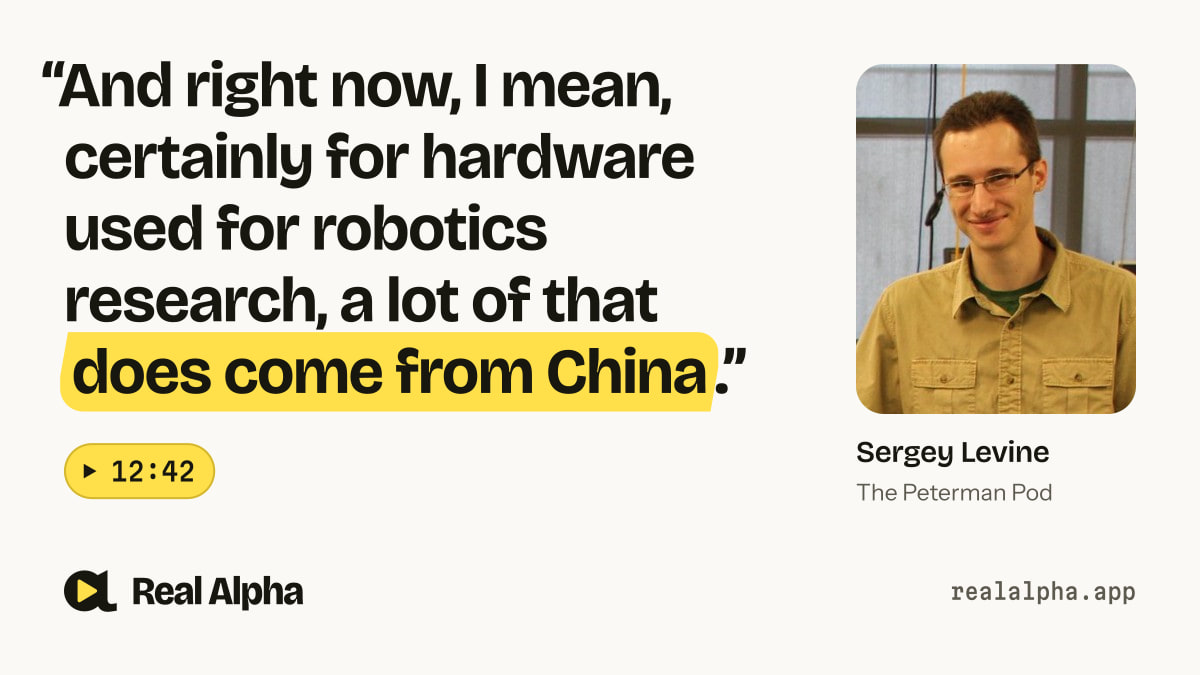
“And right now, I mean, certainly for hardware used for robotics research, a lot of that does come from China.”
 Sergey Levineat 12:42 · The Peterman Pod
Takeaways
- Robotics depends on manufacturing, supply chains and hardware R&D too.
- US robotics research hardware often comes from China.
- Levine says domestic sourcing is possible with ecosystem investment.
About this segment
Sergey Levine says robotics progress depends on supply chains, manufacturing and hardware R&D, not just strong ML labs. He notes US research hardware often comes from China and says domestic sourcing is possible.

Sergey Levine is cofounder of Physical Intelligence and robotics researcher.
Co-founded Physical Intelligence, building a foundation model to bring general-purpose AI into the physical world.

Ryan Peterman, Host · Host, The Peterman Pod
Went from new grad to staff engineer at Instagram in three years.
From “Sergey Levine: Humanoid Robotics Results, Chinese Labs & Future Timelines”, Aug 24, 2026. Watch the full episode
Thanks. We'll look at and fix what's off.
Transcript
Transcribed by machine (Whisper) from the episode’s audio, so a word may be off here and there.
- 10:22
As a bystander, I see on Twitter, these really impressive demonstrations of Chinese robotics, It almost feels like they're ahead in some sense, but I don't have that deep domain expertise. And so I was curious your thoughts on, you know, what do you think of China's robotics and, you know, are they further along? I think that one thing that is very useful and constructive for us to do, those of us that work on these things in the United States and in Europe, is to ask, what is the lesson to learn?
- 11:01
And to me, one lesson is that it's important to have a healthy ecosystem. And ecosystem means that there should be, you know, obviously good researchers, good engineers working on these things. There should be like healthy open source. But it also means that the different industries that contribute to robotics need to individually be very healthy. And those industries are not just the computer science, ML, and model building stuff.
- 11:33
It's also supply chains, manufacturing, hardware, R&D. These are all very important things. And aspects of those things are things that the United States does quite well. Other aspects of them are things where the United States has sort of let things go a little bit. And I think that what we should do is we should look at what's going on in the world, look at some of the excellent results. that Chinese labs are doing, that labs in other countries are doing, and we should take away that lesson that we should strive to build a healthier ecosystem. And that means investing in all the different facets that contribute to this. So, you know, I'm not like, I'm not much of a business person. I'm not much of an investment person. So I don't, I can't claim to know how to do this, but I think that it's important to sort of fully embrace that this is like a holistic thing and
- 12:22
not something where we can do just like one piece of it and like outsource everything else, basically. Of all that, the pieces of the ecosystem, are there parts of it as a robotics researcher in the U.S.? If it was better, that would have the biggest impact on the advancement of robotics? Yeah, I think certainly availability of reliable, low-cost hardware is a big deal. And right now, I mean, certainly for hardware used for robotics research, a lot of that does come from China.
- 12:51
And it's good. It's relatively inexpensive. It's of high quality. and meets the standards that people generally need. But it would be awfully nice to be able to source all that domestically as well. And I don't think there's anything impossible about that. I think it's just a matter of sort of embracing the fact that that entire ecosystem needs to be supported rather than just one piece of it.