The alpha, twice a week
That was 4 min.
Get the best new moments in your inbox every Wednesday and Saturday. It's free.
Check your inbox
We sent a link to your address. Click it to finish signing up. Not there in a minute? Look in spam.
or
The Mishal Husain Show · 4 min · Nov 13, 2026
Cameron says an arms ban risked security without changing events
 David Cameron
 says his government used pressure and targeted sanctions but rejected a broader arms halt.
In this episode
Full analysis- 12:57Care-cost caps need insurance to share the riskPro pick 4 min
- 25:18Cameron says Britain’s economic problems are domestic3 min
- 7:02Alzheimer's research could bring blood tests by 20306 min
- 31:37Cameron says an arms ban risked security without changing events4 min
- 28:03Cameron says referendum planning began years before 20154 min
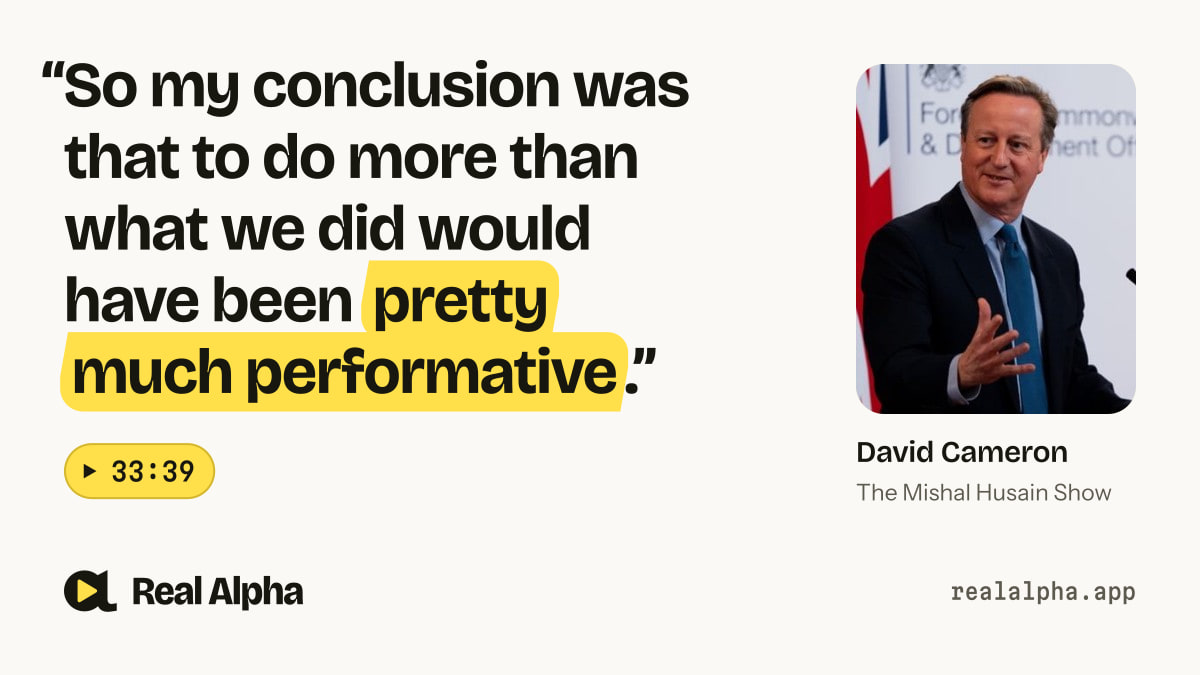
“So my conclusion was that to do more than what we did would have been pretty much performative.”
 David Cameronat 33:39 · The Mishal Husain Show
Takeaways
- He says repeated visits and pressure helped secure some aid access.
- He judged a broader arms halt unlikely to change events.
- The F-35's integrated supply chain raised security concerns.
About this segment
David Cameron says his government used pressure and targeted sanctions but rejected a broader arms halt. He argues its effect would have been limited and the F-35 supply chain mattered to UK security.

David Cameron is a former UK prime minister and foreign secretary.
Made dementia research a political priority, helped double investment, and now champions the search for an Alzheimer’s cure.

Mishal Husain, Host · Host, The Mishal Husain Show
From “David Cameron on Ending Alzheimer’s, Brexit and a Possible Comeback | The Mishal Husain Show”, Nov 13, 2026. Watch the full episode
Thanks. We'll look at and fix what's off.
Transcript
From the transcript The Mishal Husain Show publishes with the episode.
- 31:49
I look at that period and think... we did a huge amount to try and get the Israeli government to focus on the need to get aid into Gaza, to treat prisoners properly, and to try to bring about the changes that were necessary.
- 32:09
This was dialogue. I don't think you took action. Well, we took action in that I went to Israel repeatedly. I used all the leverage that we had to try and get aid in. And I think it did It did work to an extent, but it was incredibly frustrating. But I think we were right in our overall position in that this was a horrific attack on Israel, and we wanted to demonstrate our support in the light of that.
- 32:38
But we also, I had some very, very tough conversations, and I did take action. For instance, I did sanctions and travel bans against violent settlers, put in place the Do you wish you'd done more? The sanctions that were done. Well, actually, one of the things, one of my few interventions after the election was to ask the question, well, why haven't Smotrich and Ben-Gavir been sanctioned in the way that I was just about to do before the election intervened? So, no, I think we had the right.
- 33:04
Which is the choice of Rishi Sunak to call the election at that point. But I'm thinking about a moment a few months before, April 2024. Because in all of this period, arms exports licenses continued. You didn't stop that. And that was even the case after three British citizens, James Kirby, James Henderson, John Chapman, had been killed in the World Central Kitchen attack on an aid convoy. Even at that point, you didn't stop the arms export licenses.
- 33:29
Well, you had to ask yourself the question, what will the effect of this be? Will it actually have an impact on what is happening? And my conclusion was it wouldn't. And you also got to ask, what are the other consequences? Because there are programs like, I think, the F-35, where there's quite an integrated supply chain. Of course, the F-35 is very important to our security. So my conclusion was that to do more than what we did would have been pretty much performative. And I think, actually, if we look at what's happened since, I would argue that it was largely performative. And also, you could say the same about the recognition of Palestine. Now, I moved the dial on that. By saying, when I was foreign secretary, by saying that it shouldn't come at the end of the process, that recognition of the Palestinian state should be part of
- 34:17
the process. It doesn't have to wait for the end. And it's something, you know, I always thought the American position, it was going to be the last thing that happened. I thought that was wrong, and I made that very clear. But again, I would say the decision the government made actually in the end was quite a performative one because it just threw this bone out, as it were, to the backbenchers rather than saying, let's make the recognition of Palestine part of the political process that we want to see.
- 34:42
Okay, so 70,000 dead in Gaza and you don't think you should have taken more action while you could have? We did a lot of things to try and help
- 34:50
the people in Gaza by going to Egypt, going to visit the aid convoys, putting the money in. Also... by the way, the government I led increased the aid budget to its highest level ever. So we were able to intervene in these sorts of humanitarian crises. But it was an extremely difficult situation. But I don't think the things that people were asking me to do on, for instance, the arms ban, I think they would have been performative rather than real. And I think they might have damaged our own security in a dangerous world because of things like the F-35.