The alpha, twice a week
That was 2 min.
Get the best new moments in your inbox every Wednesday and Saturday. It's free.
Check your inbox
We sent a link to your address. Click it to finish signing up. Not there in a minute? Look in spam.
or
Lenny's Podcast · 2 min · Nov 2, 2025
Canva expanded by following unmet customer needs
 Melanie Perkins
 says Canva began with Australian yearbooks, where coordinators lacked easy design tools.
In this episode
Full analysis- 8:03Build from the future you want, then work backward6 min
- 23:43Canva spent two years rewriting its editor without shippingPro pick 3 min
- 26:20Investor rejections helped sharpen Canva’s pitch5 min
- 40:33Canva ties company growth to doing the most good5 min
- 37:59Canva turns more than a million yearly requests into product work3 min
- 50:16Canva expanded by following unmet customer needs2 min
- 16:46Canva turns mission goals into milestones the team can celebrate5 min
- 30:58Canva rebuilt its practices instead of copying other companies3 min
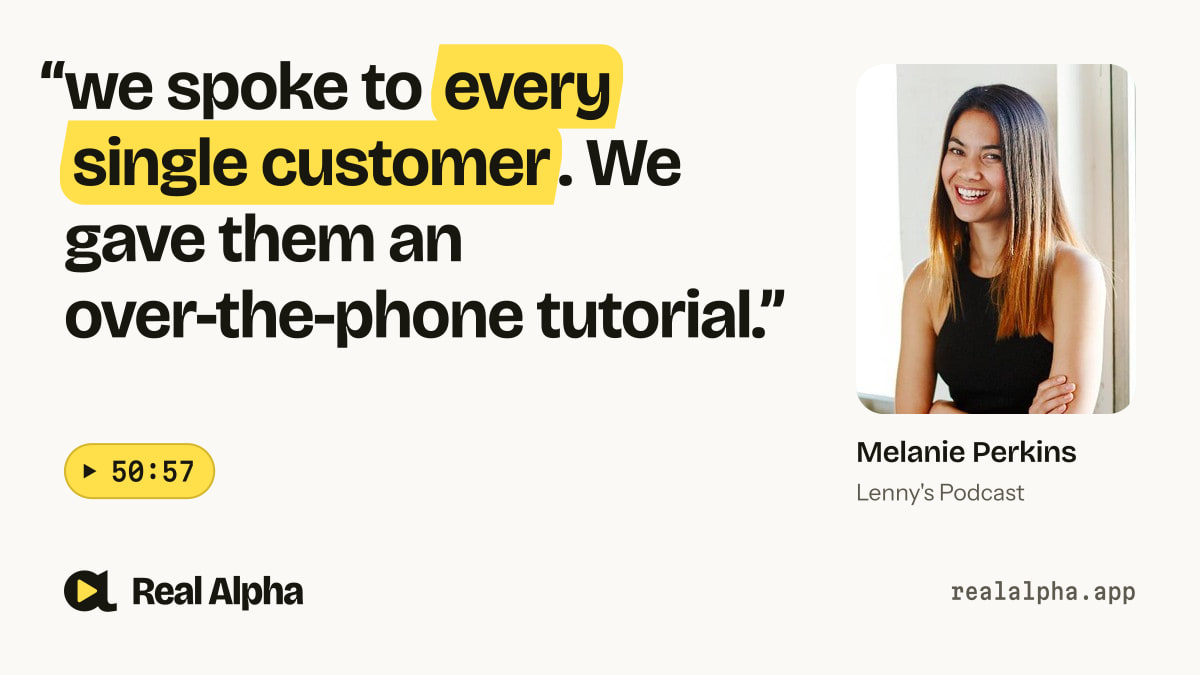
“we spoke to every single customer. We gave them an over-the-phone tutorial.”
 Melanie Perkinsat 50:57 · Lenny's Podcast
Takeaways
- Canva began by serving Australian school yearbook coordinators.
- The founders spoke with every customer and gave phone tutorials.
- A school’s request to make newsletters pointed to adjacent demand.
About this segment
Melanie Perkins says Canva began with Australian yearbooks, where coordinators lacked easy design tools. Customer conversations and requests for other uses helped the team see where to expand.

Melanie Perkins is CEO and co-founder of Canva.
Co-founded Canva and leads its mission to empower everyone to design, while steering its pledge to do good.

Lenny Rachitsky, Host · Host, Lenny's Podcast
Spent seven years at Airbnb; his product newsletter has over 1M subscribers.
From “She turned 100+ rejections into a $42B company | Melanie Perkins”, Nov 2, 2025. Watch the full episode
Thanks. We'll look at and fix what's off.
Transcript
Transcribed by machine (Whisper) from the episode’s audio, so a word may be off here and there.
- 50:21
One is just at the beginning of the journey where a lot of founders try to figure out their wedge and their specific niche. Just how did you think about that? Like, here's how we might have a chance to. I don't think it wasn't even around back then, I don't think. Just like how did you approach your early wedge of users? One of the most important things that we did was we didn't really worry about competitors at all.
- 50:43
We actually just saw where is there a gap in the market that we can uniquely fill? And what can we solve a problem, a core problem that people currently have today? And so with our first company, that was yearbooks in Australia, and there wasn't great tools, and these yearbook coordinators got thrown in to have to design something, and they'd have no design experience. And, you know, we spoke to every single customer.
- 51:04
We gave them an over-the-phone tutorial. We understood all of their pain points. We got continuous customer feedback, and then we tried to iterate and improve. And then when we were thinking about Canva, a few years into that, actually, one of the schools said, I love this product so much. Can I use it to design newsletters? and they had all sorts of other things that they wanted to use it for. And we kind of looked around and were like, oh, there's still nothing on the market.
- 51:28
This was like a few years into it that actually does the thing that we're doing but for all these other things. And so it was much more like where is the gap in the market that people are currently having a pain point? And if you can solve that pain point really well and solve it in such a way that people actually want to pay for it because it is truly solving a real pain point that they have, I think that kind of sets it up for success rather than be a problem or a solution looking for a problem.
- 51:53
So what I'm hearing there is you didn't overthink, here's my ICP, here's like the wedge and the strategy of how we expand into this large thing. It's like, here's people with a problem that hasn't been solved in years that we keep seeing. Let's try to solve it. Exactly that. And if you take that problem-centered approach that helps people to achieve something they actually want to do in real life, you're probably going to be in a reasonably good spot, especially if it maps to a larger market.
- 52:16
That's a particularly great thing. if it only solves one person's problem, that might not be a great company going forward. But if a few people have that same problem. But I think that again, like back to that big ladder and that first rung, not getting too, I think it's better to solve a small number of people's problem really well than trying to solve a large number of people's problem not very well at all.