The alpha, twice a week
That was 4 min.
Get the best new moments in your inbox every Wednesday and Saturday. It's free.
Check your inbox
We sent a link to your address. Click it to finish signing up. Not there in a minute? Look in spam.
or
Wall Street Week · 4 min · Nov 14, 2026
Care demand is rising while home-care pay remains low
 Ai-jen Poo
 cites 11,400 people turning 65 daily and says 70% will need long-term care; home-care workers earn a median $23,000.
In this episode
Full analysis- 29:47Care jobs need policy support to become good jobs4 min
- 15:51Stadium subsidies need a business case, not just fan passion2 min
- 42:06Wedding gold also serves as collateral for consumer loansPro pick 4 min
- 26:06Care demand is rising while home-care pay remains low4 min
- 18:04Indiana would bear any shortfall on the stadium bonds3 min
- 39:01Social reciprocity helps sustain India's expensive weddings3 min
- 7:41Tariffs on Canada also tax U.S. manufacturers3 min
- 4:29Midterms barely constrain presidential foreign policy3 min
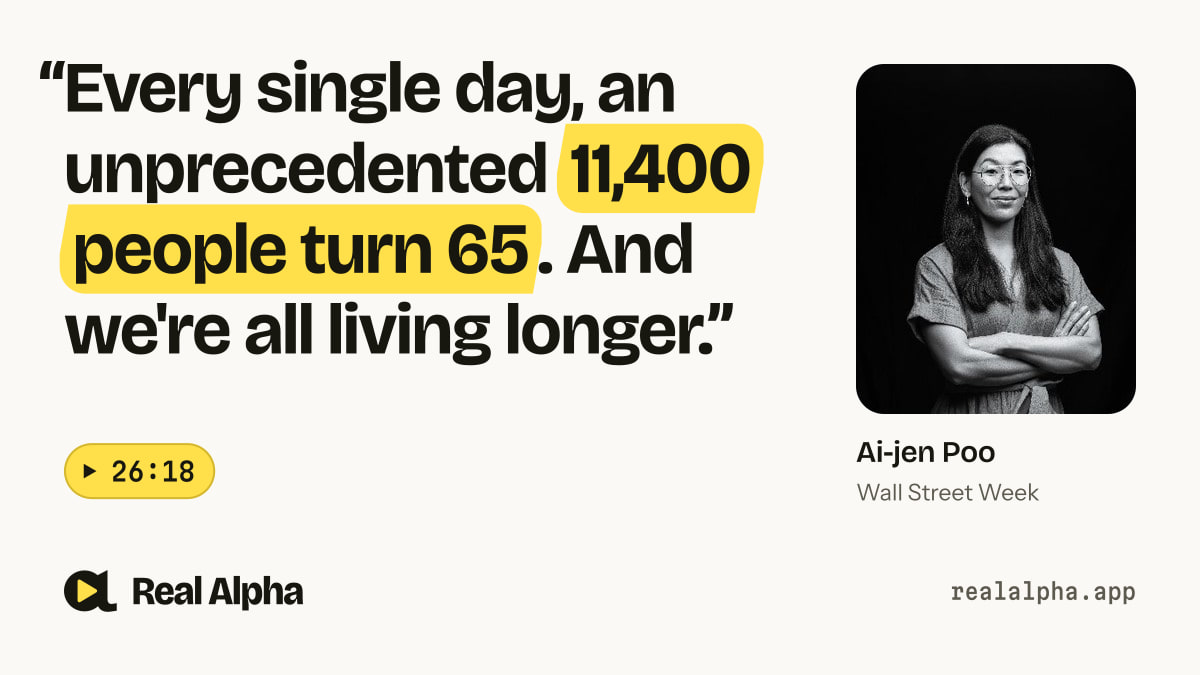
“Every single day, an unprecedented 11,400 people turn 65. And we're all living longer.”
 Ai-jen Pooat 26:18 · Wall Street Week
Takeaways
- About 11,400 people turn 65 each day; 70% will need long-term care.
- Home-care workers have a median annual income of about $23,000.
- Upward mobility fell from 90% of children to roughly one in two.
About this segment
Ai-jen Poo cites 11,400 people turning 65 daily and says 70% will need long-term care; home-care workers earn a median $23,000. Katz says upward mobility has fallen from 90% of children to about half.

President, National Domestic Workers Alliance
Co-founded the National Domestic Workers Alliance and led campaigns winning protections for domestic and care workers.
- DW
David Westin, Host
From “Nvidia Shakeup, Midwest Stadium Bids, Care Work Gap, India’s Wedding Economy | Wall Street Week”, Nov 14, 2026. Watch the full episode
Thanks. We'll look at and fix what's off.
Transcript
From the transcript Wall Street Week publishes with the episode.
- 26:08
America today is experiencing a huge growth in the need for care. And that's across the lifespan, but particularly on the growing aging population in our country. Every single day, an unprecedented 11,400 people turn 65. And we're all living longer. And about 70% of us will need long-term care in our country. And we just don't have the workforce in place to support that.
- 26:36
The demand is there. But is iGenPOOP? President of the National Domestic Workers Alliance, sees it, the bigger question is whether the economics of the jobs are strong enough to attract workers and keep them.
- 26:51
The median income for a home care worker in America is about $ 23, 000 per year, which is impossible to support a family on and sustain in. And so if we made these good jobs, this could be a huge opportunity for economic mobility and real. Yeah, access to good jobs for workers for the future. And so that is the opportunity, but it's also a challenge because we're not there yet.
- 27:20
That tension has surfaced before. As the American economy has changed, workers have repeatedly moved into new jobs. Some of those shifts created new pathways into the middle class. Others did not. Harvard economist Larry Katz has spent much of his career studying those changes. including one of the country's earliest big shifts, as workers moved off the farm and into an industrial economy.
- 27:48
Nineteenth century, the vast majority of the workforce worked in agriculture, and we had rising demand for clerks, for engineer types for a wide range of skilled manufacturing jobs and service sector jobs.
- 28:06
In that transition, many of the jobs workers found offered something important, a chance to earn more and move up.
- 28:14
As the wages of workers in such occupations rose with the big demand from industry, what you saw was a grassroots movement in the U.S. to provide access to high schools. town and city after city, built them and hired teachers. And in some sense, the race between education and technology was a very even match in this period. The next generation had the skills and were able to move out of the farm into the new industry jobs.
- 28:48
How are we doing with the subsequent waves? In the mid-20th century, 90% of kids had higher incomes than their parents if you measured them both at age 30. Today, it's more like a coin flip in terms of the share of children who end up with higher earnings than their parents. It's much less upward mobility. Some of that is slower productivity growth, but not a lot. Most of it is the distribution of income has become much more skewed and unequal, and the opportunities for moving up seem to have been not, we have not done as good a job in investing. And you've seen since 1980 a large increase in inequality and in some measures much slower growth than the real living standards of typical workers, even though overall productivity and those who are at the top have done very well.