The alpha, twice a week
That was 3 min.
Get the best new moments in your inbox every Wednesday and Saturday. It's free.
Check your inbox
We sent a link to your address. Click it to finish signing up. Not there in a minute? Look in spam.
or
Wall Street Week · 3 min · Nov 14, 2026
Midterms barely constrain presidential foreign policy
 Richard Haass
 argues midterms have little direct effect on foreign policy because presidents retain most authority.
In this episode
Full analysis- 29:47Care jobs need policy support to become good jobs4 min
- 15:51Stadium subsidies need a business case, not just fan passion2 min
- 42:06Wedding gold also serves as collateral for consumer loansPro pick 4 min
- 26:06Care demand is rising while home-care pay remains low4 min
- 18:04Indiana would bear any shortfall on the stadium bonds3 min
- 39:01Social reciprocity helps sustain India's expensive weddings3 min
- 7:41Tariffs on Canada also tax U.S. manufacturers3 min
- 4:29Midterms barely constrain presidential foreign policy3 min
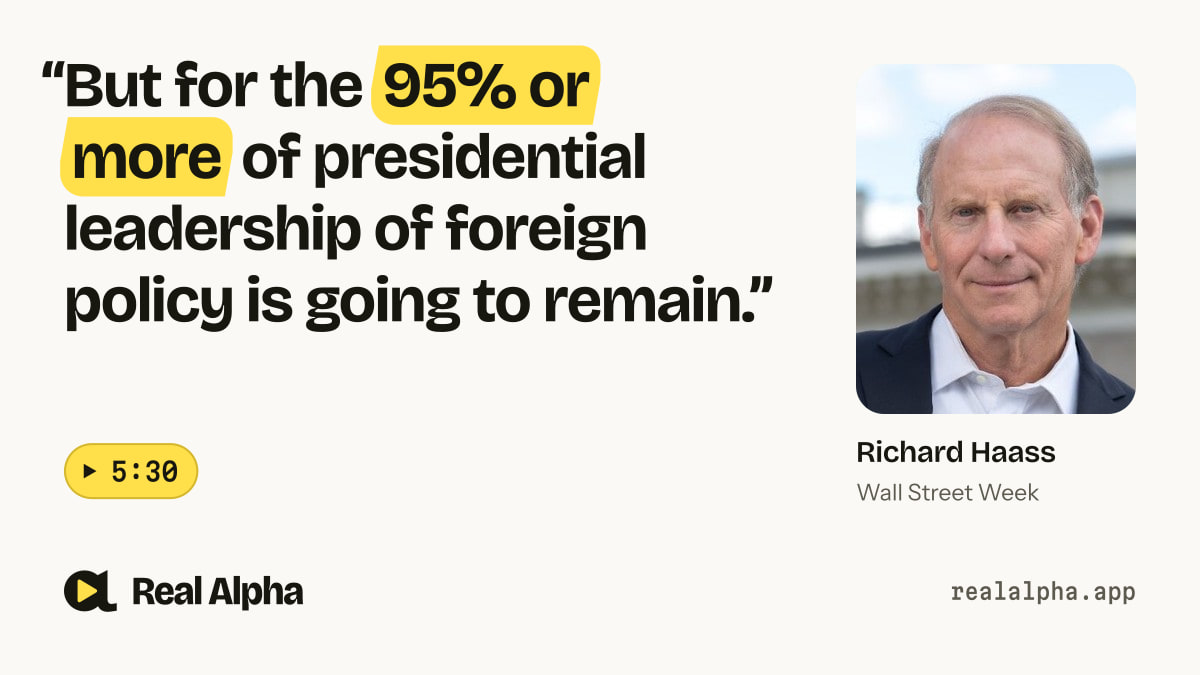
“But for the 95% or more of presidential leadership of foreign policy is going to remain.”
 Richard Haassat 5:30 · Wall Street Week
Takeaways
- Presidents retain broad authority over military action, tariffs and diplomacy.
- Haass says about three-quarters of U.S. embassies are empty.
- He sees Trump, Putin and Xi entering talks from weakened positions.
About this segment
Richard Haass argues midterms have little direct effect on foreign policy because presidents retain most authority. He says the vote still signals political weakness to leaders in Tehran, Beijing and Moscow.

Senior counselor, Centerview Partners
Chaired Northern Ireland peace negotiations and led the Council on Foreign Relations for twenty years.
- DW
David Westin, Host
From “Nvidia Shakeup, Midwest Stadium Bids, Care Work Gap, India’s Wedding Economy | Wall Street Week”, Nov 14, 2026. Watch the full episode
Thanks. We'll look at and fix what's off.
Transcript
From the transcript Wall Street Week publishes with the episode.
- 4:32
There was a midterm election. Thank you, David. Which had a lot of ramifications for the Congress, where you had both houses switch. Generally, think of that as domestic, the Congress. What possible effects could it have on international relations and President Trump's position?
- 4:49
Well, the first point to make is a version of the point you made, that historically, The lion's share of the control over American foreign policy has been the prerogative of the executive. What, 50, 60 years ago, Arthur Schlesinger Jr. wrote a book, what, The Imperial Presidency. And that was in the context of Vietnam. But every president since has gone to war or used military force without congressional approval.
- 5:11
Congress has delegated enormous powers, for example, when it comes to tariffs. Presidents can do what they want in diplomacy and so forth. So the short answer to your question, David, is the election won't matter So if tomorrow Donald Trump wants to make a new proposal, more pro-Russian, more pro-Ukrainian, when it comes to that war, he can do it. But for the 95% or more of presidential leadership of foreign policy is going to remain. Plus, this administration doesn't have ambassadors for the most part. About three quarters of our embassies are empty. The way policy is made gives informality a new meaning. So again, there's not a lot of entry points for the Congress here.
- 5:52
You have dealt with U.S. diplomacy at the highest levels of government, both in the White House as well as the State Department. So you've seen this over years. To what extent does the political standing of the president in the United States domestically affect his position with respect to others, like Vladimir Putin, and even more important, perhaps, President Xi that he's meeting with at the ASEAN summit?
- 6:12
No, you're exactly right. I think it hurts Donald Trump with the Iranians. They are pretty good readers. of the American political system. A lot of their senior people went to school here. So they're watching. They saw the midterms. My guess is they've decided they can drive a harder bargain. That one of the takeaways from the election is the American people don't have much more stomach for this. Donald Trump's standing has diminished. So I think we'll see probably a tougher line, if possible tougher. It's been pretty tough up to now, out of Tehran. Yeah, and you've got these upcoming meetings with President Xi and with Vladimir Putin So, yeah, they've taken note of what's happened. Funnily enough, though, David, I think all three are somewhat weakened. Donald Trump comes out of the midterms with very little wind at his back,
- 6:52
so to speak. Vladimir Putin's not winning and over the last couple of months has been more losing the war against Ukraine. His economy is a shambles. Xi Jinping also, as you know, has enormous economic problems. So, yeah, the so-called big three ain't so big right now. And that's an interesting context for this meeting.