The alpha, twice a week
That was 2 min.
Get the best new moments in your inbox every Wednesday and Saturday. It's free.
Check your inbox
We sent a link to your address. Click it to finish signing up. Not there in a minute? Look in spam.
or
The Pragmatic Engineer · 2 min · Oct 21, 2026
Central server approvals created a black market at Yahoo
 Will Larson
 recalls Yahoo's founder approving server allocations, which led engineers to hoard and informally lend machines.
In this episode
Full analysis- 19:39Digg launched a rewrite without load testing or rollback capacityPro pick 6 min
- 50:47ZIRP pushed managers toward hiring and people-focused workPro pick 7 min
- 1:33:30Middle managers may need to return to hands-on engineeringPro pick 6 min
- 1:16:22Durable teams let leaders focus on the problems only they can solve5 min
- 1:26:01A CTO needs both technical judgment and bureaucratic experience6 min
- 57:21Staff engineers are distinguished by how they resolve ambiguity4 min
- 10:19Central server approvals created a black market at Yahoo2 min
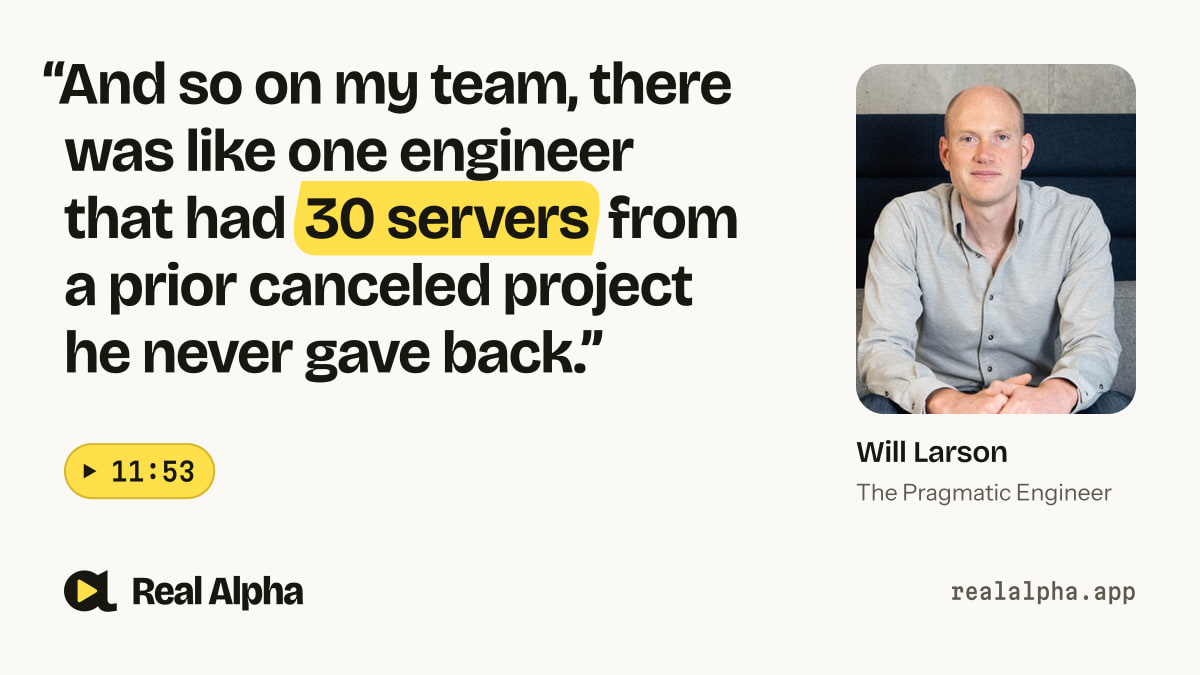
“And so on my team, there was like one engineer that had 30 servers from a prior canceled project he never gave back.”
 Will Larsonat 11:53 · The Pragmatic Engineer
Takeaways
- David Filo reviewed server allocations.
- One engineer held 30 servers from a canceled project.
- Informal server lending emerged when teams couldn't get approval.
About this segment
Will Larson recalls Yahoo's founder approving server allocations, which led engineers to hoard and informally lend machines. The rule left outdated capacity in use and made new projects depend on favors.

Will Larson is CTO of Imprint and author on engineering leadership.
Led engineering at Stripe, Uber, Calm and Carta; author of Staff Engineer and The Engineering Executive's Primer.

Gergely Orosz, Host · Host, The Pragmatic Engineer
Spent four years at Uber heading mobile, web and backend teams; shipped part of its payments system.
From “The revised rules of engineering management with Will Larson”, Oct 21, 2026. Watch the full episode
Thanks. We'll look at and fix what's off.
Transcript
Transcribed by machine (Whisper) from the episode’s audio, so a word may be off here and there.
- 10:26
from Yahoo? I think Yahoo, honestly, is a really interesting company, right? And so I think one of the challenges for Yahoo is if you came into tech in 2007, 2008, a lot of open source sort of made things easy. Yahoo, though, is a company that predated all these open source libraries. And so how do you run a server at Yahoo in 2007, 2008? You run Y Apache. So they had their own fork of Apache with a Y in front of it. What programming language do you run on Y Apache? Well, of course, you'd run YPHP, which was their fork of PHP. And what UI library would you use? You might know this one, but it's YUI. And then how do you install things? So if you think about like, you know, Ubuntu, you'd have kind of like APT or whatnot. Well, you'd use Yinst, which was this Perl script that would navigate kind of the dependencies for installation. And so just like
- 11:19
really, really fascinating place to come up. But every single thing there, they made from scratch. patch even they had like a precursor to kafka which i think was called y repl which basically would be like a read log to do replication kind of outside of a database and that that was like a core tool for managing state just like a fascinating place and i think if i just had like one quick yahoo story that i loved so david filo kind of famously approved every server that was allocated in the company and so one of the founders like would review and so the the theory was this would drive accountability, right?
- 11:54
You had to prove you needed more servers. What it actually did is it created like the black market of servers. And so on my team, there was like one engineer that had 30 servers from a prior canceled project he never gave back. And so he would basically sell them to you effectively, right? And so if you couldn't get approval. For like favors and IOU and that kind of stuff. And so it actually meant they had massive numbers of outdated servers that were like using like inefficient like power wattage because people would never give servers back.
- 12:25
And so you had to find like someone who liked you with servers to loan for your projects to launch. Like fascinating how these incentives drive just like wild, wild situations. Well, I guess that's one thing you remembered for when you later became an engineering leader. Yeah, it was very instructive, right? And I'm sure, I'm curious, like did David Filo know