The alpha, twice a week
That was 4 min.
Get the best new moments in your inbox every Wednesday and Saturday. It's free.
Check your inbox
We sent a link to your address. Click it to finish signing up. Not there in a minute? Look in spam.
or
The Pragmatic Engineer · 4 min · Oct 21, 2026
Staff engineers are distinguished by how they resolve ambiguity
 Will Larson
 still favors career ladders because they surface glue and maintenance work, but says promotion criteria cannot eliminate judgment.
In this episode
Full analysis- 19:39Digg launched a rewrite without load testing or rollback capacityPro pick 6 min
- 50:47ZIRP pushed managers toward hiring and people-focused workPro pick 7 min
- 1:33:30Middle managers may need to return to hands-on engineeringPro pick 6 min
- 1:16:22Durable teams let leaders focus on the problems only they can solve5 min
- 1:26:01A CTO needs both technical judgment and bureaucratic experience6 min
- 57:21Staff engineers are distinguished by how they resolve ambiguity4 min
- 10:19Central server approvals created a black market at Yahoo2 min
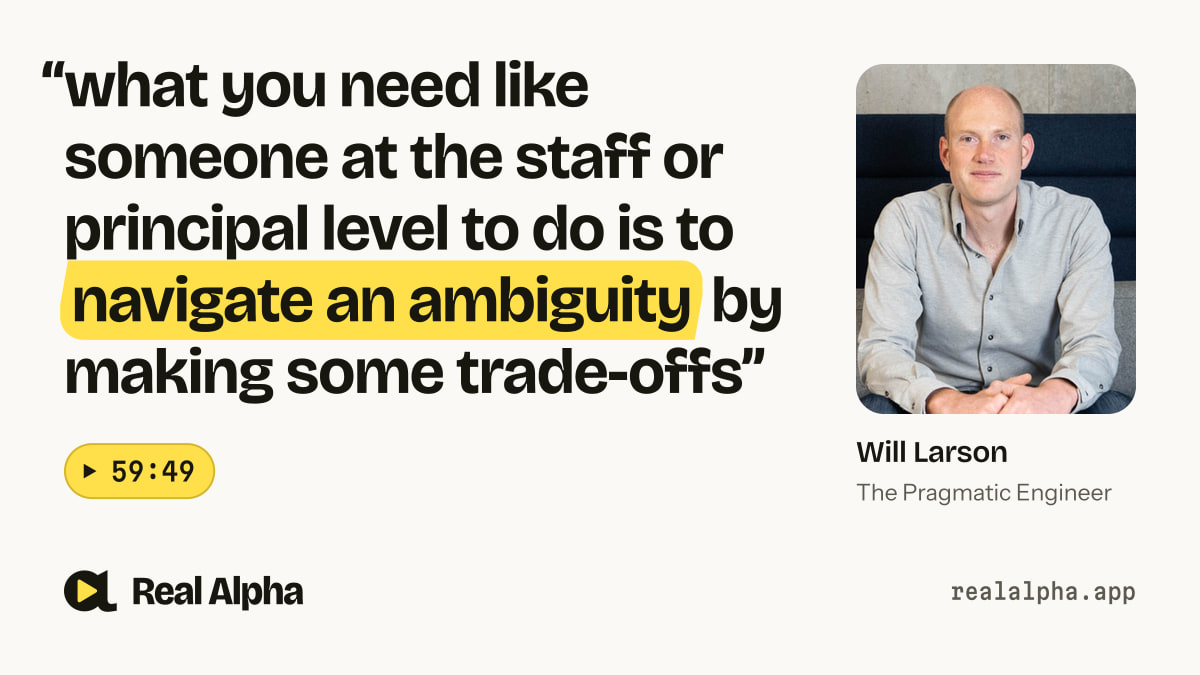
“what you need like someone at the staff or principal level to do is to navigate an ambiguity by making some trade-offs”
 Will Larsonat 59:49 · The Pragmatic Engineer
Takeaways
- Rubrics can make promotion decisions fairer and protect less-visible work.
- Overly specific criteria invite people to game the measurement.
- Staff-level judgment means making trade-offs instead of waiting for others.
About this segment
Will Larson still favors career ladders because they surface glue and maintenance work, but says promotion criteria cannot eliminate judgment. At senior levels, he values navigating ambiguity through trade-offs, prototypes, and product context.

Will Larson is CTO of Imprint and author on engineering leadership.
Led engineering at Stripe, Uber, Calm and Carta; author of Staff Engineer and The Engineering Executive's Primer.

Gergely Orosz, Host · Host, The Pragmatic Engineer
Spent four years at Uber heading mobile, web and backend teams; shipped part of its payments system.
From “The revised rules of engineering management with Will Larson”, Oct 21, 2026. Watch the full episode
Thanks. We'll look at and fix what's off.
Transcript
Transcribed by machine (Whisper) from the episode’s audio, so a word may be off here and there.
- 57:28
do you think career opportunities are have changed for software engineers working at startups mid-sized companies that you see because we used to have a pretty clear career ladder eng1 eng2 senior eng staff eng it was clear on how you get promoted to start with you know ai tools are out you know they're writing the code which used to be like eng1 and eng2 they're now getting better at like architecture we're talking about loops do we have a career ladder should we have a career ladder If you are a manager at a company, should you be worried about putting together a career ladder right now?
- 58:00
It's a good question, right? And I do think the expectation is certainly from the teams that we should have career ladders, right? And that is, so the belief, which I think is like backed up in research, is that like having rubrics drives more fair decisions than not having rubrics. And so I think this anchoring on career ladders is like something that's here to stay. And I do think if you don't have that, then you do undervalue certain things, right?
- 58:23
And so maintenance work, glue work, gel work, whatever you want to call it, I think gets like under-emphasized and flashy things that actually work and get over-emphasized. I think that's definitely true. So I'm still a believer in career laddering, right? I think it's still valuable. But what should be there, I think, is like complicated. And I think it's like much less clear about what should be it.
- 58:44
I think, I don't know which consultancy has been selling some of these career ladders. kind of small company by small company, you see the exact same career ladder from some kind of like, I don't know, like packet you can buy somewhere. And so I think all of those are just really outdated, but we don't have like the next version of it. That said, when I think about folks getting to like staff or principal these days, like what I really care about is I've been thinking about doing like an add on to staff engineer, I'll get to it in like, I don't know, the next decade sometime. But it's really about decision making and complicated situations. And so first, this idea of navigating ambiguity and so at stripe i remember working on this project where we wanted to go multi-region and i kept getting from the engineers trying to lead it like we need
- 59:28
product to decide how on cross-region replication works or what like what's the product behavior that we support if there is like a only the consistency and availability of no partition ability they wanted the product team to make these like cap theorem trade-offs which um the product team can't possibly make cap their own trade-offs right and what they were doing is they're finding a way to get stuck when instead like what you need like someone at the staff or principal level to do is to navigate an ambiguity by making some trade-offs build the conviction figuring out how to like make a prototype that like tests like whether the the prediction the assumptions that made are valuable and and workable or not and so i think these ambiguous problems are still a really challenging one and to me like a strong marker even today even with agents you
- 1:00:17
still have these complicated trade-offs that you have to make. And some of the trade-offs, to your point about kind of understanding the business earlier, do come from not just understanding how the technology works, but the product implications. And to understand product implications, you have to understand what your users are actually trying to do. You have to understand the unit economics of the product that you're offering and the cost to service it and to actually what you're charging. And so increasingly, I think you have to be quite broad to actually work these ambiguous problems. But I do think decision-making has always been where staff and principal engineers have to make the impact. And that hasn't changed at all. I don't actually think agents are exceptionally good at making these trade-offs. I think the agents often don't even
- 1:00:57
recognize the trade-offs because they're not. out in the context window, kind of subtle, implicit things that live kind of outside of the software. What about Eng1, Eng2 careers?