The alpha, twice a week
That was 7 min.
Get the best new moments in your inbox every Wednesday and Saturday. It's free.
Check your inbox
We sent a link to your address. Click it to finish signing up. Not there in a minute? Look in spam.
or
Silicon Valley Girl · 7 min · Oct 30, 2026
Challenge AI instead of accepting its first answer
 Karim R. Lakhani
 recommends prompts that challenge proposals, search for red flags and explore alternatives.
The episode’s best minutes
Full analysis- 9:02Challenge AI instead of accepting its first answer7 min
- 15:46Juniors need fundamentals to learn from AI7 min
- 43:26Middle managers may face more AI risk than juniorsPro pick 7 min
- 4 more moments in the full episode
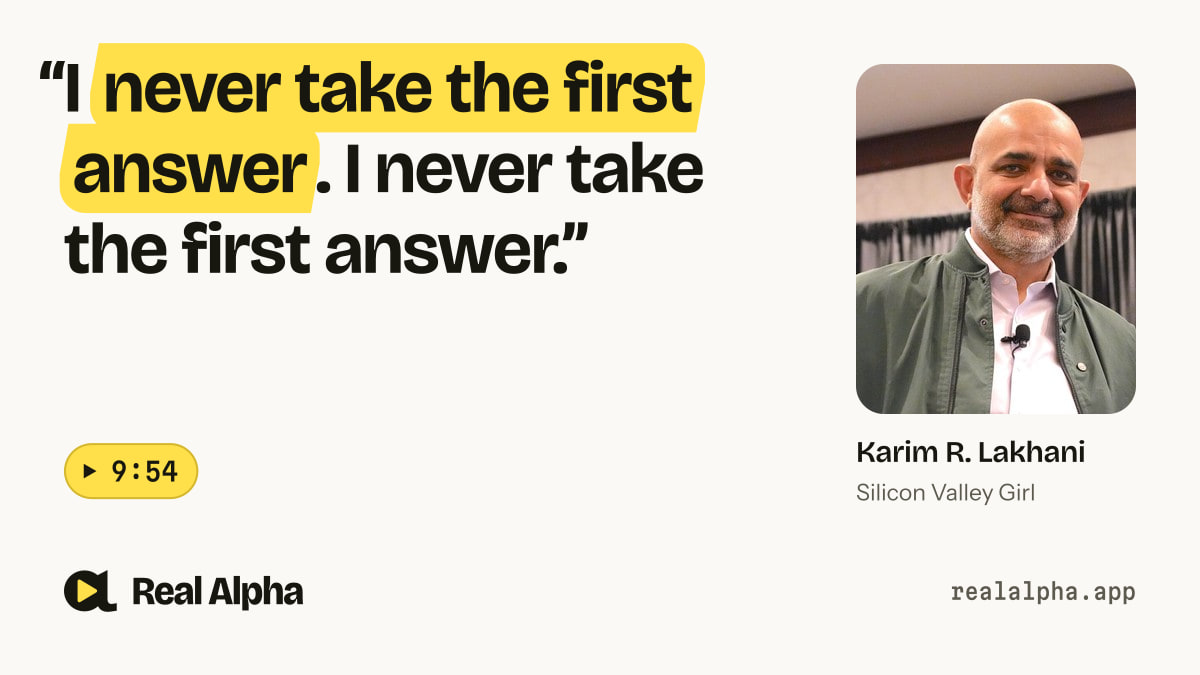
“I never take the first answer. I never take the first answer.”
 Karim R. Lakhaniat 9:54 · Silicon Valley Girl
Takeaways
- Ask AI to argue against a proposal and find red flags.
- Use more research and alternatives to test its claims.
- Build enough subject knowledge to judge the result.
About this segment
Karim R. Lakhani recommends prompts that challenge proposals, search for red flags and explore alternatives. This helps people use AI without outsourcing judgment to a plausible first answer.

Karim R. Lakhani is a Harvard Business School professor.
Pioneered field experiments on open innovation and AI’s impact on business; co-authored Competing in the Age of AI.

Marina Mogilko, Host · Host, Silicon Valley Girl
Co-founded LinguaTrip and built Linguamarina, an English-learning YouTube channel with almost 9M subscribers.
From “Harvard AI Professor: The People Most at Risk From AI Aren’t Who You Think”, Oct 30, 2026. Watch the full episode
Thanks. We'll look at and fix what's off.
Transcript
Transcribed by machine (Whisper) from the episode’s audio, so a word may be off here and there.
- 9:07
I think the first is like, don't believe what I'm saying either, like pushback at me. Then it's like, if a proposal is given in front of you, kind of argue always. Like, give me a proposal and come up with three different arguments that would make this obvious or make this non-relevant as another thing. The other one is, like, always do additional research. Like, you've got this thing, but go ahead and go additional research and find me red flags or find me sort of the black swans that may not be happening.
- 9:36
And so it's these types of – and depending on the task at hand, you can – like, if it's a research agent, you can actually push today's models to do – they're going to be thrifty in tokens. And you want to actually, like – I'm always like, let's just squander tokens now in this space until we figure these things out. to actually go and go way more deeper than what the model will do itself. And don't, I never take the first answer.
- 10:00
I never take the first answer. And either I've got the system prompt for it to go back and come up with the alternatives, or I'll just push back myself. I was trying Google's Argonne latest model. So my whole process was, let's give AI data, let's tell it how to use that data, let's describe a workflow. What's happening with the new models, you just give them access to whatever data, and they figure out which data to use.
- 11:49
Does that change the process you just described? I think it does, but I think it's dangerous. So here's my perspective. Not dangerous, I mean, I think I'm overstating it. I think it's worth paying attention to. What's happening inside of these models, right? They are regressing to the mean. In the end, it's a statistical model that is predicting the next word overall. Everybody knows that. That's in the audience here.
- 12:09
But philosophically, what's going on is that if you let it choose the approach and you're not paying attention to the approach it's choosing, then the worry is that it's going to pick the average approach and not the one that's going to differentiate you or find you the answer. So many people have said, like, prompting is becoming easier. Models can prompt themselves. I go, I get that. But foundationally, what's happening is that it's still going to go to the mean prompt and the average prompt.
- 12:33
And the average prompts aren't going to be good enough for your particular use case. And so this is where I think we have a very interesting learning and growing part for humans in place. So the models we show in our research, the models allow you to do more and expand your role. Great. Now, the question is, as you expand your role, like we've heard, for example, that product development teams are becoming one-person teams, right?
- 12:59
So the engineer can also do design, can also do user interviews, and can also do QA testing because the AI helps you along the way. Great. But do you actually understand the principles of design? And do you actually have a sense of taste? Because that's what designers do. They have a sense of taste. You know, my daughter did four years of industrial design. She has way better taste in products than I do, right?
- 13:23
And the AI can provide you with some semblance of design, but is that going to be enough to differentiate you or not? And so, will you get the average design or will you get the one based on expertise? And there, the measure of taste will matter a ton because you will say, okay, like, give me a design for this webpage or give me a design for this product. And you get the average response. And even saying, give me a Steve Jobs one isn't enough.
- 13:47
Like, there's a sense of taste. So the question I would always have is like, you're better off like learning from the AI, but what the elements of design need to be first. And then you make the decision on the genre you want to go down under or the approach of the design instead of, again, pressing play and getting it to do everything along. So to your question, you give a data set, it can figure out five different ways to do regression analysis, you know, five different models.
- 14:10
But I've had, you know, 20 years of research experience, five years of PhD training. Oftentimes, the models it picks aren't the right models to go after because, again, they're the average answers, not the ones for the task at hand. And this is where you can use the AI to help you educate, to learn, but also push it into three different targets of models and then be adversarial about it and say, prove myself wrong, prove yourself wrong, find me pros and cons along the way to get to the baseline that you're getting to.
- 14:39
The problem I see here, if I'm a one person team, for example, and I want to use AI for a design, how do I measure AI's taste and how to understand whether it's a world class work or just very, very mediocre? Exactly. And that's where I think the response doesn't go away, because in the end, you're going to put your name. I have fired people who have told me, well, the AI gave me that. Again, are you a meat interface to AI?
- 14:59
Then I don't need you. Right. You have to still be engaged. And I think that's the really tricky part we're in the middle of and which is becoming, it's important for me as an educator, as a researcher, I've always fallen in that trap, but also for all of us because what we see is that it becomes so easy to cut and paste. It's so easy to do that versus if you are going to be a one person product team, then you need to be.
- 15:26
sense of, okay, I now need to build some knowledge about design. And where do I learn that from? How do I bring that up? And how do I set up my AI system so that it's not just give me the first design, but I can actually prompt it to go in different directions. So the burden of learning and taste is back to the human. Otherwise, we're going to be back in the phase of what you said, the machines will replace humans if humans stop accessing their judgment.