The alpha, twice a week
That was 7 min.
Get the best new moments in your inbox every Wednesday and Saturday. It's free.
Check your inbox
We sent a link to your address. Click it to finish signing up. Not there in a minute? Look in spam.
or
Silicon Valley Girl · 7 min · Oct 30, 2026
Juniors need fundamentals to learn from AI
 Karim R. Lakhani
 argues that juniors should learn foundational skills, then use AI to observe patterns at scale.
The episode’s best minutes
Full analysis- 9:02Challenge AI instead of accepting its first answer7 min
- 15:46Juniors need fundamentals to learn from AI7 min
- 43:26Middle managers may face more AI risk than juniorsPro pick 7 min
- 4 more moments in the full episode
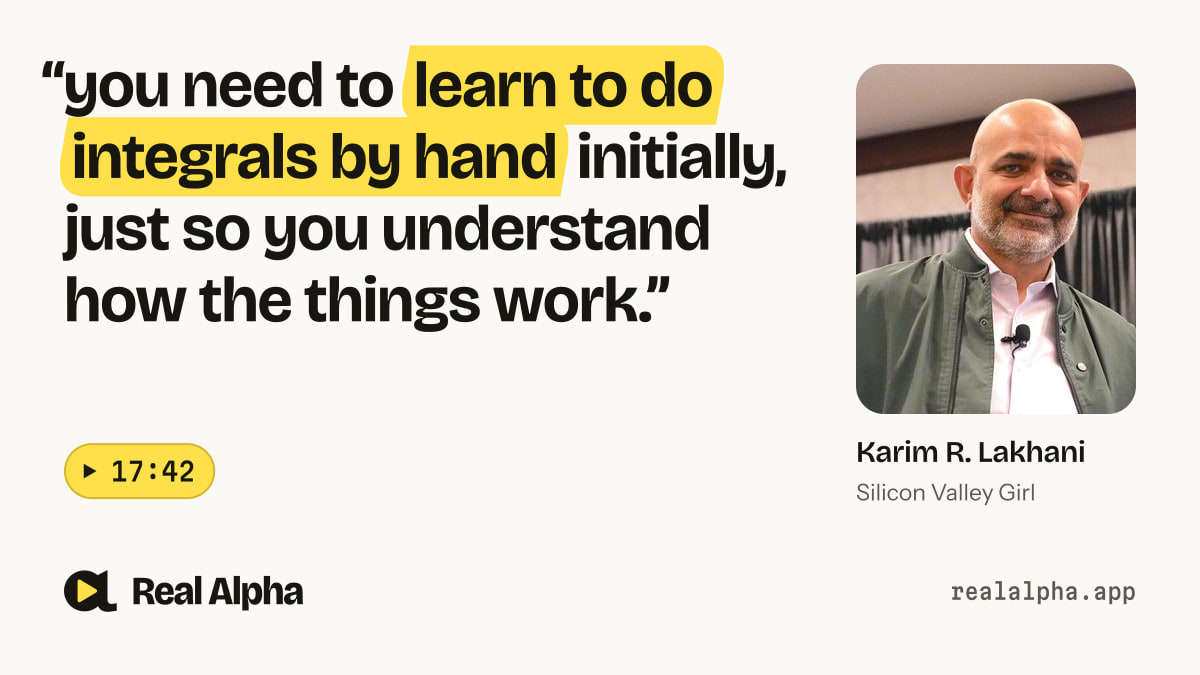
“you need to learn to do integrals by hand initially, just so you understand how the things work.”
 Karim R. Lakhaniat 17:42 · Silicon Valley Girl
Takeaways
- Learn the basics before handing work to AI.
- Observe many AI examples to recognize underlying patterns.
- Harvard MBA students build AI projects instead of taking a final exam.
About this segment
Karim R. Lakhani argues that juniors should learn foundational skills, then use AI to observe patterns at scale. Harvard MBA students now build AI tools and projects as part of their course.

Karim R. Lakhani is a Harvard Business School professor.
Pioneered field experiments on open innovation and AI’s impact on business; co-authored Competing in the Age of AI.

Marina Mogilko, Host · Host, Silicon Valley Girl
Co-founded LinguaTrip and built Linguamarina, an English-learning YouTube channel with almost 9M subscribers.
From “Harvard AI Professor: The People Most at Risk From AI Aren’t Who You Think”, Oct 30, 2026. Watch the full episode
Answers “Is a computer science degree still worth it?” See all 5 answers
Thanks. We'll look at and fix what's off.
Transcript
Transcribed by machine (Whisper) from the episode’s audio, so a word may be off here and there.
- 15:51
What do you tell to your students when they ask you, how do I learn taste? If all of the basic tasks are already taken by AI. Where is this place for the junior in the career ladder and how do they develop this taste? Look, again, I feel like I'm in the middle of that tsunami right now at Harvard Business School with, you know, 25-year-olds that come, 27-year-olds that come to our campus. I think there are three different perspectives I'll add to this. And I have more questions than I have answers, but I have heuristics on this. The first is you can imagine this career ladder story. I think the interesting question is, are the bottom rungs of the career ladder being pulled out from juniors, or is the AI a springboard for you to go higher?
- 16:31
So my good colleague, Mitch Weiss, has sort of said he feels that this is a springboard and not just a removal. But if taste is required, it's there. Yes. So let's get there, right? Exactly, right? So then it's like, okay, it's a springboard. So then the question becomes, how do you as a junior person develop the taste to design the best investment banking analysis, design the best consulting study, design the best product, design the best...
- 16:55
customer experience and so forth, right? That's where the burden of learning becomes even heavier on you. That's where you have to sort of take responsibility for the learning, where you say, if now I can do so many different things, what are the foundational pieces that I need to understand so I can learn to push back on this? And this is where my second aha has been. So I just watched this great YouTube conversation with Stephen Wolfram, who you might want to actually invite on your show.
- 17:21
And in this interview, he said something that has just, I heard it like 10 days ago, and it's just been like rattling in my brain. You know, he designed mathematical languages to do integrals. And so he goes that you don't need to do integrals anymore by hand. You can just use integrals. But he saw his kids in school learning integrals. And he's like, why? I designed this, you know, decades ago. Why now are you learning integrals?
- 17:43
And what his story was, which is actually super interesting, was that, look, you need to learn to do integrals by hand initially, just so you understand how the things work. But the next 50 integrals or the next 100 integrals, you should let the machine do it. Because actually, if you observe 1,000 integrals being done by the machine, you will learn a lot more about integrals than you doing the next 40 by hand, the next 60 by hand, the next 80 by hand.
- 18:08
And so what is interesting there for me, I think this is a thesis about how do we deal with this automation, which is a foundational piece you need to learn and do by yourself first. But then you can give to the machine to do the rest. And then you are now an observer of the underlying patterns that are becoming true to make this happen. And so I think for me, as we're thinking about this role expansion story, it behooves us when we're going to be responsible for these things to understand the fundamentals enough to be able to then use the machines in the proper way.
- 18:41
And so it – and again, it's in a bit of ways self-centered because I'm an educator. I say people need to keep learning. I think the learning side keeps increasing in importance because it's no longer what I just learned in school or what I learned in university. It's going to be these continual things as capabilities expand of these models and we're going to use them for our things. We still have to understand the foundations pieces to be able to push forward.
- 19:07
Yeah. So basically, I see two challenges here. First challenge, don't jump to the machine too fast. Because what we see with kids, they're just using ChatGPT for homework and you probably see it in specialists. We've seen studies, totally. The cutting and pasting, you don't learn anything at all. Yeah. And the second, not danger, but challenge, you have to learn so much more. four years of college because it's the basics plus the whole junior layer of the career ladder.
- 19:32
And I think the main thing is learning how to learn, I think, is the biggest thing that I tell my students. Like, that's going to be the thing that unlocks them. You're not afraid of the challenges. You're actually thrilled by the challenges, but you have a routine to learn how to learn. And actually with AI now, learning how to learn is actually quite easy. Like, there's explanatory powers and different ways of teaching you things, quizzing you in those ways That's all unlocked and available to us if we know how to use those capabilities.
- 20:00
If you compare this year's students versus students two years ago, are the students now learning much more than they used to a couple of years ago? Yeah, so look, in my MBA class, we have a required course on AI, so everybody has to do it. And we've had to pivot the course. It's three years old now, and every year we have to pivot the course. Or every week. Yeah, exactly. In the middle of teaching, we have to change stuff.
- 20:22
And so one of our big challenges was like last year, the clause showed up all of a sudden. And we're like, if you don't talk about clause in our course, we're dead. Like we won't have any legitimacy. So how do we pivot rapidly to teach about clause and so forth? The aha moment for us was to say, we can't just talk about AI in business school. We have to do AI. So we've done this radical shift in our class where half the class now coming, we're going to teach again in the spring, is going to be building with AI.
- 20:51
And so they actually have to learn to solve business problems with AI and build advanced AI tools. So they're going to be building rags. They're going to be doing evals. They're going to be building multi-agentic systems. They're going to be building, you know, whole ranges of things to solve business problems and to understand the nature of the technology itself and how it's changing. We had to throw out a final exam because how can we legitimately have a course on AI and not use an AI tool to do the final exam?
- 21:18
So what we said is you actually have to now build projects. So you have to vibe code projects. So we had all 900 of our MBA students vibe code solutions, and some of them were spectacular. Like I was blown away for what the students were able to build. So we pushed a ton of building as part of the AI curriculum more to basically sort of push them to say, These capabilities are such where the only way you will actually understand what the AI's impact on your job and your company and your future life is going to be if you are fully immersed in it and you learn how to get the most out of the tools.
- 21:56
At the same time, we push the foundations of like, what are the economics behind it? What's the strategy behind it? What does the change management part look like? And we couple these exercises with the cases and the discussions to really get them to sort of see, I now can do all these magical things, but then what's the implication for me in terms of a company or a strategy or a job that I sort of see?
- 22:16
And so that's been, for me, super challenging because, you know, for 17 years, I was just happy to just put a case in front of the students and go. And now we're doing a lot of doing in the classroom. But also it's a blessing because it really pushes me to the bleeding edge to sort of see where the edges are for both myself and our students and what needs to happen. When you say this, this really makes me want to take the course.