The alpha, twice a week
That was 7 min.
Get the best new moments in your inbox every Wednesday and Saturday. It's free.
Check your inbox
We sent a link to your address. Click it to finish signing up. Not there in a minute? Look in spam.
or
Silicon Valley Girl · 7 min · Oct 30, 2026
Middle managers may face more AI risk than juniors
 Karim R. Lakhani
 says middle managers may be more exposed because many resist adopting AI, while juniors often experiment readily.
The episode’s best minutes
Full analysis- 9:02Challenge AI instead of accepting its first answer7 min
- 15:46Juniors need fundamentals to learn from AI7 min
- 43:26Middle managers may face more AI risk than juniorsPro pick 7 min
- 4 more moments in the full episode
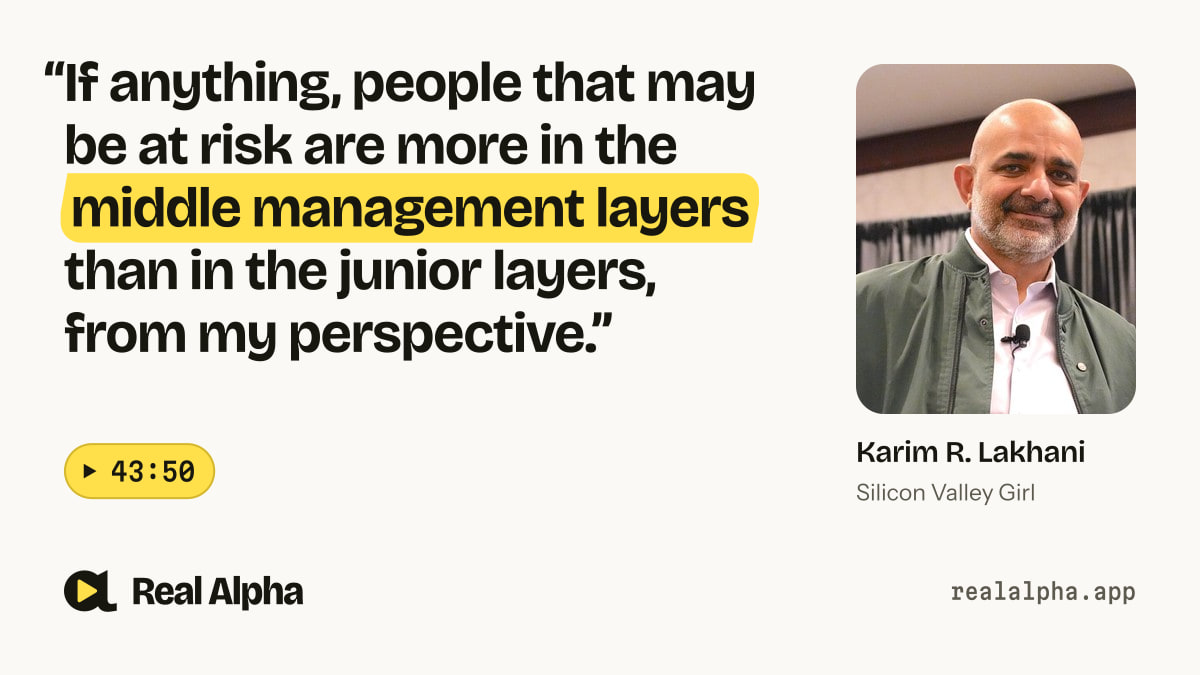
“If anything, people that may be at risk are more in the middle management layers than in the junior layers, from my perspective.”
 Karim R. Lakhaniat 43:50 · Silicon Valley Girl
Takeaways Pro pick
- Middle layers may resist AI more than early-career workers.
- A business that merely wraps a model needs a reason to exist.
- Leaders must use AI themselves to assess its effect on their expertise.
One of Pro's picks, open to you here. Try Pro free for 7 days
One of Pro's picks. The rest of the summary and the 3 takeaways are in Real Alpha Pro; the video, the quote and the transcript stay free.
Read it with Pro, 7 days freeAbout this segment
Karim R. Lakhani says middle managers may be more exposed because many resist adopting AI, while juniors often experiment readily. He urges companies to rethink their work and test whether new models strengthen or erase their value.

Karim R. Lakhani is a Harvard Business School professor.
Pioneered field experiments on open innovation and AI’s impact on business; co-authored Competing in the Age of AI.

Marina Mogilko, Host · Host, Silicon Valley Girl
Co-founded LinguaTrip and built Linguamarina, an English-learning YouTube channel with almost 9M subscribers.
From “Harvard AI Professor: The People Most at Risk From AI Aren’t Who You Think”, Oct 30, 2026. Watch the full episode
Answers “Which jobs will AI replace, and which are safe?” See all 241 answers
Answers “Are AI wrappers a real business?” See all 29 answers
Thanks. We'll look at and fix what's off.
Transcript
Transcribed by machine (Whisper) from the episode’s audio, so a word may be off here and there.
- 43:38
I didn't mention you had another fascinating study where people were working with AI and the output of a person with AI equaled a two-person team output, right? Exactly, yeah. This is our Parton Gamble study, yeah. When this happens, when junior work is getting automated in 2030, what does an organization pay for? So let me step back first. I don't think junior work is being automated. So I don't think that question is settled, to be quite honest.
- 44:04
If anything, people that may be at risk are more in the middle management layers than in the junior layers, from my perspective. Here's why. The junior people are fearless to absorbing AI and doing stuff. you've probably seen, I've seen high schoolers and undergrads. I don't see undergrads routinely as part of my graduate school work at HBS. But when I encounter them, I'm like, wow, you guys are a different set of human beings that are able to whip up all these things so quickly.
- 44:30
So I would contend, and again, it's easy for us to say soft, there's multi-causal, the causal density is high in terms of why juniors, why the early career market is soft right now, it may not just be AI. And my belief is that in fact, the middle layer is more at risk than the junior layer. Why? Because I observe inside of companies, AI usage. And the middle layer is the one that's resisting the most, doesn't want to change. So it's the 35-year-olds to the 55-year-olds that are pushing back against AI usage and not changing, versus the more enlightened 55-year-olds. And again, the K-curve people with the junior people could run circles are on most of the organization.
- 45:09
So I think that's the first thing to say. Like, I don't think it's settled at all. Other calls. colleagues of mine, esteemed colleagues are worried about the junior side. I'm like, if you hit real organizations and see real workers with real data, you would be skeptical about if this is the case. But it depends on the junior, right? Exactly. Right. So if, again, this is the pushback to the junior people. If all you are is a copy paste meat interface to the model. That job is gone, right?
- 45:34
That job is gone. That job is completely gone. And by the way, that's the same question I ask law firms and every other CEO. I go, if all you are going to be is a thin wrapper around Anthropic at a law firm, or you're going to be a thin wrapper around OpenAI's model for a manufacturing firm, why should you exist? And that is very challenging for them to actually hear about. And so the question I ask is, how do we redefine jobs? And what does the nature of work now look like? Even in your setting, you could potentially be doing 10x more if you deployed AI Even more at scale than what you're doing right now.
- 46:10
And who are the right people to bring you along in that journey? Because you yourself can't do it all yourselves. And I think that's the question to be asking. So to your 2030 question, I still feel that there's going to be a tale of two cities. I think there's going to be a set of firms that get it, that understand it. And there'll be both startups and large enterprises that do the heavy lifting to redefine the work.
- 46:33
One of my colleagues, Ram Koning, has built up this frontier firm radar where he's looking at startups and their AI usage, and he's actually running experiments in actually showing them how to use AI better. And when he does that, they find faster AR, faster launches of products, and so forth. So even with startups, there is a learning curve of how to use AI better. And so I believe that there'll be a set of firms and a set of founders and a set of senior managers and people inside the firms that get it and start to accelerate.
- 47:04
And then I think there'll be everybody else and they will be plodding along. And the only question in my mind by 2030 is if you, again, go back to the late 90s and Amazon being established and retailers sort of laughing at Amazon saying, oh, how cute. Right? But Bezos rethought retail commerce inside out versus Kmart and Sears just added a website to their database and weren't able to adjust. And Walmart struggled for a long time, then figured it out and is now as competitive as before. So the question I have for incumbent firms is, are you going to be Walmart or are you going to be Kmart? Now that the cost of intelligence, the cost of expertise has gone down to zero. Companies are nothing but bundles of expertise.
- 47:51
And if that cost has gone down to zero, what do you do now? And how do you set yourself up now for your business? And for incumbents, it's really, you know, you have two futures ahead, a Kmart or a Walmart view versus the Bezos. And the question is, who are going to be the Bezos in all these industries? Because I think all of them are up for grabs in professional services, in manufacturing, in consumer.
- 48:14
The value destruction that people are anticipating quickly, I think, will take longer. than just because, again, I sort of see inertia in so many organizations and inertia in customer behavior and buying behavior and so forth. We're still humans. We're not machines. Exactly. Okay. Well, I guess the last philosophical question is how do you determine that you're not a wrapper? Wrapper around a frontier model with them getting so advanced.
- 48:46
Yeah. I think it's such a good question. I don't know the answer to that yet. You know what Craig Brockman told me, president of OpenAI, he told me, like, ask yourself whether your business is improving with a new frontier model or is it disappearing? This is how you figure out your moat and how it's affected by the new. Yeah, and I think you can't outsource that thinking to somebody else outside of your organization or somebody junior in the organization.
- 49:13
You actually have to do that thinking yourself. And it goes back to, look, you have to force yourself to do AI in your work. If you believe my thesis that these models are about expertise, they absorb expertise, and the expertise is improving exponentially in these models, and you became a leader in an organization because you have expertise, you have to play with them right now. And I'm reminded of the fact that when email came out in the last century, Stefan Bensal of Moderna talks about this.
- 49:44
I also experienced this, that our bosses' bosses would not do email.