The alpha, twice a week
That was 3 min.
Get the best new moments in your inbox every Wednesday and Saturday. It's free.
Check your inbox
We sent a link to your address. Click it to finish signing up. Not there in a minute? Look in spam.
or
Newcomer Pod · 3 min · Jun 26, 2026
Chinese models are progressing beyond distillation
 Aidan Gomez
 expects the U.S. to keep leading, but says Chinese models are capable, well-resourced and increasingly independent of distillation.
In this episode
Full episode- 11:35Democratic countries need sovereign AI for resilience3 min
- 3:18Enterprise AI use can grow far beyond codingPro pick 3 min
- 18:25AI agents may displace workers more than past technologies3 min
- 6:08Self-hosting open models can cost more than it appears4 min
- 15:15Chinese models are progressing beyond distillation3 min
- 0:32Transformers persist by absorbing ideas from other architectures3 min
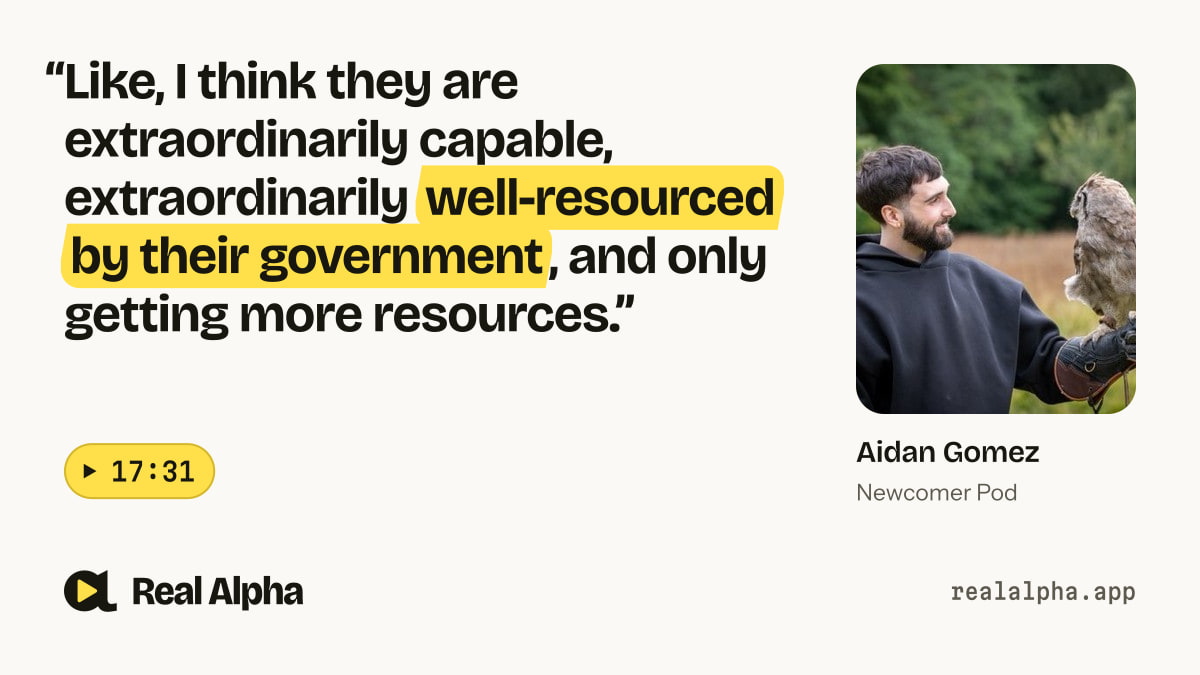
“Like, I think they are extraordinarily capable, extraordinarily well-resourced by their government, and only getting more resources.”
 Aidan Gomezat 17:31 · Newcomer Pod
Takeaways
- He expects the U.S. to keep leading in model capability.
- He says Chinese models are capable and increasingly independent of distillation.
- He wants multiple democracies competing for the global AI market.
About this segment
Aidan Gomez expects the U.S. to keep leading, but says Chinese models are capable, well-resourced and increasingly independent of distillation. He argues more democracies need to compete in the global AI market.

Aidan Gomez is a Cohere co-founder and Transformer co-author.
Co-founded Cohere, the sovereign AI company, and co-authored the Transformer paper, Attention Is All You Need.
- EN
Eric Newcomer, Host
From “Aidan Gomez Unfiltered on AGI, China & AI's Biggest Risk”, Jun 26, 2026. Watch the full episode
Answers “Is China catching up in AI?” See all 8 answers
Thanks. We'll look at and fix what's off.
Transcript
Transcribed by machine (Whisper) from the episode’s audio, so a word may be off here and there.
- 15:17
What is your gloss of, yeah, the Trump anthropic back and forth? I mean, first, there was, you know, yeah, the anthropic trying to limit how much they could be used in wartime situations, and now it's this sudden blockage of fable. I don't know. What did you take away from those two situations? Well, it wasn't super surprising. This is sort of exactly the scenario that we have been warning against.
- 15:45
And I think that anyone who was naive to the potential risk of something like this happening were woken up quite suddenly. I think that... What does it mean? I mean, like a big issue here is that the way the Trump administration went about it was focused on letting anyone outside the U.S. use it, because that sort of woke up the other democracies that there would be sort of a preference for the U.S.
- 16:19
rather than a preference for the U.S. and its allies. Is that sort of the right depiction of your view? Yeah, the U.S. is optimizing for its interests, as it should. But I think in doing so, it does present a huge risk for anyone outside of the U.S. Like if you built your critical infrastructure on top of some service that you depend on to live or to operate or to have an economy at all, you now lose access to that.
- 16:54
So we're talking about, you know, the weakness of relying on one democracy for the rest of the democratic world. What about the other part of this, which is, what's your read on how strong China is in sort of the foundation model of business right now? We see DeepSeek raising this enormous round. Like, do you think there's a real risk that China leapfrogs the Western world in sort of model development?
- 17:18
Leapfrogs? I would be very surprised. I do think the U.S. is going to continue to lead in capability. I think the dismissals of Chinese models as, like, just distillations or anything like that is cope. Like, I think they are extraordinarily capable, extraordinarily well-resourced by their government, and only getting more resources. And they're just very good at building this tech. I'm sure distillation has played a part, but increasingly independent of distillation, I think they're on a very strong trajectory, which just drives more urgency to make sure, you know, players like Cohere, alliances form around them, get supported so that we have more than one democracy competing against China for the global market.
- 18:13
Because very quickly, you could see the world split into two. But what you really want is a democratic alliance of two, three, four, five against an autocratic singular player.