The alpha, twice a week
That was 6 min.
Get the best new moments in your inbox every Wednesday and Saturday. It's free.
Check your inbox
We sent a link to your address. Click it to finish signing up. Not there in a minute? Look in spam.
or
Lex Fridman Podcast · 6 min · Jun 5, 2025
Chrome's moonshot case was a faster, safer browser
 Sundar Pichai
Chrome began as a response to dynamic web apps outgrowing slow browsers.
In this episode
Full analysis- 34:18AI progress may be dramatic even before AGI arrives7 min
- 55:53Merging Google Brain and DeepMind took patiencePro pick 7 min
- 1:30:35AI has raised Google’s engineering velocity by 10%7 min
- 51:13Google's AI bet was built before public opinion shifted5 min
- 1:15:08Chrome's moonshot case was a faster, safer browser6 min
- 27:40Gemini's stronger reasoning lets Google expose more of the raw model5 min
- 1:02:21AI Mode will add context without abandoning links or ads7 min
- 1:37:30Android could shift from apps to an adaptive AI interface4 min
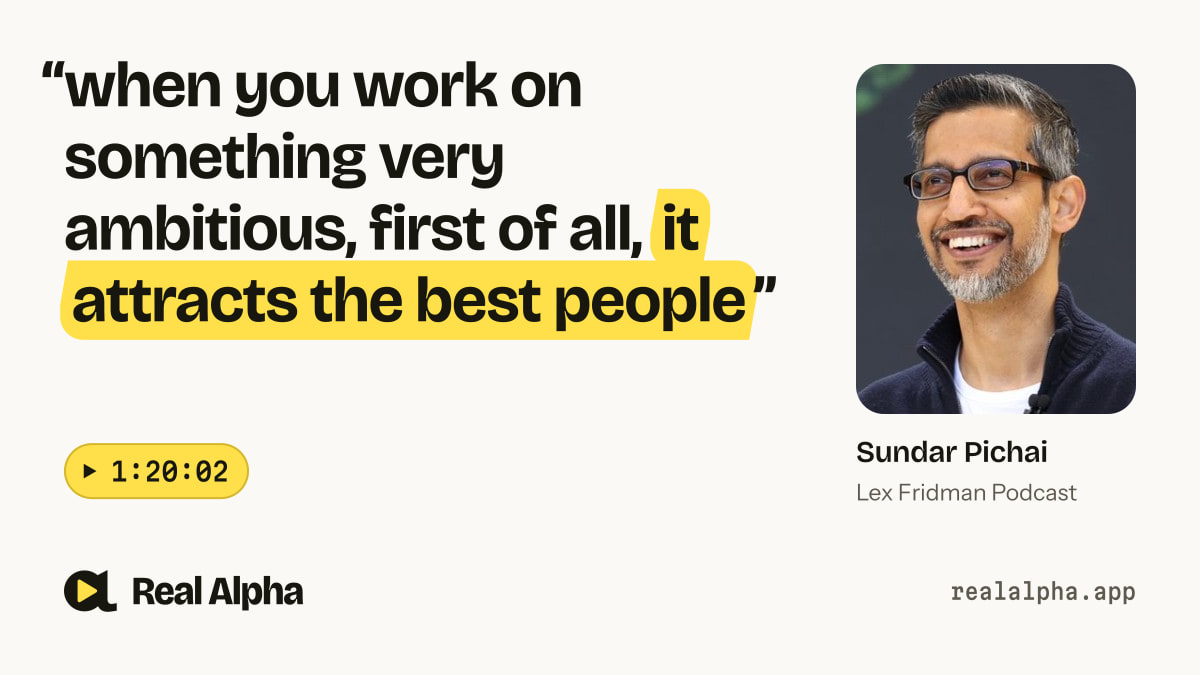
“when you work on something very ambitious, first of all, it attracts the best people”
 Sundar Pichaiat 1:20:02 · Lex Fridman Podcast
Takeaways
- Dynamic web apps exposed browser performance limits.
- Chrome paired sandboxed tabs with a faster JavaScript engine.
- Moonshots can attract talent and pay off before full completion.
About this segment
Chrome began as a response to dynamic web apps outgrowing slow browsers. Sundar Pichai describes the technical choices behind it and why ambitious projects can attract strong teams even before success is certain.

Sundar Pichai is CEO of Google and Alphabet.
Helped build Google Toolbar and Chrome, then led Google from 2015 and Alphabet from 2019.

Lex Fridman, Host · Host, Lex Fridman Podcast
Robotics and AI researcher at MIT; started the show in 2018.
From “Sundar Pichai: CEO of Google and Alphabet | Lex Fridman Podcast #471”, Jun 5, 2025. Watch the full episode
Thanks. We'll look at and fix what's off.
Transcript
Transcribed by machine (Whisper) from the episode’s audio, so a word may be off here and there.
- 1:15:15
But I think both will be there. I have to ask you about Chrome. I have to say, for me personally, Google Chrome was probably, I don't know, I'd like to see where I would rank it. But in this temptation, and this is not a recency bias, although it might be a little bit, but I think it's up there, top three, maybe the number one piece of software for me of all time. So it's incredible. It's really incredible.
- 1:15:42
The browsers are a window to the web. And Chrome really continued for many years, but even initially, to push the innovation on that front when it was stale and it continues to challenge. It continues to make it more performant, so efficient, and just innovate constantly. And the Chromium aspect of it. Anyway, you were one of the pioneers of Chrome, pushing for it when it was an insane idea probably one of the ideas that was criticized and doubted and so on so can you tell me um the story of what it took to push for chrome what was your vision look it was a such a dynamic time uh you know around 2004 2005 with ajax the web suddenly becoming dynamic, in a matter of few months, Flickr, Gmail, Google Maps, all kind of came into existence, right? Like the fact that you have an interactive dynamic web, the web was evolving
- 1:16:49
from simple text pages, simple HTML to rich dynamic applications. But at the same time, you could see the browser was never meant for that world, right? Like JavaScript execution was super slow. You know, the browser was far away from being an operating system for that rich modern web, which was coming into place. So that's the opportunity we saw. Like, you know, it's an amazing early team. I still remember the day we got a shell on WebKit running and how fast it was.
- 1:17:30
You know, we had the clear vision for building a browser, like we wanted to bring core OS principles into the browser, right? Like, so we built a secure browser sandbox. Each tab was its own. These things are common now, but at the time, like it was pretty unique. We found an amazing team in Aarhus, Denmark, with a leader who built a V8, the JavaScript VM, which at the time was 25 times faster than, any other JavaScript VM out there.
- 1:18:04
And by the way, you're right. We open-sourced it all and put it in Chromium, too. But we really thought the web could work much better, much faster, and you could be much safer. browsing the web. And the name Chrome came was because we literally felt people were like the Chrome of the browser was getting clunkier. We wanted to minimize it. And so that was the origins of the project. Definitely, obviously, highly biased person here talking about Chrome, but it's the most fun I've had building a product from the ground up. And it was an extraordinary team uh had uh my co-founders on the project were terrific so definite fond memories so for people who don't know sundar it's probably fair to say you're the reason we have chrome yes i know there's a lot of incredible engineers but pushing for it inside a company that probably was opposing
- 1:19:01
it because it's a crazy idea because uh as everybody probably knows it's incredibly difficult to build a browser yeah look i uh eric who was the ceo at the time i think it was less that he was opposed to it, he kind of firsthand knew what a crazy thing it is to go build a browser. And so he definitely was like, this is, you know, there was a crazy aspect to actually wanting to go build a browser. But he was very supportive.
- 1:19:29
You know, everyone, the founders were, I think once we started, you know, building something and we could use it and see how much better from then on, like, you know, you're really tinkering with the product and making it better it came to life pretty fast what uh wisdom do you draw from that from um pushing through on a crazy idea in the early days that ends up being revolutionary what for future crazy ideas like it i mean this this is something larry and sergey articulated clearly i really internalize this early on which is you know their whole feeling around, working on moonshots, like as a way, when you work on something very ambitious, first of all, it attracts the best people, right?
- 1:20:15
So that's an advantage you get. Number two, because it's so ambitious, you don't have others working on something crazy. So you pretty much have the path to yourselves, right? It's like Waymo and self-driving. Number three, it is even if you end up quite not accomplishing what you set out to do and you end up doing 60, 80% of it, it'll end up being a terrific success. So, you know, that's the advice I would give people, right? I think like, you know, it's just aiming for big ideas, has all these advantages and it's risky, but it also has all these advantages, which people I don't think fully internalize. I mean, you mentioned one of the craziest, biggest moonshots, which is Waymo.