The alpha, twice a week
That was 5 min.
Get the best new moments in your inbox every Wednesday and Saturday. It's free.
Check your inbox
We sent a link to your address. Click it to finish signing up. Not there in a minute? Look in spam.
or
The Pragmatic Engineer · 5 min · Nov 18, 2026
CodeRabbit hires for agency and runs cross-functional war rooms
 Harjot Gill
 says engineering hires need either experience they can unlearn or high agency; strategy-game experience is one signal.
In this episode
Full analysis- 20:18Software factories turn each release into a learning loop4 min
- 25:29Code review shifts from reading diffs to managing release risk6 min
- 55:17Startups have less time to win and need more AI capitalPro pick 8 min
- 15:37A six-week agent build shipped without Gill reading the code3 min
- 40:22CodeRabbit built its own CI as agent workloads grew3 min
- 46:02CodeRabbit routes models by task instead of letting users choose5 min
- 1:08:12CodeRabbit hires for agency and runs cross-functional war rooms5 min
- 11:50Copilot exposed a code-review bottleneck before ChatGPT3 min
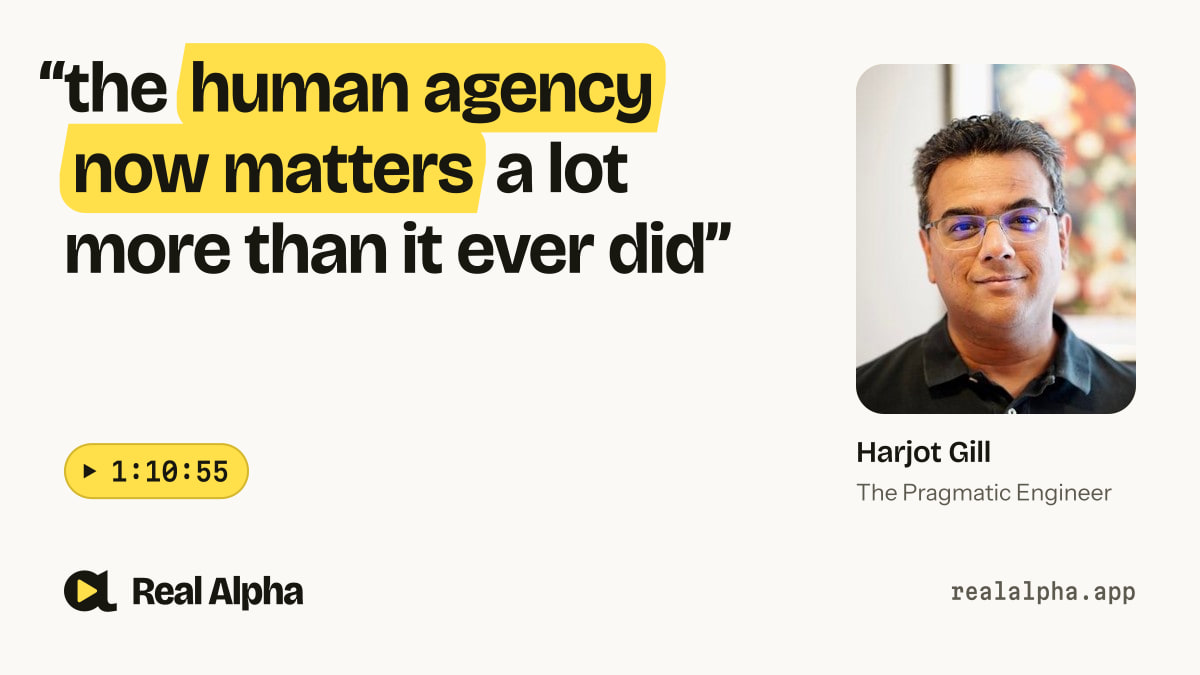
“the human agency now matters a lot more than it ever did”
 Harjot Gillat 1:10:55 · The Pragmatic Engineer
Takeaways
- High agency matters more than a fixed career path.
- Strategy games are one hiring signal, not a universal qualification.
- War rooms let product, design and engineering shape software together.
About this segment
Harjot Gill says engineering hires need either experience they can unlearn or high agency; strategy-game experience is one signal. War rooms bring product, design and engineering together to shape software live.

Harjot Gill is founder and CEO of CodeRabbit.
Co-founded CodeRabbit, the AI code review company that became the most installed AI app on GitHub and GitLab.

Gergely Orosz, Host · Host, The Pragmatic Engineer
Spent four years at Uber heading mobile, web and backend teams; shipped part of its payments system.
From “Software factories and code reviews with Harjot Gill”, Nov 18, 2026. Watch the full episode
Thanks. We'll look at and fix what's off.
Transcript
Transcribed by machine (Whisper) from the episode’s audio, so a word may be off here and there.
- 1:08:19
Let's talk a bit about hiring because this is also a very, very interesting topic. First, can you tell me how did CodeRabbit grow over the years and how has your hiring changed? Because you did mention that you're hiring a lot slower, right? In some areas, yes. In many areas, we are hiring rapidly. Like sales is one area where we have really doubled down. on the field sales because one of the things we found with um generative ai and is that the last mile is still a problem like people still need a lot of hand holding in how to set up the systems in the right way yes so those kind of things you can accelerate with ai you have to have those meetings you have to have on So those areas we are hiring rapidly, but other areas now we are like rethinking what we need to hire for.
- 1:09:01
Let's talk about software engineering specifically. Software engineering is the most trickiest area right now. Every month we are learning something. Like one of the things we have found is like the problem solving skills, system skills, like people like who came from like even I wrote a tweet about like I'm looking for people who have played strategy games. Let me read this tweet because that was a really interesting one. So you are hiring and you said, I mean, there's a KB.
- 1:09:24
we're hiring the person who applies must meet one of the following two criterias to join either has tastefully shipped at least 1 000 prs in the last 30 days or has played at least 500 hours of simulation games such as civilization age of empires transport tycoon factory etc almost like now if you ask me about the software building looks feels like it's like playing one of those games right now i mean i talk about civilization like each like you basically make the moves and each turn is like a release for me right and you learn something in the next turn and while you are steering the civilization you still have like i don't know workers improving your roads and building fields and so on that's how the agents are and each turn you're like just making these agents work on something meaningful right which we think is is a great ROI for your civilization
- 1:10:08
right almost like now running these agents feels to me feels like buildings if people have grown playing strategy games i think they will be very successful in with these agents right now They can multitask. They have like a range of things. They can, I mean, at least they have a good problem that these agents can then work off. And how is hiring going for you so far? How easy or more like hard are you finding to hire these folks who have this kind of experience?
- 1:10:35
So the way we are looking at it is like either someone who's already a tenured senior engineer at a good place, they have to come and first unlearn, right? Or you hire someone even who's like fresh out of college, but they have high agency, but can learn faster. what we found that the people who are like coming with like are not set in the ways and have come especially from the background of like like playing this like strategy games and all have been very successful that's just my take on it and that's what we're looking for i think the human agency now matters a lot more than it ever did person who was 10x knew what to build is now suddenly becoming 100x with these agents right because now you at least have a problem list or the the most impactful areas these agents can work on and you could just unleash these agents
- 1:11:18
as much as possible in parallel. So we talk about individuals, but I know you have a concept called pods that you also call it as war rooms. That's right. What are our war rooms? So what we found is like, that's another area, like I think we have to, like the collaboration has become even more important. So I've like in previous startups, on remote teams, we are like building distributed systems. So it doesn't matter like teams like in India or Eastern Europe, I've done all.
- 1:11:40
But now like what we're seeing is that now we are moving so fast, like somewhere one person is on the steering wheel, but other people are shaping the software as it's getting built. And everyone is able to touch the software, by the way. Even product managers get to touch it. And the kind of PRs they're making is relevant to change a copy on something or some information architecture flows, right?
- 1:11:59
But everyone's touching the software at the same time. And it's great if they can be in a wallroom setting. So we kind of create these wallrooms where we share plans on a Slack canvas. We all agree on it. And we all collaborate in a room in a more face-to-face setting. So you get everyone in a room, into a table. It's all real time. You kind of close the door and like, all right, let's solve the problem.
- 1:12:18
And you're crafting this out in real time. Sometimes you will lay the foundation by running a goal, but when you're at the stage where you want to really craft the UI and experience, you want to get people in the room and really craft it live. Yeah, it's funny. At Uber, we used to have up to 2017 something called the War Room, which is like this. There's an important project, get everyone in, sometimes fly people in because they're distributed, and then spend maybe a week there, build up.
- 1:12:39
This was pre-AI, so with AI, it's a lot faster, but just build a proof of concept, whiteboard, code, and then have a prototype and then everyone goes back to their teams and just kind of builds it from there. But it's now working, the core thing. Yeah, now we're doing that more often. Like that's exactly the idea. And you need like people with different... It's like you have product managers in the same room, you have designers, you have people who understand back end, the front end, and they are like crafting the software together.
- 1:13:02
It is hard work and sometimes it is late work.