The alpha, twice a week
That was 3 min.
Get the best new moments in your inbox every Wednesday and Saturday. It's free.
Check your inbox
We sent a link to your address. Click it to finish signing up. Not there in a minute? Look in spam.
or
The Pragmatic Engineer · 3 min · Nov 18, 2026
Copilot exposed a code-review bottleneck before ChatGPT
 Harjot Gill
 recalls Copilot accelerating code output while reviews were already backing up.
In this episode
Full analysis- 20:18Software factories turn each release into a learning loop4 min
- 25:29Code review shifts from reading diffs to managing release risk6 min
- 55:17Startups have less time to win and need more AI capitalPro pick 8 min
- 15:37A six-week agent build shipped without Gill reading the code3 min
- 40:22CodeRabbit built its own CI as agent workloads grew3 min
- 46:02CodeRabbit routes models by task instead of letting users choose5 min
- 1:08:12CodeRabbit hires for agency and runs cross-functional war rooms5 min
- 11:50Copilot exposed a code-review bottleneck before ChatGPT3 min
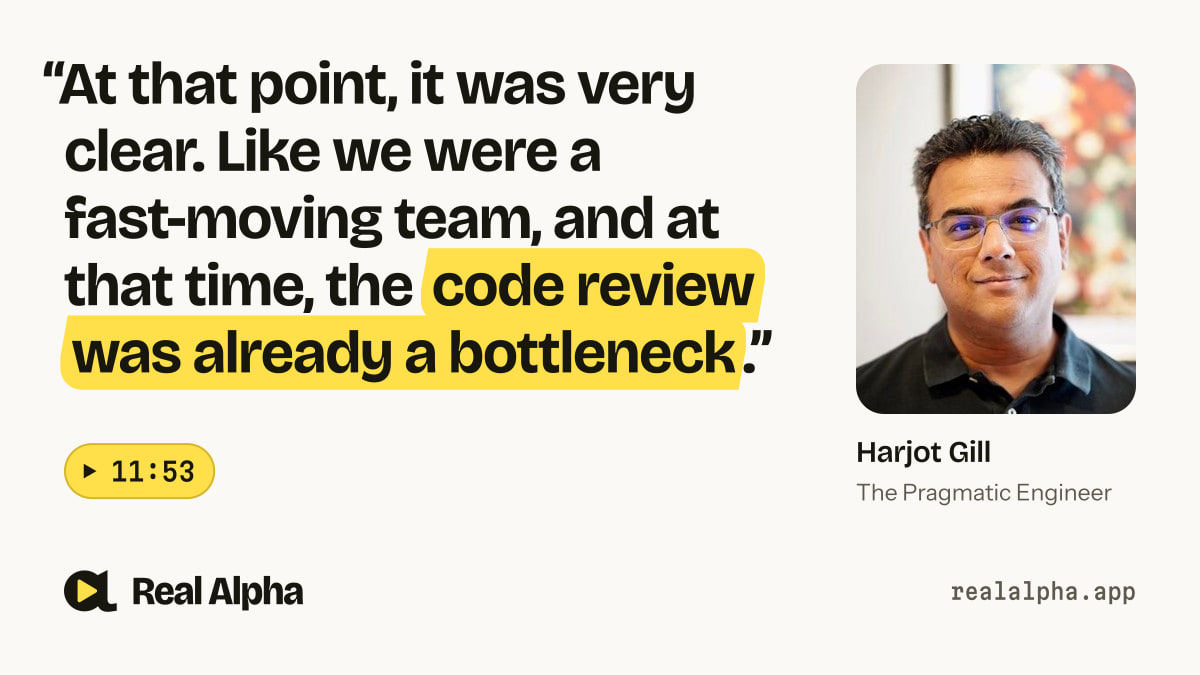
“At that point, it was very clear. Like we were a fast-moving team, and at that time, the code review was already a bottleneck.”
 Harjot Gillat 11:53 · The Pragmatic Engineer
Takeaways
- Code review was already slowing a fast-moving team.
- He predicted AI would write most code before ChatGPT.
- The opportunity looked larger than legacy code-quality tools.
About this segment
Harjot Gill recalls Copilot accelerating code output while reviews were already backing up. That bottleneck helped him see AI code review as a much larger market than legacy quality tooling.

Harjot Gill is founder and CEO of CodeRabbit.
Co-founded CodeRabbit, the AI code review company that became the most installed AI app on GitHub and GitLab.

Gergely Orosz, Host · Host, The Pragmatic Engineer
Spent four years at Uber heading mobile, web and backend teams; shipped part of its payments system.
From “Software factories and code reviews with Harjot Gill”, Nov 18, 2026. Watch the full episode
Thanks. We'll look at and fix what's off.
Transcript
Transcribed by machine (Whisper) from the episode’s audio, so a word may be off here and there.
- 11:58
And this was, I believe, even before ChatGPT had come out. At that point, it was very clear. Like we were a fast-moving team, and at that time, the code review was already a bottleneck. So people were doing stack pull requests. We built our own tool called SPR. We open-sourced it. But the thing is that, like, it was still not ideal, like, given the volume of the code just started growing after GitHub Copilot.
- 12:19
It was very clear that AI is going to write most of the code. And so just to pause there, when you saw GitHub Copilot in 2021, this was before ChatGPT, you already predicted or kind of like fast forwarded saying, oh, AI will write most of the code. That's right. This was not a commonly held view, like a select view might have held it, but what made you assume this? Can you talk us through your thinking process at that time?
- 12:48
I was in the arena, like as a leader, like I was actually coding on the ground. Even at that company, a lot of the work I was doing janitorial, like just. making sure the developers were productive, adding all the linters, the tooling, everything to go faster. As a leader, my goal has always been how quickly we can get to the next milestone. And when I touched that system, I don't know, it just came to me that, okay, this is going to change everything.
- 13:11
The tool was really good in sensing what I needed to do next. And I was accepting the suggestions. It was like writing really complex algorithms. You just provide a few comments on what you want to do, and the code came out. Tab complete, right? it was pretty magical. And at that time, it was just clear to me, I don't know how, but I mean, once you are in the arena, I think you see these patterns long enough, the second order effects.
- 13:35
And the same thing was clear to me three months back on how software is going to be built. Like I would say I'm still learning. It's not like we're not on a stable ground yet. Things are moving too fast. And some of the things I'm seeing now, we could not have predicted even six months back on how the software development is going to evolve from here. You found a code rabbit on this kind of notion or prediction?
- 13:55
Was that how it happened? Actually, we didn't realize this would be such a big opportunity. One thing was clear, it would become a bottleneck, but we thought, I mean, the market cap, we were looking at Snyk and a few other companies in the GitHub ecosystems, right? Because we have an installation which is like inside the version control systems like GitHub. Like there was some precedence around previous generation companies like Sonar Source, based out of Europe, which are like code quality agents.
- 14:19
So we were kind of like thinking, okay, the market cap would be like in that territory. what we didn't realize that this is like much much bigger market cap opportunity because people who were not even traditionally buying those tools would line up to buy AI code reviews even though we don't sell to individual users a large number of our users and our individuals paying for the product. So you've been a NeoVim user you you wrote a lot of code for like decades pretty much