The alpha, twice a week
That was 6 min.
Get the best new moments in your inbox every Wednesday and Saturday. It's free.
Check your inbox
We sent a link to your address. Click it to finish signing up. Not there in a minute? Look in spam.
or
Cheeky Pint · 6 min · Oct 27, 2026
Contrarian bets pay when consensus relies on bad forecasts
 Scott Kirby
 explains why United ordered planes during COVID and why surveys misread future travel demand.
The episode’s best minutes
Full analysis- 0:22Contrarian bets pay when consensus relies on bad forecastsPro pick 6 min
- 31:40Starlink wins customers because speed matters more than free Wi-Fi6 min
- 57:19Low-cost airlines fail when they abandon cheap airportsPro pick 4 min
- 5 more moments in the full episode
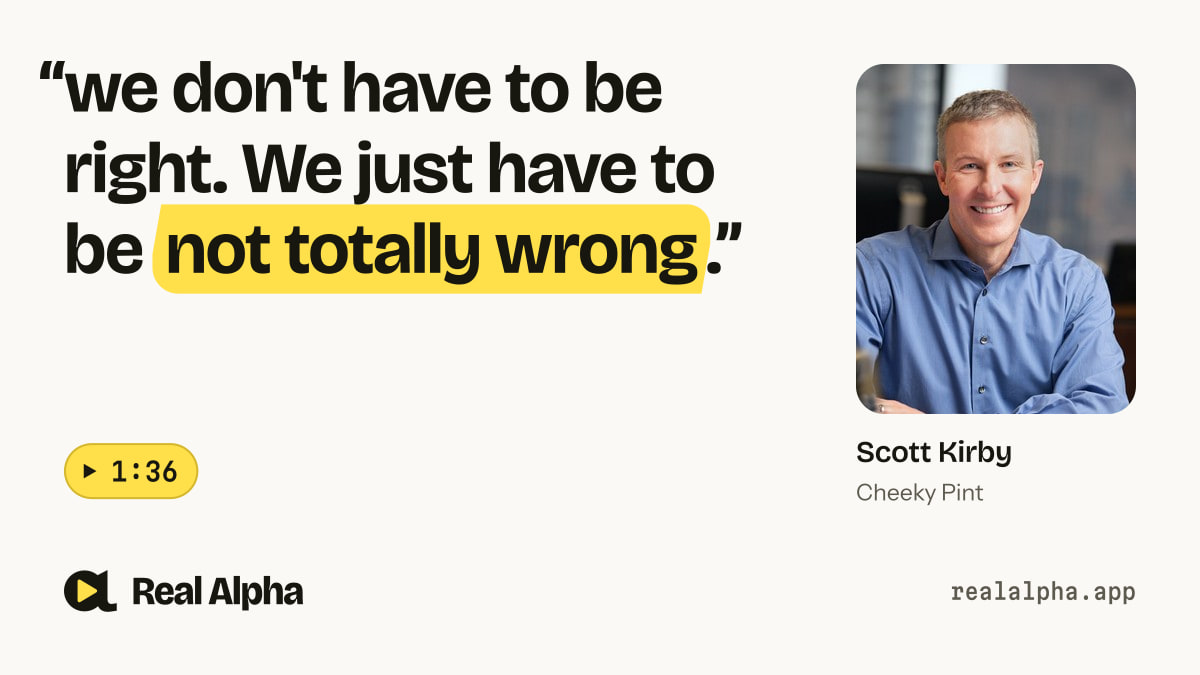
“we don't have to be right. We just have to be not totally wrong.”
 Scott Kirbyat 1:36 · Cheeky Pint
Takeaways Pro pick
- United ordered 200 wide-body planes while competitors retired fleets.
- Surveys capture how people feel now, not what they will do later.
- Extreme events expose opportunities that standard models miss.
One of Pro's picks, open to you here. Try Pro free for 7 days
One of Pro's picks. The rest of the summary and the 3 takeaways are in Real Alpha Pro; the video, the quote and the transcript stay free.
Read it with Pro, 7 days freeAbout this segment
Scott Kirby explains why United ordered planes during COVID and why surveys misread future travel demand. He says companies should make bets when the odds favor being less wrong than everyone else.

Scott Kirby is CEO of United Airlines.
Helped transform United’s culture and execute its growth plan, leading operations, marketing, sales and network planning.

John Collison, Host · Co-founder & president, Stripe
Sold his first startup, Auctomatic, at 17, then co-founded Stripe in 2010.
From “The airline CEO putting Starlink on every plane”, Oct 27, 2026. Watch the full episode
Thanks. We'll look at and fix what's off.
Transcript
Transcribed by machine (Whisper) from the episode’s audio, so a word may be off here and there.
- 0:26
so you did a big fleet order during covid that looked risky was it risky you know i didn't think it was so back during covid um every single expert in the world said travel demand is going to be down by 50 forever that's like what everyone said um it one other point like you should ignore the experts in the outside of two sigma the tails experts are terrible uh and i just thought they wrong, that I thought COVID was going to be deep and last a long time would end and travel demand would recover.
- 0:55
Everyone else around the globe was shrinking. So we did the biggest, the exact opposite, like literally every global long haul airline in the world, except for United, permanently retired part of their wide body fleets. We looked at that and said, we think the premise is wrong. And it's just a huge opportunity to do the opposite, do the biggest aircraft order in history, which we did. And I remember telling our board when they asked, they said the same thing.
- 1:16
this seems like a really big risk, like everyone else is shrinking, and you're gonna do the biggest. How big was the order? 200 wide bodies, and then we did another several hundred narrow bodies. Okay, so pretty big. And those are airplanes that list for, that we get a big discount, but they list for like $400 million. Sure, yeah. And I told our board, this is one of those cases, because everyone else is shrinking, we don't have to be right.
- 1:41
We just have to be not totally wrong. If we're not, so it's just one of those situations where the odds are so stacked in your favor. And people out here in Silicon Valley do this kind of stuff all the time where figure out something that you have a different view than everyone else and go big on it. And if it works, the returns are huge. And the downsides are smaller. And so find those- But there's been this cycle with large capital purchases is actually also a tech story that's relevant with memory.
- 2:13
Like Samsung came to down memory by systematically investing into every downturn because it's very cyclical. And obviously, it's hugely beneficial today. The flip side of that is everyone wants to invest when it's at its peak. Have we gone full circle? Yeah, you want to invest when everyone else, when things are down and not invest when things are up. I mean, for us and probably for memory, it's a little harder, too, because our assets are so long-lived.
- 2:41
But for us, our assets are 30-year. I guess for a chip factory, it's less because the technology moves away. But it's 30-year life. So we're going to go through several recessions and we're going to go through several ups and downs. So it's a little harder to do that. But you get better terms, you get better deals. Like we got really good pricing, for example, during the downturn. You're the only person ordering aircraft.
- 3:01
Because we're the only one in the world. And we sort of launched the market. For Boeing, they kind of could go to other customers and say, look, United believes you should too. Right. So I remember, it's very striking. I remember that period of people over extrapolating COVID. Like the tech version of that was companies deciding that they're going to be fully remote forever. And a lot of companies decided that and then were like, wait a second, no, that's not right. Why were people so wrong on the travel side of things? Because there are two things that are human nature that are mistakes. One is to extrapolate the current into the future. Assume that everything that's happening today is going to continue into the future. And two, trusting people on surveys. Like surveys are the absolute worst way to figure out
- 3:46
what's going to happen in the future. Because the reason travel experts thought travel, they did surveys and people were terrified. Like everyone's dying. And you ask them, are you going to travel internationally again? No. Like, but, and that was. True what they thought at the time, but like once it was over, of course they were going to go back to traveling again. So I ignore, and by the way, I said this earlier, like experts live in the world of two standard deviations.
- 4:11
They force fit everything into things that they've already seen. And so when things happen outside two standard deviations, when the tails happen, which is where you create all the value. Famously in finance, the frequency of six sigma events is. That's where I first started, you know, like, you know, VAR, Valuation at Risk, is the dumbest model in history. It's stupid, like, you know, things that shouldn't happen in the history of the universe happen once every five years.
- 4:35
Because it's a dumb, dumb, fundamentally flawed mathematical model that assumes everything is normally distributed. It's not. And it's just the perfect, it's really where I had a debate when I was getting my master's degree back in the 90s. this was about Black Shoals, you know, there's such a dumb model for valuing options because it assumes a normal distribution. The world is not normally distributed.
- 4:57
The tails are much fatter in everything that matters. And anyway, that applies to everything, but especially in a crisis. Black Shoals has a lot of assume a spherical cow-like assumptions baked into it. Okay, I love hearing you talk about the over-fixation on surveys, but like the travel industry, the airline industry, loves surveys. You know, United probably surveys people up the wazoo, and definitely at Stripe, we find we need to deprogram people a bit, because in tech, people love running things via metrics, and you can outsource your thinking to the dashboards and the metrics.
- 5:28
And so we're trying to encourage people to, I mean, yes, your opinions should survive contact with reality, but the metrics are not going to tell you what to do. And it sounds like... Yeah. So we use surveys. I like surveys for how did people feel about stuff we've already done? I ignore surveys for what are we going to do in the future. Apple Famousy does not do a lot of focus group testing on the products.
- 5:49
They just build the products they want to build. That's the way I, you know, stuff that we're doing right now. Today, we rolled out a Starlink tracker. We didn't ask anyone about that. Like, I sit on an airplane and talk to customers, and I know they're going to think that's cool. And they do think it's cool. When you're getting to the second thing, which is people try to overmeasure tiny steps, and it's just like, do the Starlink tracker.
- 6:07
If it's not useful, whatever. It doesn't matter. Yeah, and that's like, and especially in a world of AI, you can do so much so fast. Like, it's really powerful. I have a different view of what we'll probably talk about, but I at least have a different view of where the value is going to be created in AI. But you can just try so much so fast. And some of it doesn't work and people don't care. It takes more time to do a survey or a focus group