The alpha, twice a week
That was 4 min.
Get the best new moments in your inbox every Wednesday and Saturday. It's free.
Check your inbox
We sent a link to your address. Click it to finish signing up. Not there in a minute? Look in spam.
or
Cheeky Pint · 4 min · Oct 27, 2026
Low-cost airlines fail when they abandon cheap airports
 Scott Kirby
 argues that low-cost carriers lose their edge when they move into expensive major airports.
The episode’s best minutes
Full analysis- 0:22Contrarian bets pay when consensus relies on bad forecastsPro pick 6 min
- 31:40Starlink wins customers because speed matters more than free Wi-Fi6 min
- 57:19Low-cost airlines fail when they abandon cheap airportsPro pick 4 min
- 5 more moments in the full episode
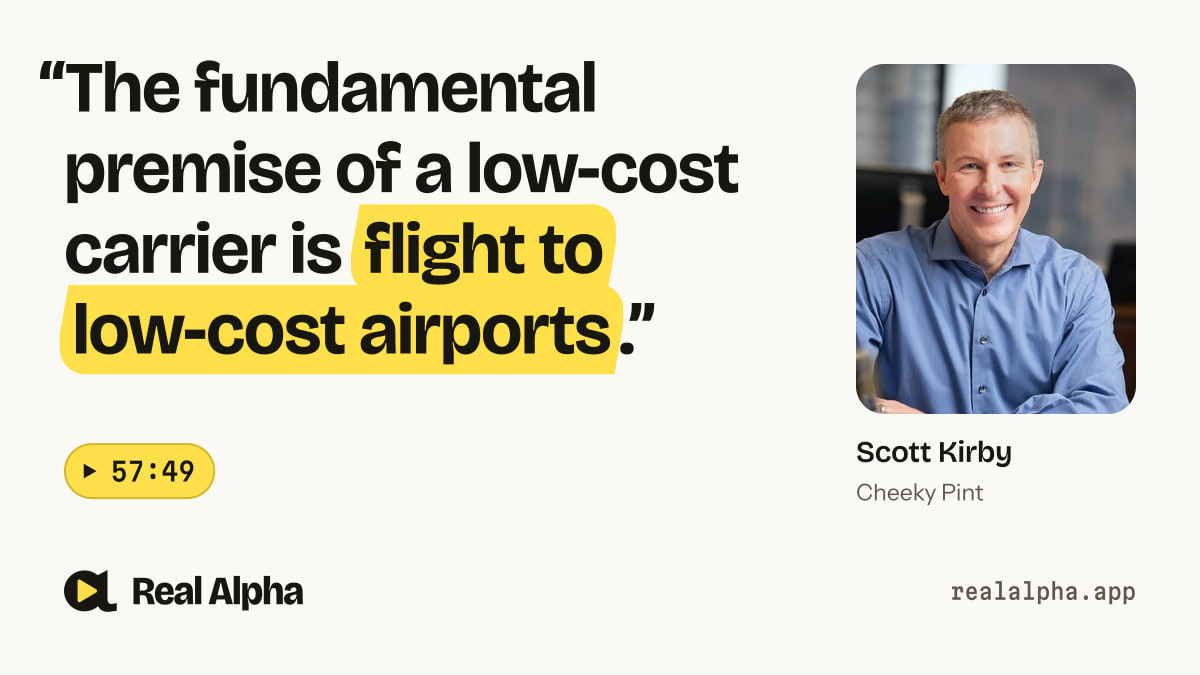
“The fundamental premise of a low-cost carrier is flight to low-cost airports.”
 Scott Kirbyat 57:49 · Cheeky Pint
Takeaways Pro pick
- Low-cost economics depend on using low-cost airports.
- Major-airport fees can consume most of a budget carrier’s fare.
- Airlines should stick to the model they are built to execute.
One of Pro's picks, open to you here. Try Pro free for 7 days
One of Pro's picks. The rest of the summary and the 3 takeaways are in Real Alpha Pro; the video, the quote and the transcript stay free.
Read it with Pro, 7 days freeAbout this segment
Scott Kirby argues that low-cost carriers lose their edge when they move into expensive major airports. Ryanair succeeds by staying disciplined about its model and accepting its limits.

Scott Kirby is CEO of United Airlines.
Helped transform United’s culture and execute its growth plan, leading operations, marketing, sales and network planning.

John Collison, Host · Co-founder & president, Stripe
Sold his first startup, Auctomatic, at 17, then co-founded Stripe in 2010.
From “The airline CEO putting Starlink on every plane”, Oct 27, 2026. Watch the full episode
Thanks. We'll look at and fix what's off.
Transcript
Transcribed by machine (Whisper) from the episode’s audio, so a word may be off here and there.
- 57:23
my joke was people may make the mistake of flying spirit once, but they're not going to do it twice. Why did Spirit go bust? Because they weren't charging as much as their cost. They were not able to charge enough. It's pretty simple. It was simple. They weren't able to charge enough. And look, what's happened... Because of cost inflation, basically. Cost inflation, but there's a whole bunch of things.
- 57:43
But fundamentally, what I think has happened to the low-cost carriers, there's really one still low-cost carrier successful airline in the world. It's Ryanair. I was going to ask. The fundamental premise of a low-cost carrier is flight to low-cost airports. You know, Southwest, when they started flying here, they flew to Oakland, not San Francisco. San Francisco's too expensive. In L.A., they didn't fly to LX.
- 58:05
They flew to Burbank in Ontario. LX is too expensive. And Ryanair still does it, right? They don't fly to Heathrow. They don't fly to Charlottesville. They fly to secondary airports because they're low-cost. So all these companies' eyes get too big for their size. And all in the U.S., every single one of them, like, abandoned that. Is it ego? And then they went to fly into, I mean, it's, I don't know why.
- 58:25
Well, they run out of, like, customers, right? Yeah, and they went into, you know, Chicago and Newark and San Francisco. And, like, back to the New Yorker, you can't charge $58 when you're paying the airport authority $52. You just can't. Is it a chasing growth story? Like, I'm always very impressed by In-N-Out as a business because they don't chase growth. They famously do everything within one day's drive at the refrigeration centers.
- 58:47
And so, you know, they are distribution centers. And so they're only in kind of the California West Coast type area. and they don't feel the desire to go crazy on the menu and like we have the salad this and we have the whatever that. They keep the menu very narrow. And I feel like maybe if they're a public company, they would be trying to chase growth and we're going to expand this way. And they just do the same thing exceptionally well with a cost advantage.
- 59:08
Is the problem that as public companies maybe or as just like short-term oriented companies, they had this good thing flying to Oakland and flying to the secondary airports and for whatever reason they just got distracted from it? Yeah, I would actually say a little different than just chasing growth, I would say, know who you are, know what your strengths are, and stick to your knitting. Companies are not good at trying to be something they're not.
- 59:32
And in the past, you know, this predated me, but all the big airlines, you know, American, Delta, Northwest, Continental, tried to go compete with Southwest by creating airlines within an airline that were going to try to out Southwest Southwest. And in Europe, they still do it. And in Asia, they still do it. They try to out low-cost carrier, low-cost carrier, and they're terrible at it. and every single one of them has been nobody does it well because that and by the way southwest is now trying to be like us and They're not going to be very good at that either.
- 1:00:03
You've got to stick to the things that you're good at. We aren't going to ever go try to compete with Allegiant Airlines and be Allegiant Airlines because we'd be terrible. They're better at Allegiant. If they try to compete with us, they're screwed. The low-cost model works, but you have to understand what you are. You've got to stick to it. And you've got to accept that there's limitations. I'm not going to be as big as United Airlines.
- 1:00:22
I'm not going to fly to Chicago O'Hare. Allegiant is an example. Allegiant Airlines, which mostly applies to Vegas, They fall from small cities. They've done a great, you know, they're one of the four airlines that's going to be profitable this year. What else have you learned from Reiner? The guy's entertaining. Michael O'Leary is entertaining. We would like to get him in the pub here. You got him here?
- 1:00:45
No, no, I would like to. You'll get a few more swear words than you get out of me. He knows his business exceptionally well. He's a very impressive CEO. But they're also like in and out. They have avoided distraction. He's disciplined. They always get asked about transatlantic. Discipline is probably a better way. It doesn't work because you don't get the low cost advantage when you can't have the number of turns be high enough.
- 1:01:03
They get asked about Wi-Fi in the planes, and it's like, guys, the flights are short. Just look at your phone for an hour or something. You don't need it on an hour-long flight. He's disciplined. That's a better way of saying it. So getting outside, you have to be disciplined to be successful.