The alpha, twice a week
That was 6 min.
Get the best new moments in your inbox every Wednesday and Saturday. It's free.
Check your inbox
We sent a link to your address. Click it to finish signing up. Not there in a minute? Look in spam.
or
Cheeky Pint · 6 min · Oct 27, 2026
Starlink wins customers because speed matters more than free Wi-Fi
 Scott Kirby
 says United chose Starlink because customers would value the better connection, then anecdotes convinced him to equip more of the fleet.
The episode’s best minutes
Full analysis- 0:22Contrarian bets pay when consensus relies on bad forecastsPro pick 6 min
- 31:40Starlink wins customers because speed matters more than free Wi-Fi6 min
- 57:19Low-cost airlines fail when they abandon cheap airportsPro pick 4 min
- 5 more moments in the full episode
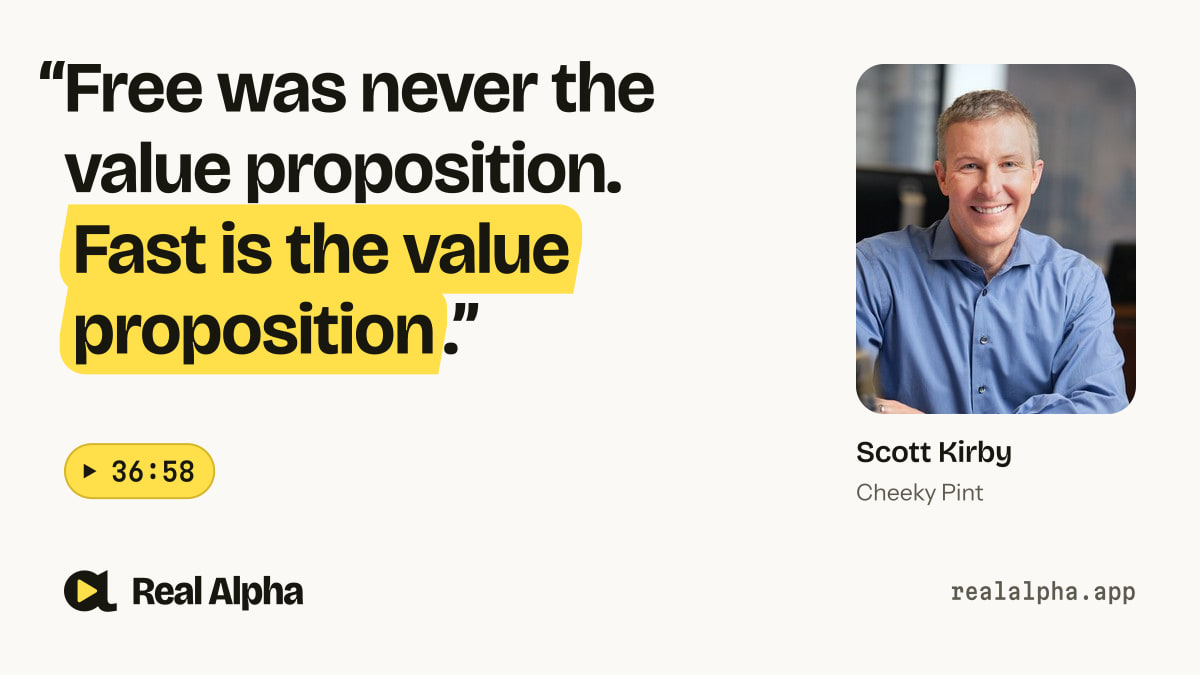
“Free was never the value proposition. Fast is the value proposition.”
 Scott Kirbyat 36:58 · Cheeky Pint
Takeaways
- Customers were already changing flights to get Starlink.
- Reliable availability matters more than a chance of getting it.
- Fast connectivity—not free service—is the selling point.
About this segment
Scott Kirby says United chose Starlink because customers would value the better connection, then anecdotes convinced him to equip more of the fleet. He expects a few years of differentiation to win loyal customers.

Scott Kirby is CEO of United Airlines.
Helped transform United’s culture and execute its growth plan, leading operations, marketing, sales and network planning.

John Collison, Host · Co-founder & president, Stripe
Sold his first startup, Auctomatic, at 17, then co-founded Stripe in 2010.
From “The airline CEO putting Starlink on every plane”, Oct 27, 2026. Watch the full episode
Thanks. We'll look at and fix what's off.
Transcript
Transcribed by machine (Whisper) from the episode’s audio, so a word may be off here and there.
- 31:43
The fact that every airline has not chosen Starlink suggests to me that the economic deal for an airline was not like an obviously, oh, yeah, we must do this. It required, you know, there was a case you could have made to not do it because some airlines did not do it. Talk us through how you made the decision to do it. How painful was the decision? It wasn't painful. It was, I thought it would be a big deal to customers.
- 32:10
And so I wanted to do it. Economics were, yes, it's more expensive, but it's a whole lot better. You often get what you pay for, and that's true in this case. Mostly at airlines, you look at this, like these things are incremental. And so it really takes time to put them on. And the easiest way to put it on is to do it in a heavy check. So you got an airplane that's going to be down, you strip the airplane down.
- 32:33
And while you're working on it, you already got the airplane down, put Starlink on. And that's how we started. And we had, we were only going to do like 65% of our fleet because planes were retiring. And once we put it on the first aircraft, we realized like, I just like all these anecdotes. Like I'm talking to people like, I'm switching to flying a regional flight because it's got Starlink. And I was like, holy cow.
- 32:54
No, I was booking a flight this week and I was just thinking through it. I had to book around the Brewers game. Whereas if I had known for certainty that my flight was going to have Starlink, I would have booked it during the game. And there's such a huge gap between maybe there's Starlink. Congratulations, by the way. We're not talking about it right now. Maybe there's Starlink versus there is definitely Starlink.
- 33:17
So it feels to me like you actually haven't reaped any of the benefits yet because certainty is going to make a huge difference. I think you're right. I think we've got some. But getting to 50% matters. But you're right. So we wrote out a tracker today that gives you a bunch more data. We're going to put in the app sometime soon the probability that there'll be Starlink on your flight. So at least know the probability for flights.
- 33:40
And it'll be different. Like today, you know, if you're flying on a Max 8, if you're flying on a Max 8, it might be 25%. But if you're booking for Christmas, it's 36% because we know how many we plan to have done. And so we're going to have that. we also are gonna have a bunch of premier markets that we're gonna get to 100%. So our first hub, I'm not gonna tell you the date yet, the first hub that's gonna be 100% Starlink is Los Angeles.
- 34:06
So sometime in the first half of next year, if you're in LA. And is that because that's the most competitive hub? It's a competitive hub, but it also like, it's also the kind of aircraft that fly there. So our only aircraft that are still a challenge, we have to get Boeing over the finish line on some of the certification work on the 787s. We will get there, but if you've got a market like San Francisco that has a lot of 787s, it's going to take longer because Boeing is slower.
- 34:36
Was the CapEx or OpEx more painful in the economic model as you look at it? The numbers aren't that big. Oh, really? Well, I mean- But then why is Delta's strategy rational or do you think it's completely mistaken? It was a mistake. I think at all airlines, even the ones that kind of, if you watch the other airlines that picked it after United had done it, they're sort of stepping into it gradually.
- 35:01
That's just the way we've always done it in airlines. You know, everything is slow. Like, doing aircraft remodification takes eight years. Like, just, like, that's the way we've done it. And so I think it's just the way everyone has done it. And, like, and if you're thinking that this is, like, an eight-year project, okay, I'm a year behind on starting, but that's not that big deal. You know, United will be at 12%.
- 35:19
You know, we'll be a year behind. like it's not gonna be enough to matter like it's a you can in a traditional way of looking at it it can feel rational i don't think any people we even didn't appreciate how big it was thought it was big but then we put the pedal to the metal and spacex supported us and going is this gonna be the biggest differentiator of all time i think it is i think it's the biggest competitive event and it's temporary like it's not everybody eventually is going to have yeah high speed low earth orbit internet connectivity. It's going to be a must-have. But we are going to have a few years of being the only airline that has it at scale. And that's our mission is we're going to convince customers that It is the best airline, and we're going to get customers to switch their loyalty to nine,
- 36:04
get our credit card, switch their loyalty to nine, and not because of Starlink. They're going to try us for Starlink, and they're going to stay because all the other technology and everything else is better, and the technology in particular is so much better than technology other, and it's accelerating because we're out there at TechStack, and because we're, like, our gap is getting wider and wider with our technology every day.
- 36:23
You have a two-to-three-year window to woo customers. Exactly. That's exactly right. What do you think of Elon's strategy of requiring airlines to make it free? We were gonna make it free anyway, so, you know. Free was gonna be, although, in fairness, free is not the value proposition. Fast is the value proposition. And the truth is, like, I've flown all three of my big competitors who have it free on the legacy systems, and it's terrible.
- 36:48
I've flown them each two or three times in the last year. It's terrible because there's not enough, it's physics. There's not enough bandwidth to make it free. I was sad when they started making it free. free. Because I'm like, this is going to make my experience worse. It makes it unusable for almost everyone. Free was never the value proposition. Fast is the value proposition. And there's only one option for fast and free. That is the only option. You can call it the other fast and free, but it's not. It's like dial-up internet. It's slower than dial-up internet.
- 37:13
So you mentioned that in the long run, everyone will have Star Week. The technology stack is just in theory. Or maybe Amazon, but they'll have low wealth. How do you think about in the long run where a reason people prefer, say, the Asian Airlines versus the American Airlines is they feel like the soft bits are better