The alpha, twice a week
That was 4 min.
Get the best new moments in your inbox every Wednesday and Saturday. It's free.
Check your inbox
We sent a link to your address. Click it to finish signing up. Not there in a minute? Look in spam.
or
Training Data · 4 min · Oct 29, 2026
Cross-team alignment takes repeated communication
 Chase Lochmiller
 uses a weekly staff meeting to surface cross-team blockers and says leaders must repeat priorities more than feels necessary.
In this episode
Full analysis- 2:09A founder scales by growing alongside the companyPro pick 5 min
- 14:54Most startups fail through execution, not competitionPro pick 5 min
- 24:06Bitcoin mining bridged Crusoe to AI infrastructure8 min
- 7:09Cross-team alignment takes repeated communication4 min
- 37:16Companies can outgrow people who once fit their roles4 min
- 48:32CEOs need to actively seek out bad news2 min
- 32:30Coaching and practice can make a CEO a better communicator5 min
- 44:01Data centers need to explain their local impact3 min
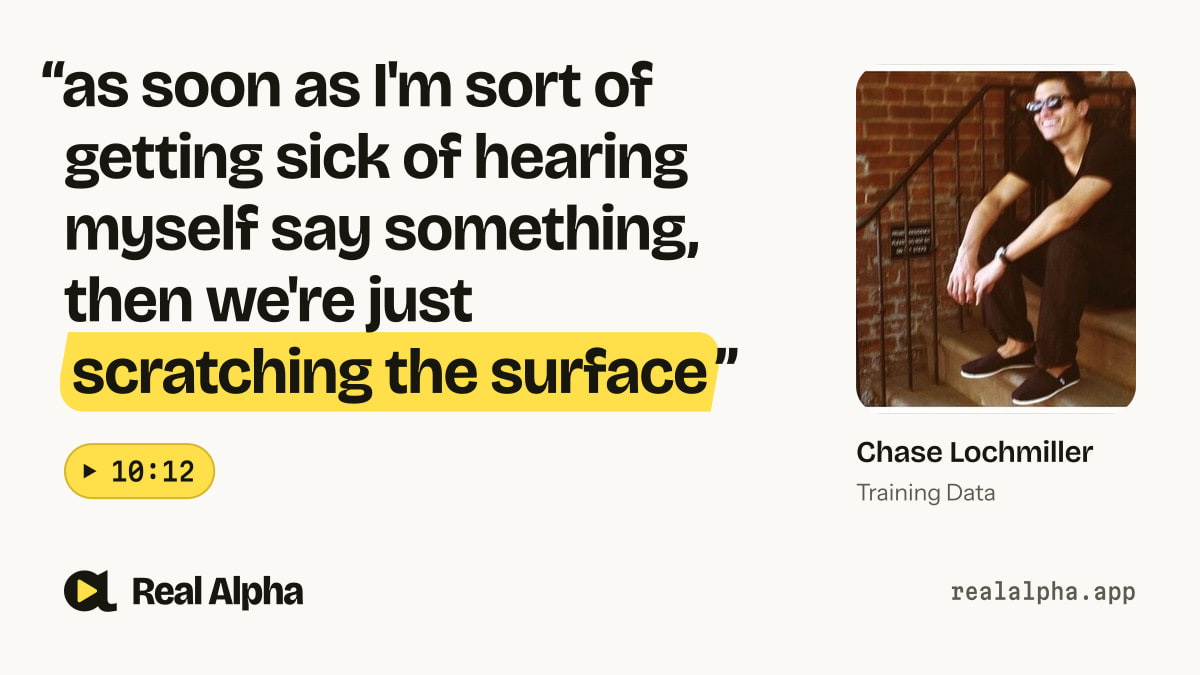
“as soon as I'm sort of getting sick of hearing myself say something, then we're just scratching the surface”
 Chase Lochmillerat 10:12 · Training Data
Takeaways
- Use a weekly staff meeting to surface cross-org coordination problems.
- Align teams on direction, ownership and how their work connects.
- Keep repeating priorities after smaller-team habits stop working.
About this segment
Chase Lochmiller uses a weekly staff meeting to surface cross-team blockers and says leaders must repeat priorities more than feels necessary. At scale, alignment requires deliberate, repeated communication.

Chase Lochmiller is CEO of Crusoe.
Co-founded Crusoe in 2018 on the bet that energy would be AI's biggest bottleneck, and builds the data centers.

Sonya Huang, Host · Partner, Sequoia Capital
Works with OpenAI and Anthropic; co-wrote Sequoia's essay on generative AI.

Pat Grady, Host · Co-steward, Sequoia Capital
Joined Sequoia in 2007; backed Snowflake, Zoom, ServiceNow and OpenAI.
From “Crusoe CEO Chase Lochmiller: Turning Stranded Energy Into Intelligence”, Oct 29, 2026. Watch the full episode
Thanks. We'll look at and fix what's off.
Transcript
Transcribed by machine (Whisper) from the episode’s audio, so a word may be off here and there.
- 7:14
vertically integrated AI infrastructure platform that we're building here at Crusoe. Trust is an interesting word. We talked about it on the call. Actually, I just finished a call before this. I kind of said to everybody, like, how many people in your organization do you deeply trust enough to say you're the DRI on this thing that cuts across the whole org and have deep trust? And it was like three to four people on average.
- 7:37
Are you just a naturally trusting fellow? Did you have to learn to let go? I don't think my team would describe me as like a just naturally very trusting person. Look, it's not that I'm like, you know, hands off, go, you know, go for it, you know, you know, go, go do whatever you want. That's, that's not really my approach to management. It's, it's really, uh, I want to understand what we're doing in this vertical where we have alignment on a direction we're headed.
- 8:06
I get it and I get how it influences the other pieces of the business. And then I hold, you know, my team accountable to go execute on what we agreed upon, you know, from a plan perspective. Okay. On that DRI topic, it seems to me as CEOs grow, like they've got their orgs, those orgs get bigger. They struggle with getting things done across the orgs. They, at some point, are like, we need DRIs. We need to entrust those DRIs.
- 8:33
And the bigger the orgs get, the harder it gets. and you've got like four different major orgs underneath you. How do you get someone that cuts across? How do you have many versions of you? You know, we struggle with this problem just like any organization, right? Anytime you're trying to do something that is cross-org, you know, pulling in resources from one team to work with another resource from another team, you know, it just is complicated.
- 9:02
You know, we do have a program management function which helps, but, you know, who's ultimately accountable for delivery of a lot of these things. The way I find is like, you know, I run a, I run a staff meeting once a week that like has, you know, a lot of the, you know, key executives and my direct reports in the meeting and we cover things across the whole business. And, you know, when there are pain points of how teams are working together, they, they surface in those meetings and, you know, we try to address them and, but, you know, there There is an inherent tension to doing things that are cross-functional or cross-organization.
- 9:38
We've sort of had to figure it out, though. You know, just being a vertically integrated business, having... collaboration between those layers that are where you're transitioning across the stack, I think is a critical function if you're going to be successful as a vertically integrated company. And then like, what have you learned about that? Like, you must have skinned your knees on it. Any ahas other than the staff meeting?
- 10:02
You know, I was always used to just working in smaller teams and smaller organizations. And if I said something once, people kind of listened and, you know, we worked in a small group and, it all kind of worked itself out. I found it that as soon as I'm sort of getting sick of hearing myself say something, then we're just scratching the surface of when I'm just hitting the point where I'm saying it enough times. And so just that whole communication layer about getting people on the same page to march in the same direction, it's sometimes painful the amount of times you have to remind people um of what we're doing and why we're doing it and who's doing what and but you know that that's sort of what it takes to get alignment and i think that is one of the challenges of running a bigger organization and it's why there are opportunities always for
- 10:56
startups is that they can be more nimble they can move quicker uh than than than bigger companies and we're trying to fight that inertia of a bigger company to be able to continue to move fast and capture the opportunity at this moment in time when it's sort of required to be a dynamic organization