The alpha, twice a week
That was 3 min.
Get the best new moments in your inbox every Wednesday and Saturday. It's free.
Check your inbox
We sent a link to your address. Click it to finish signing up. Not there in a minute? Look in spam.
or
Training Data · 3 min · Oct 29, 2026
Data centers need to explain their local impact
 Chase Lochmiller
 calls the industry's main challenge a marketing problem and describes explaining energy, water, tax and school impacts to local communities.
In this episode
Full analysis- 2:09A founder scales by growing alongside the companyPro pick 5 min
- 14:54Most startups fail through execution, not competitionPro pick 5 min
- 24:06Bitcoin mining bridged Crusoe to AI infrastructure8 min
- 7:09Cross-team alignment takes repeated communication4 min
- 37:16Companies can outgrow people who once fit their roles4 min
- 48:32CEOs need to actively seek out bad news2 min
- 32:30Coaching and practice can make a CEO a better communicator5 min
- 44:01Data centers need to explain their local impact3 min
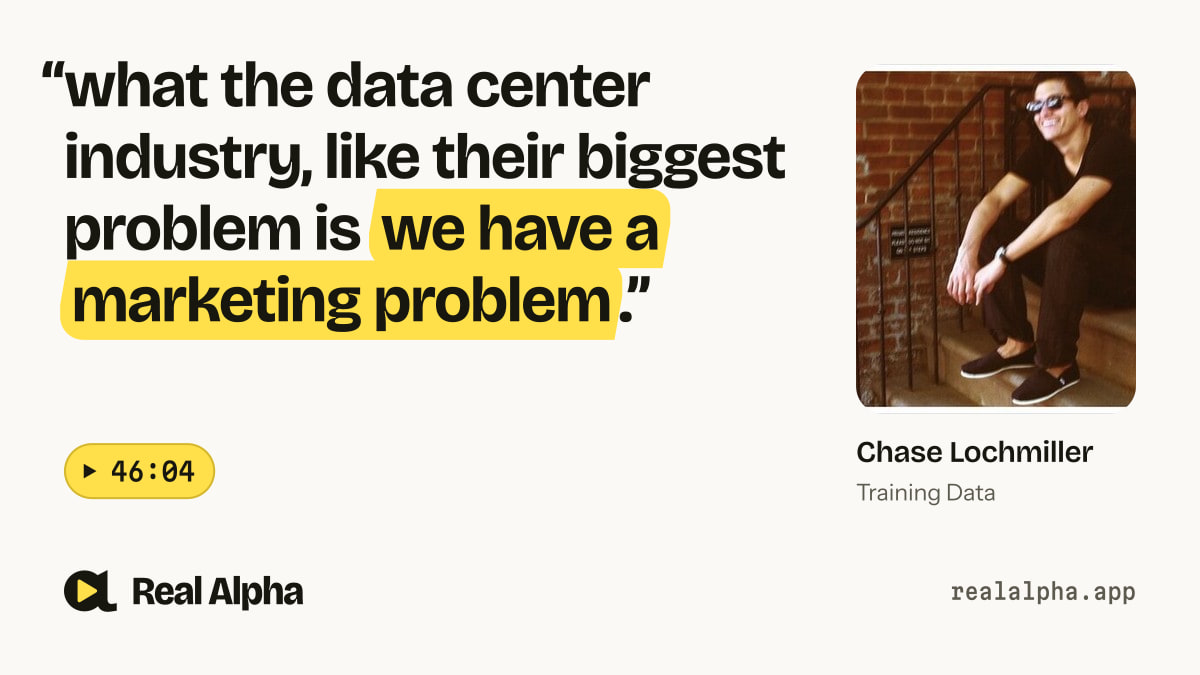
“what the data center industry, like their biggest problem is we have a marketing problem.”
 Chase Lochmillerat 46:04 · Training Data
Takeaways
- Explain local energy, water, tax and school impacts directly.
- Meet community criticism with facts, not condescension.
- Treat public understanding as an infrastructure industry's operating challenge.
About this segment
Chase Lochmiller calls the industry's main challenge a marketing problem and describes explaining energy, water, tax and school impacts to local communities. He says factual, respectful conversations can make people receptive.

Chase Lochmiller is CEO of Crusoe.
Co-founded Crusoe in 2018 on the bet that energy would be AI's biggest bottleneck, and builds the data centers.

Sonya Huang, Host · Partner, Sequoia Capital
Works with OpenAI and Anthropic; co-wrote Sequoia's essay on generative AI.

Pat Grady, Host · Co-steward, Sequoia Capital
Joined Sequoia in 2007; backed Snowflake, Zoom, ServiceNow and OpenAI.
From “Crusoe CEO Chase Lochmiller: Turning Stranded Energy Into Intelligence”, Oct 29, 2026. Watch the full episode
Thanks. We'll look at and fix what's off.
Transcript
Transcribed by machine (Whisper) from the episode’s audio, so a word may be off here and there.
- 44:05
attacking them or protesting them. And you're sort of in the middle of a wave. It's an election issue around the data centers. And I've heard your story on why it's good for communities and why it's great for humanity. Are you facing some of that heavy criticism yourself? And how do you deal with it personally is do you have security like where are how how tricky is this for you the way i think about it is when i look around at the people at crusoe these are all people that want to do good for the world there's not a single person i met at crusoe that doesn't want to do good for the world And I believe fundamentally that there is a right way to, you know, bring this infrastructure to life where everybody can benefit, you know, energy, you know, from a water usage standpoint, from a tax revenue standpoint, from a school and community standpoint, and then from, you know, the end use cases and how it's actually fueling human progress through, you know, the greatest technological wave we've ever experienced.
- 45:10
I've heard you explain it. You explain it extremely well, and you make a lot of sense. And I wish the rest of the AI leaders would explain it as well as you did. But for you, you must be catching a lot of flack. Well, so my major thing is I always try to take a very first-principled approach to things. And if I have high conviction in something that I've built up from a set of ground truth facts, I have no problem disagreeing with someone.
- 45:42
And, you know, I can try to poke holes into why, you know, someone else I think is wrong and why, you know, we're trying to do things the right way. But I do feel like fundamentally at Crusoe, like permeates in the culture, like people want to do this the right way. People want to do this as a good service to the world. This has become a political issue, particularly around the, you know, the AI data centers. And there's just so much misinformation around this out there that, you know, I've often said that like what the data center industry, like their biggest problem is we have a marketing problem. We haven't been able to get the truth out there. And to me, the truth is on our side.
- 46:20
and so when you explain the truth and i've been in these rooms you know where you know i i go to these local communities i meet with the county judge i meet with um you know folks in these communities that where we're building infrastructure and when you sit down you really explain to them what's happening and you know you're not coming at it from like a hey i'm smarter than you you gotta like listen to me it's like it's like here's just like what's happening and here's here's how we're trying to do our very best to make it uh good for you and and good for us and good for the world. I think when you have those conversations, people are receptive to it. Independent of politics, political allegiances, I think people are receptive to authenticity and facts. That's really our approach to this. Now, am I worried from a security standpoint? Sure. We've had to
- 47:09
increase our security footprint just given...