The alpha, twice a week
That was 4 min.
Get the best new moments in your inbox every Wednesday and Saturday. It's free.
Check your inbox
We sent a link to your address. Click it to finish signing up. Not there in a minute? Look in spam.
or
Founders · 4 min · Nov 11, 2026
Crypto revenue surged as January trading drove capital needs
 Vlad Tenev
Stimulus, limited spending options and crypto interest helped push trading activity up.
In this episode
Full analysis- 18:22Micky Malka’s first call helped Robinhood raise emergency capitalPro pick 7 min
- 8:52Robinhood prepared emergency funding before it needed it3 min
- 1:05:26Tenev used a 50-year test to decide what to build3 min
- 25:00Robinhood’s emergency round drew $10 billion in demand4 min
- 58:03An academic leave made Tenev’s startup bet reversible7 min
- 13:29Crypto revenue surged as January trading drove capital needs4 min
- 29:28Hyperinflation made copper cookware a store of wealth4 min
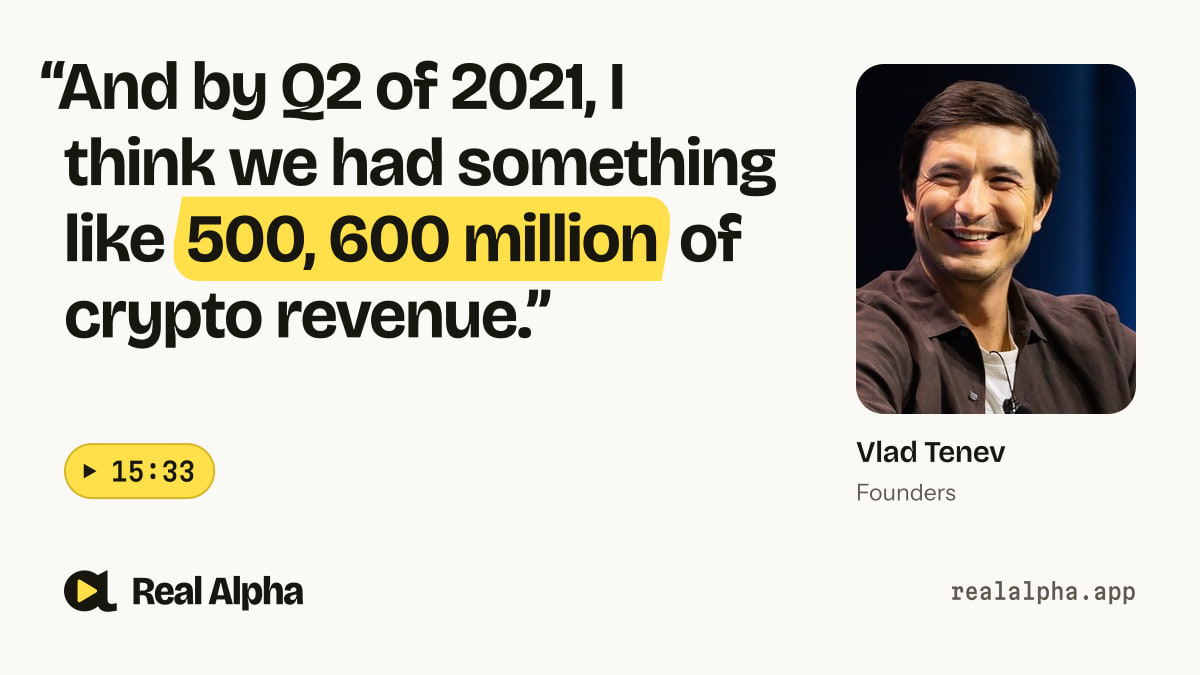
“And by Q2 of 2021, I think we had something like 500, 600 million of crypto revenue.”
 Vlad Tenevat 15:33 · Founders
Takeaways
- Crypto revenue was close to zero for years after launch.
- Quarterly crypto revenue reached $500–600 million by Q2 2021.
- The surge in activity brought rapidly rising capital requirements.
About this segment
Stimulus, limited spending options and crypto interest helped push trading activity up. Crypto revenue went from near zero to $500–600 million in a quarter as capital requirements also climbed.

Vlad Tenev is co-founder and CEO of Robinhood.
Co-founded Robinhood in 2013, then steered it from a $500M loss in 2023 to a $1.1B profit.

David Senra, Host · Host, Founders
Has read an entrepreneur's biography every week for Founders since 2016.
From “Building Robinhood, Surviving GameStop & A $500 Million Phone Call | Vlad Tenev”, Nov 11, 2026. Watch the full episode
Thanks. We'll look at and fix what's off.
Transcript
Transcribed by machine (Whisper) from the episode’s audio, so a word may be off here and there.
- 13:42
Then January of 2021 happened, and it was like a huge inflection point in speculative trading activity. Why? I don't remember. I think part of it was the new year. Every time you cross from like end of December to early January, we kind of see an inflection point in activity, like a step change in activity. I think it's behavioral. People are home. You know, the end of the year is kind of closing of the chapter, opening the new one, and people start thinking about their finances more. So they open Robinhood accounts and start buying stocks. So there was that. There was also stimulus checks, which dropped in people's accounts.
- 14:36
there was lack of other things to do to spend your money. I mean, a lot of restaurants and sporting events were closed. So in the zero interest rate environment, yeah, what we saw was just an insane amount of interest in crypto and stocks at the same time. In our crypto business, which we launched in January of 2018, and for a while it was generating next to nothing in revenue for many years, like close to zero, because January of 2018 was the start of a prolonged crypto winter.
- 15:21
Okay. And we had just gotten started, so we didn't have an established base of activity. So people were buying and there were some moments where, you know, we had more activity, but call it close to zero until 2020. Then Q3 of 2020, it just went up by 10x. So we started seeing, you know, tens of millions of quarterly revenue. Q4, it was hundreds. And by Q2 of 2021, I think we had something like 500, 600 million of crypto revenue.
- 15:53
So it went from nothing to our largest or second largest revenue stream. And this was happening alongside all of the meme stock stuff. So, yeah, we had to contend with both of these things. And remember, by that point, my mind was on the full-day trading outage of March of 2020. That was like the last big crisis we had. So I was like, I'm an engineer, keep the systems up, make sure that, you know, we can serve our customers.
- 16:25
Because, you know, that was the devil I knew. So, yeah, we were just kind of blindsided by the capital requirements issue springing up overnight again. Our capital requirements. Was it really overnight? It was basically overnight. And day of, this got kind of confusing because the numbers kept changing. but the first number that came through the automated files was something like 3 billion. So it was like 3 billion, then 1.8 billion.
- 16:53
Then we had a file that was 700 million.