The alpha, twice a week
That was 4 min.
Get the best new moments in your inbox every Wednesday and Saturday. It's free.
Check your inbox
We sent a link to your address. Click it to finish signing up. Not there in a minute? Look in spam.
or
Founders · 4 min · Nov 11, 2026
Robinhood’s emergency round drew $10 billion in demand
 Vlad Tenev
Micky’s commitment made later investor calls easier, and the round drew far more demand than expected.
In this episode
Full analysis- 18:22Micky Malka’s first call helped Robinhood raise emergency capitalPro pick 7 min
- 8:52Robinhood prepared emergency funding before it needed it3 min
- 1:05:26Tenev used a 50-year test to decide what to build3 min
- 25:00Robinhood’s emergency round drew $10 billion in demand4 min
- 58:03An academic leave made Tenev’s startup bet reversible7 min
- 13:29Crypto revenue surged as January trading drove capital needs4 min
- 29:28Hyperinflation made copper cookware a store of wealth4 min
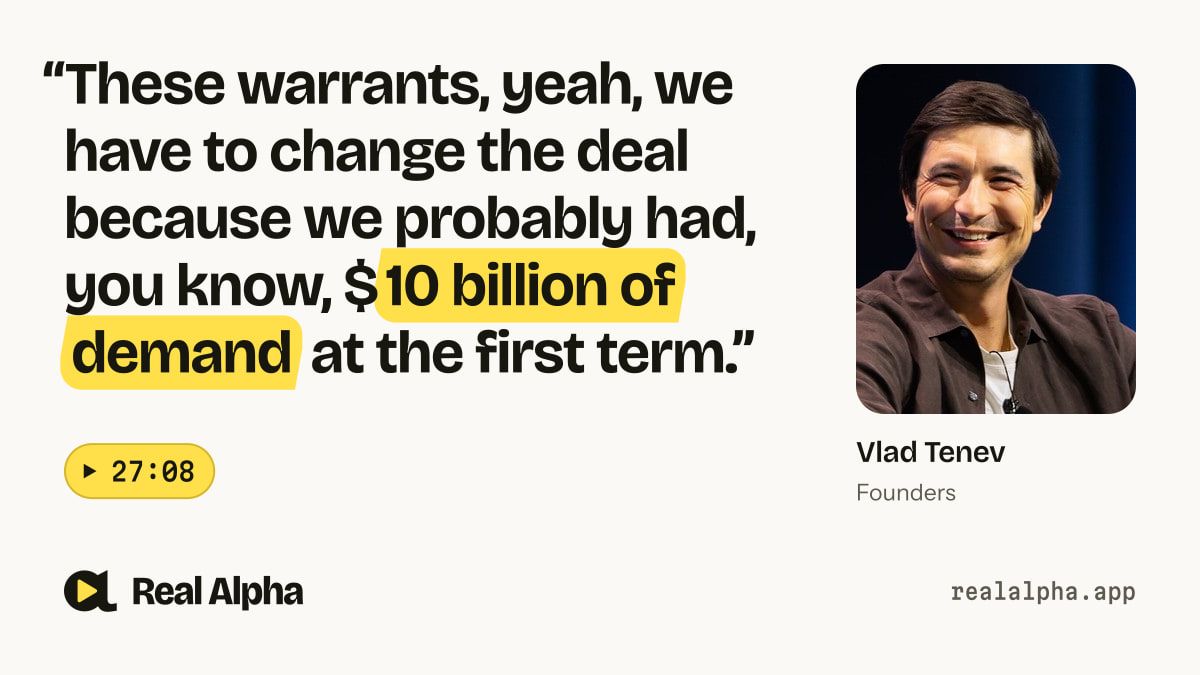
“These warrants, yeah, we have to change the deal because we probably had, you know, $10 billion of demand at the first term.”
 Vlad Tenevat 27:08 · Founders
Takeaways
- Micky’s on-the-spot commitment helped subsequent fundraising calls.
- Demand reached about $10 billion, requiring changes to the deal.
- Tenev reassured banks that Robinhood’s financial condition remained strong.
About this segment
Micky’s commitment made later investor calls easier, and the round drew far more demand than expected. Vlad Tenev also had to reassure banks that could pull credit lines.

Vlad Tenev is co-founder and CEO of Robinhood.
Co-founded Robinhood in 2013, then steered it from a $500M loss in 2023 to a $1.1B profit.

David Senra, Host · Host, Founders
Has read an entrepreneur's biography every week for Founders since 2016.
From “Building Robinhood, Surviving GameStop & A $500 Million Phone Call | Vlad Tenev”, Nov 11, 2026. Watch the full episode
Thanks. We'll look at and fix what's off.
Transcript
Transcribed by machine (Whisper) from the episode’s audio, so a word may be off here and there.
- 25:13
a lot of money, this big like financial need that we had, which typically companies that are in that state are not doing well. It's a kind of a bad situation. But the reason we were in that situation was because we were growing too quickly. It was a consequence of too much success, which is quite rare. So at that time, Robinhood was the number one app in the app store, not just in finance, which is, you know, kind of still good.
- 25:42
But we were ahead of Instagram. We were ahead of TikTok. Number one overall, extremely rare for a finance app. We'd never seen anything like that. So we were in this position where we needed capital, but also we were growing tremendously quickly, which was hard to keep in your head at the same time. Because as a leader, obviously, I'm excited about the growth, the success, the revenue. I mean, January 2028, we hit 1.8 billion run rate, something of that nature.
- 26:17
Like we had crossed, the company, I think, made $200 million in revenue in 2019. Then we went to close to a billion. So we had 5x in 12 months? Yeah. Okay. 4x, yeah. And then in 2021, we got to $1.8 billion. So obviously that growth was exciting to me and I was cheering it on. But also along with that rapid growth came just an increase in risk. But go back to the consequential nature of the call and the fact that Mickey just was like, yeah, you got the money, you're done.
- 26:51
The fact that he committed on the spot and said, I'm in, made everyone else, every conversation after him much easier. How did those conversations go? So the second call, you say, hey, Mickey Malko's giving me half a billion dollars? Same call, Mickey Malko's in, okay, I'm in too. And then eventually, we started getting the calls, right? It's like, how much is left? And then we were like, wait, wait, wait a minute.
- 27:20
These warrants, yeah, we have to change the deal because we probably had, you know, $10 billion of demand at the first term. I love the story. Or you just told, because you're like, yeah, this happened in, we're saying, what, we're January 2021? Yeah. Okay, but you're like, it actually didn't happen then. It happened March 2020 when you guys did this term sheet, didn't sign it, just put it in a fucking drawer.
- 27:24
But you knew it was going to happen. Yeah. That's incredible, dude. Yeah, pretty much. I would bet we would have gotten it done either way, but it certainly helped that we had gone through that exercise of thinking about this stuff. Have you heard of anything else like that? I can't think of another example. Of just freshened business planning to that degree. I don't want to give myself too much credit, you know.
- 27:48
I might give it to Mickey. I might have to give the credit to Mickey. That's incredible. And during that time, a lot of our counterparties, because we have lots of counterparties for running the business too. Securities lending, for instance, which are big banks, and they have credit risk departments. So I had to do a roadshow throughout all this where I talked to all of our banks and I assure them that our financial condition remains strong because, you know, if they pull their lines of credit, it could also create a cascading failure.
- 28:21
So, you know, what we pulled off, I've been told, was a miracle, right? There's many ways that the firm could have actually gone bankrupt and gone insolvent. But I think we just navigated it. Let me close the loop on Mickey, though. I have a question. How does he end his phone calls with you? What does he say? What's the last thing he says to you? I think they just kind of peter out.