The alpha, twice a week
That was 5 min.
Get the best new moments in your inbox every Wednesday and Saturday. It's free.
Check your inbox
We sent a link to your address. Click it to finish signing up. Not there in a minute? Look in spam.
or
20VC · 5 min · Nov 9, 2026
Customer-facing engineers helped Mistral find its product
 Arthur Mensch
 says embedding engineers with customers showed that chatbots alone were not enough; enterprises needed end-to-end process applications.
In this episode
Full analysis- 3:48Sovereign AI requires control of models, data and compute3 min
- 24:00Customer-facing engineers helped Mistral find its product5 min
- 6:47Third-party models offer weaker data guarantees5 min
- 13:49Energy is not yet the main cost of compute3 min
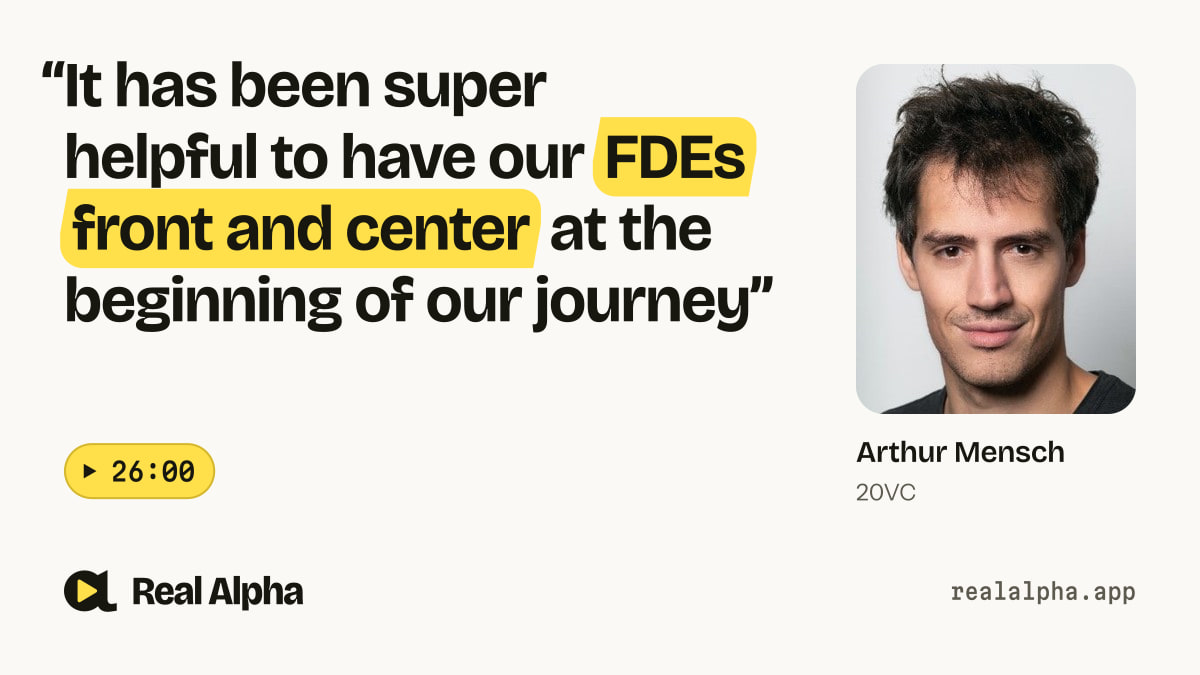
“It has been super helpful to have our FDEs front and center at the beginning of our journey”
 Arthur Menschat 26:00 · 20VC
Takeaways
- Customer work revealed that chatbots were not creating enough business value.
- Deployments surfaced reusable tools, including durable process execution.
- Accenture and TCS help scale delivery beyond Mistral's own engineers.
About this segment
Arthur Mensch says embedding engineers with customers showed that chatbots alone were not enough; enterprises needed end-to-end process applications. Mistral turned that work into reusable tools and trains partners to scale delivery.

Arthur Mensch is co-founder and CEO of Mistral.
Co-founded and leads Paris-based Mistral AI as CEO; named to Time's 100 Most Influential People in AI.

Harry Stebbings, Host · Founder, 20VC
Built a venture firm on his podcast; its third fund closed at $400M.
From “Mistral CEO: Why OpenAI & Anthropic Will Come for Your Business | Are Chinese Models Truly Safe?”, Nov 9, 2026. Watch the full episode
Thanks. We'll look at and fix what's off.
Transcript
Transcribed by machine (Whisper) from the episode’s audio, so a word may be off here and there.
- 24:12
We see OpenAI, Anthropik, DeepSeek move into application layer and also move into chip layer with Jalapeno, with Anthropik's rumor, DeepSeek are doing their own. Will we see a Mistral chip? How do you think about the importance of verticalization and owning every layer? No, it's not planned. We have gone down the stack, or I would say upstream if you look at it from an industrial perspective. We have gone from training models to serving the models we train on infrastructure that we own.
- 24:49
So that's already a pretty significant move. That's a move that took around 18 months to set up. And that is not pretty successful because we can serve the GPUs. We can serve tokens. We have tokens that are purely Europe generated in that it escapes any form of US extraterritorial law. It matters a lot for our customers. So that took us some effort. We are doubling down on this effort to scale that further.
- 25:18
And I think that's going to keep us busy for a while. We are pretty vertically integrated in that we have cloud services, infrastructure, and we go all the way to building the business applications for our customers. You mentioned the application layer. In AI, you bring the platform and you build custom applications for customers. That's how it works. That is what AI allows you to do. And sorry, this is through an FDE army.
- 25:44
Yeah, it's FDE, but building on top of common primitives. So workflow management, agent management, management of sandboxes, observability of the deployment of different business applications. So at the end, we are building cloud services that are adapted to run and build with AI agents. How do you think about doing it through Mistral FDEs versus partnerships economy, which we've traditionally had?
- 26:12
It has been super helpful to have our FDEs front and center at the beginning of our journey, because it allowed us to understand exactly how where enterprises were struggling. They started with individual productivity. It was not enough. Chatbots were not delivering any kind of value creation for them. And so we went and spent some time with the managers, the business unit owners, and understood the kind of core processes they needed to automate with artificial intelligence.
- 26:41
We did it in a way where we built business applications, custom applications that are managing state, applications where agents are operating the process end-to-end. And it was super helpful for us to understand the primitives to build. So we built durable process execution, for instance. We understood how to orchestrate agents in a way that was very effective. So having our FDE sit with customers directly has been super useful.
- 27:14
Now, what we have done since last year is to start propagating the tools to some of our partners, like Accenture, like TCS. So system integrators that are great at scaling things. and that once you give them the right tools, once you give them the right training, they can help scale because they have just more people. But having people actually sitting hands on keyboard from Mistral with our customers is super useful for our customers and it's in high demand.
- 27:47
It's super useful for us. It's not something we can scale indefinitely because we can't have tens of thousands of FDEs working for us. But it's something that now we are scaling through partners and the two motions coexist. So we are, in many accounts, we have FDEs that are working directly with customers. They're operating the projects. They're making sure that the delivery is occurring. And we work hands-in-hands with system integrators to do the work, to then do the maintenance and these kind of things.
- 28:18
What line of revenue do you not have today that you think will be most significant in five years' time?