The alpha, twice a week
That was 3 min.
Get the best new moments in your inbox every Wednesday and Saturday. It's free.
Check your inbox
We sent a link to your address. Click it to finish signing up. Not there in a minute? Look in spam.
or
20VC · 3 min · Nov 9, 2026
Energy is not yet the main cost of compute
 Arthur Mensch
 estimates energy is about 10% of compute's total cost, with chips and capital dominating today.
In this episode
Full analysis- 3:48Sovereign AI requires control of models, data and compute3 min
- 24:00Customer-facing engineers helped Mistral find its product5 min
- 6:47Third-party models offer weaker data guarantees5 min
- 13:49Energy is not yet the main cost of compute3 min
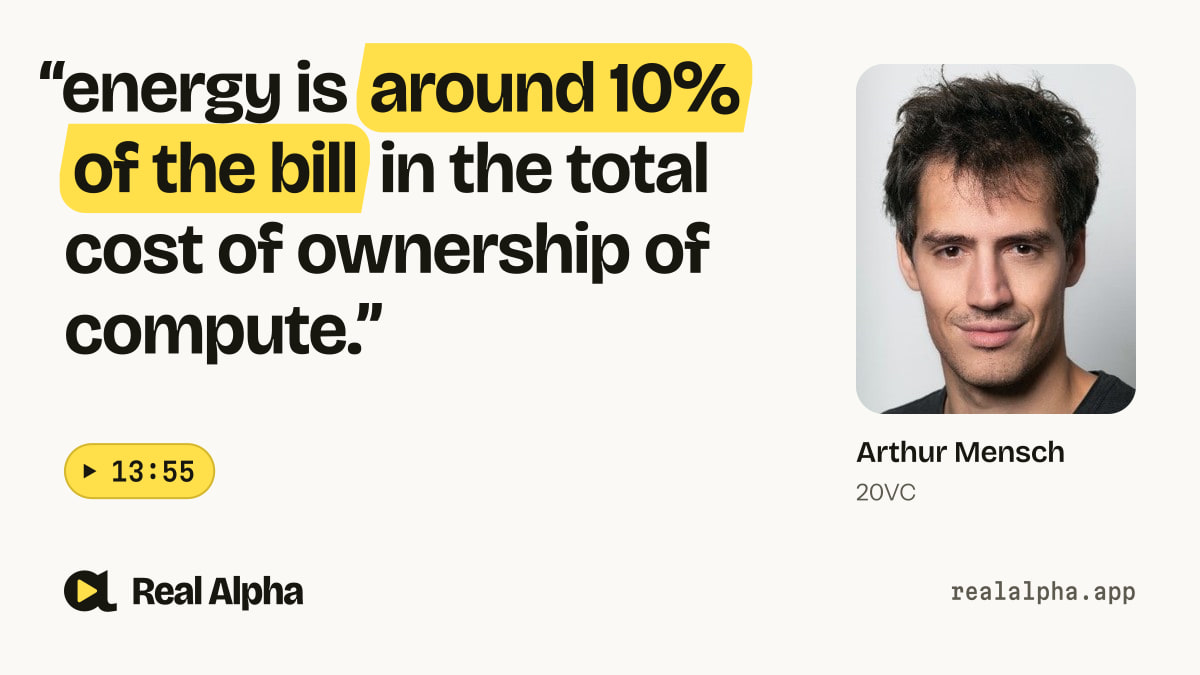
“energy is around 10% of the bill in the total cost of ownership of compute.”
 Arthur Menschat 13:55 · 20VC
Takeaways
- Energy is roughly 10% of compute's total cost of ownership.
- Chip and financing costs dominate the bill today.
- Mensch expects energy constraints to become more pressing around 2029–30.
About this segment
Arthur Mensch estimates energy is about 10% of compute's total cost, with chips and capital dominating today. He expects energy to become a constraint around 2029–30, after Europe uses existing capacity.

Arthur Mensch is co-founder and CEO of Mistral.
Co-founded and leads Paris-based Mistral AI as CEO; named to Time's 100 Most Influential People in AI.

Harry Stebbings, Host · Founder, 20VC
Built a venture firm on his podcast; its third fund closed at $400M.
From “Mistral CEO: Why OpenAI & Anthropic Will Come for Your Business | Are Chinese Models Truly Safe?”, Nov 9, 2026. Watch the full episode
Answers “What will AI look like in the next few years?” See all 395 answers
Answers “Is there enough power for AI?” See all 61 answers
Thanks. We'll look at and fix what's off.
Transcript
Transcribed by machine (Whisper) from the episode’s audio, so a word may be off here and there.
- 14:01
joke. How do you think about Ruminate on the energy supply challenge? Well, I think the first thing to realize is that energy is around 10% of the bill in the total cost of ownership of compute. So we're not talking about the place where we can make most of the optimization. So the cost of energy at the end of the day is not the one thing that matters in the economic of a project. What matters is the cost of the chips and what matters is the cost of capital. This is dominating the bill of material. So it's a problem. It will become more and more of a problem as we deploy more compute in Europe because we'll run into supply constraints. Again, it's not evenly distributed. So if you look at France, for instance, there are excessive energy, so you can build capacity. If you look at Nordics, it's also the case. In the
- 14:43
UK, it's a little less the case. Germany, it's a little less the case. But there is the realization that AI is going to drive energy consumption forward. I would say in the next two or three years, the true fight, the true challenge is to actually make sure that's For Mistral, make sure that we build as fast as possible to use the excess of energy that is already there. And so that is what we are at work doing, raising capital, building more, building the team to build all of this capacity.
- 15:10
There is excess of energy. It's not the bottleneck today. It will become the bottleneck in 29, 2030. But right now, the question is, how can we build on existing energy? Now, we need to think ahead of time in starting in 29, 2030, as multiple gigawatt of capacity are being deployed every year on AI. We do need to ramp up the production. What we are hopeful for is that in France, for instance, there is an enormous EPR program where nuclear energy is going to be produced much more.
- 15:40
You have large efforts on the solar side as well. So it's going to be a problem. It's mostly a coordination problem because if you have demand coming from AI on energy, the business case for building new nuclear plants is pretty well made. It totally is. And I agree with you. I am a big believer in Adam Smith's invisible hand, but the lead time is very real. And so that is just the 29, 20, 30 is a challenge.
- 16:04
Yeah. Nuclear plants take longer than that to build. Solar plants can go faster. And say, I do believe in that invisible hand. The states have to play a role in facilitating the build out, but also in planning ahead of time. They have a longer term vision than enterprises in general. And so we are spending some time, I'm spending some time explaining that the energy demand is going to grow and that it needs to be addressed somehow.
- 16:29
It needs to be part of the business plan of any energy supplier. You said about the cost of chips being important.