The alpha, twice a week
That was 5 min.
Get the best new moments in your inbox every Wednesday and Saturday. It's free.
Check your inbox
We sent a link to your address. Click it to finish signing up. Not there in a minute? Look in spam.
or
20VC · 5 min · Nov 9, 2026
Third-party models offer weaker data guarantees
 Arthur Mensch
 says model safety depends on knowing the training data, while third-party models can only be monitored for suspicious behavior.
In this episode
Full analysis- 3:48Sovereign AI requires control of models, data and compute3 min
- 24:00Customer-facing engineers helped Mistral find its product5 min
- 6:47Third-party models offer weaker data guarantees5 min
- 13:49Energy is not yet the main cost of compute3 min
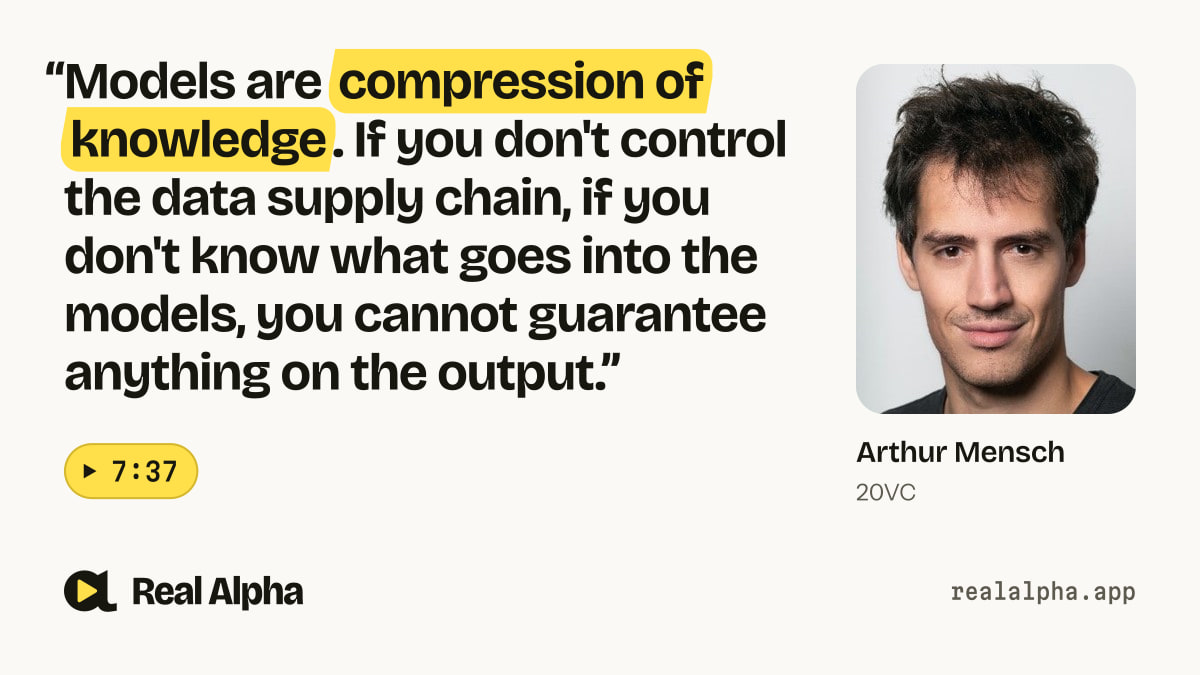
“Models are compression of knowledge. If you don't control the data supply chain, if you don't know what goes into the models, you cannot guarantee anything on the output.”
 Arthur Menschat 7:37 · 20VC
Takeaways
- Third-party models cannot offer the same data-supply guarantees.
- Monitoring can help detect behavior but cannot rule out a supply-chain attack.
- Mistral says about 80% of its token traffic uses its own models.
About this segment
Arthur Mensch says model safety depends on knowing the training data, while third-party models can only be monitored for suspicious behavior. He says about 80% of Mistral's token traffic runs on its own models.

Arthur Mensch is co-founder and CEO of Mistral.
Co-founded and leads Paris-based Mistral AI as CEO; named to Time's 100 Most Influential People in AI.

Harry Stebbings, Host · Founder, 20VC
Built a venture firm on his podcast; its third fund closed at $400M.
From “Mistral CEO: Why OpenAI & Anthropic Will Come for Your Business | Are Chinese Models Truly Safe?”, Nov 9, 2026. Watch the full episode
Thanks. We'll look at and fix what's off.
Transcript
Transcribed by machine (Whisper) from the episode’s audio, so a word may be off here and there.
- 7:00
Well, at Mistral, we have, I mean, one of our businesses to really run the inference for open models. So we run ours, but we also run others. Why do you run others? because customers want choice and when you have infrastructure you want to provide as much choice as possible to saturate the infrastructure that is the reason why that brought us to actually serve more and more of open models because in different domains you may want to pick a different model you may want to pick smaller ones you may want to pick bigger ones so the more choice you have the better usage you can make over the infrastructure the lower your cost can be and it's in a way it's a commodity market so you want the cost to be as low as possible so that's the reason why we sell those models. But what you say is true. Models are compression of knowledge. If you don't control
- 7:55
the data supply chain, if you don't know what goes into the models, you cannot guarantee anything on the output. And so when we serve our models, we can give further guarantees to our customers than when we serve third-party models. Precisely because theoretically, you can make sure that in a certain environment with a certain context, the model behaves in a certain way. There's no way of excluding that. There's no way of measuring that. We can monitor that online. That's what we do. But you can't exclude that it's being used as a vector of attack. I think it is very theoretical because I don't think it's the case today. But on the other hand, this is part of the threat model.
- 8:37
And so our customers, they are asking us to be able to provide them with all of the open-wide models that are available. We're helping them do it in a secured way where we can help them monitor what's going on. But in many cases, they are actually very keen to use our models because we're able to tell them that the data supply chain, everything we've trained them on, is something that we have validated before. What percent of token traffic is your own models versus other open source? I would say around 80% comes from our own models.
- 9:12
Wow. That's a lot more than I thought. Okay. On the 20%, everyone tells me that, Oh my God, American CIOs and CIOs would never use Chinese open source models. And actually that fear really is there. You have them as customers. You have amazing customers. Are they fearful of using Chinese open source models? It depends how critical their industry is in general to governments. If you work with defense, for instance, we work with defense customers in Europe.
- 9:39
They would never use Chinese technology. If you work in the finance sector, again, because it's critical infrastructure, they are very reluctant to do it. If you work in retail, if you work in certain domains of manufacturing, again, it depends where the reluctance is different. Again, I think there is a common understanding that open-weight models, if they are being deployed on sovereign infrastructure like ours, the only valid threat is that they go rogue and have weird behaviors in certain domains because you may have a supply chain attack on it.
- 10:05
There is a common understanding that... This is very theoretical, and it's certainly not the case today, but indeed, it's part of the conversation. I'd say what is also part of the conversation is not this, is it a threat to deploy third-party models that I don't fully understand? What is part of the conversation is, am I going to be able to get updates in six months from now? Because what's going on is models have gotten so strong that they're able to do cyber attacks, that you can use that for pretty much advanced purposes, let's say.
- 10:37
And so the consequence is that they are more and more being treated as defense systems. It's being treated de facto by the U.S. as a defense system because at some point in May, they started to ban them from outside of the U.S. If you look at what China is doing today, they're also looking at ways of restricting exports beyond a certain threshold. The reason for that is that effectively, this is a dual-use technology.
- 10:58
And so as any dual-use technology, security of supply matters even more. And so the companies we work with realize that they need security of supply, not only on the infrastructure side, but also on the model IP side. With that in mind, do you think your OpenAI and your Anthropics withholding their best models is good or bad for society? And is that just an inherent feature that will be prevalent within this industry?