The alpha, twice a week
That was 3 min.
Get the best new moments in your inbox every Wednesday and Saturday. It's free.
Check your inbox
We sent a link to your address. Click it to finish signing up. Not there in a minute? Look in spam.
or
Bloomberg Law · 3 min · Nov 19, 2026
Cutting an immigration appeal step could speed deportations
 Leon Fresco
The proposed rule would let the government bypass the Board of Immigration Appeals in many cases, sending challenges straight to federal court.
In this episode
Full analysis- 9:56Pressure to win can push prosecutors below DOJ standardsPro pick 2 min
- 14:42Warrant rules could constrain ICE’s 3,000-arrests-a-day goal3 min
- 28:27Proposed green card rules could worsen health care shortages3 min
- 3:57DOJ privilege may yield to scrutiny of alleged misconduct4 min
- 18:57Only a few thousand foreign students stay over 10 years6 min
- 25:28Cutting an immigration appeal step could speed deportations3 min
- 7:45A tracker has logged more than 200 challenges to government credibility2 min
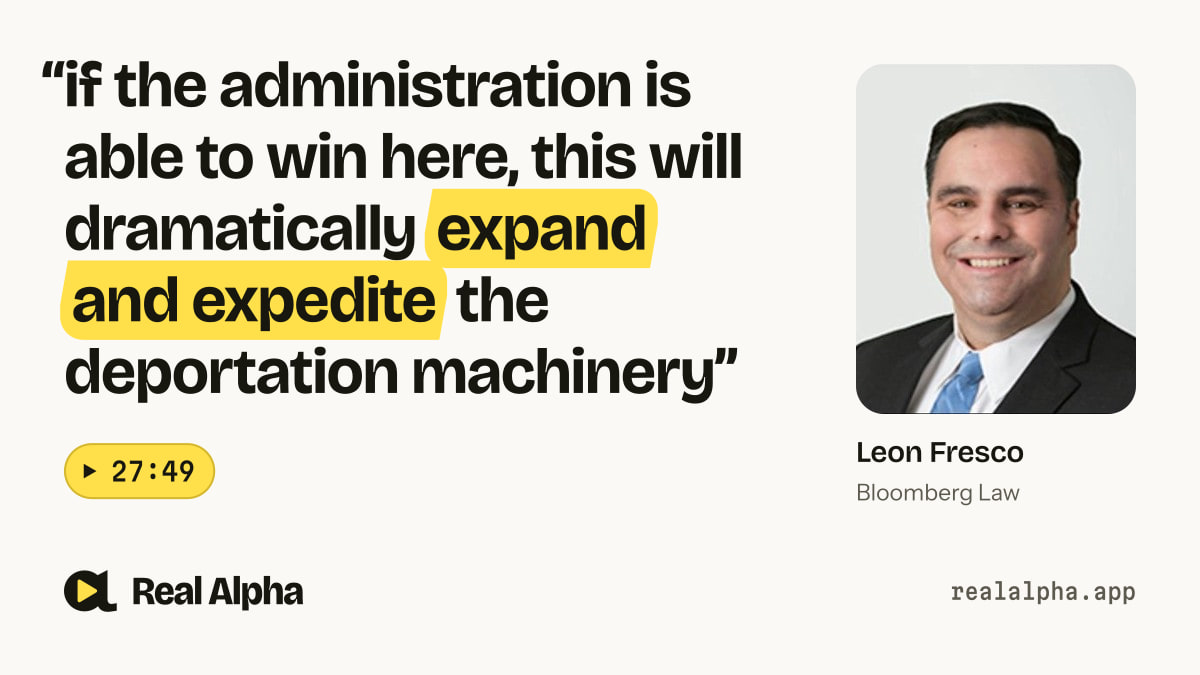
“if the administration is able to win here, this will dramatically expand and expedite the deportation machinery”
 Leon Frescoat 27:49 · Bloomberg Law
Takeaways
- Board appeals can take one to three years to prepare and decide.
- The rule would let the government skip that review in many cases.
- Fresco says the change could accelerate deportations.
About this segment
The proposed rule would let the government bypass the Board of Immigration Appeals in many cases, sending challenges straight to federal court. Leon Fresco says it could remove years of delay and speed deportations.

Partner, Holland & Knight
Drafted the Senate’s 2013 immigration reform bill and oversaw federal civil immigration litigation at DOJ.
- JG
June Grasso, Host
From “Crisis at Chicago US Attorney's Office & ICE Warrantless Arrests | Bloomberg Law”, Nov 19, 2026. Watch the full episode
Thanks. We'll look at and fix what's off.
Transcript
From the transcript Bloomberg Law publishes with the episode.
- 25:30
immigration attorney Leon Fresco of Holland & Knight. The Justice Department's immigration courts are moving forward with a regulation that will make it harder for immigrants to challenge orders against them. I mean, this sounds like something they've done before, but am I wrong? Well, right.
- 25:48
What happened was there was an interim rule and now this is the final rule. And here's what happens. If the government's trying to deport you, there used to be before this rule, two rounds of litigation. There was an immigration judge who would make the ruling and that immigration judge was an employee of the Department of Justice, or continues to be an employee of the Department of Justice, and they operate out of an immigration court, and the immigration courts are located all over the country. And then whoever lost, whether it was the government or the foreign national, they could appeal to an administrative body called the Board of Immigration Appeals, which sits in Northern Virginia at an office building next to a Target. It's the weirdest building of all time, but nevertheless, there's There's other employees of
- 26:35
the Department of Justice who sit right next to this target where they can get their slurpees or whatever they want to get. And they decide the appeals of the immigration courts. What has happened is those cases sometimes have taken one year, two years, three years in order to just get a transcript ready to go, get an appeal record ready to go. get the judges to look at them. It's too many cases. And so the administration has said, let's just skip this. And basically, unless we want to give a review, just say that everybody lost. And then if you want to go to federal court to challenge the decision, you can go directly to federal court. But let's cut one year, two years, three years, whatever it normally takes out of this system. And so when the interim rule came out, immigrants rights group sued in D.C.
- 27:30
and a federal judge blocked the rule and the Department of Justice actually appealed to the D.C. Circuit. But then the party said, look, let's dismiss this appeal and let's challenge the final rule. So now that the final rule is out, we're going to have to see if the litigants will now sue again based on the final rule, whether they will be able to win or not. But if the administration is able to win here, this will dramatically expand and expedite the deportation machinery such that if that's where this administration wants to go in the next two years, it will have a much easier ability to deport people very, very quickly than it used to have.
- 28:11
We'll see how long the litigation itself takes. Finally, let's turn to the Trump administration proposing the first major green