The alpha, twice a week
That was 6 min.
Get the best new moments in your inbox every Wednesday and Saturday. It's free.
Check your inbox
We sent a link to your address. Click it to finish signing up. Not there in a minute? Look in spam.
or
Bloomberg Law · 6 min · Nov 19, 2026
Only a few thousand foreign students stay over 10 years
 Leon Fresco
 estimates that a few thousand of roughly one million foreign students stay beyond 10 years.
In this episode
Full analysis- 9:56Pressure to win can push prosecutors below DOJ standardsPro pick 2 min
- 14:42Warrant rules could constrain ICE’s 3,000-arrests-a-day goal3 min
- 28:27Proposed green card rules could worsen health care shortages3 min
- 3:57DOJ privilege may yield to scrutiny of alleged misconduct4 min
- 18:57Only a few thousand foreign students stay over 10 years6 min
- 25:28Cutting an immigration appeal step could speed deportations3 min
- 7:45A tracker has logged more than 200 challenges to government credibility2 min
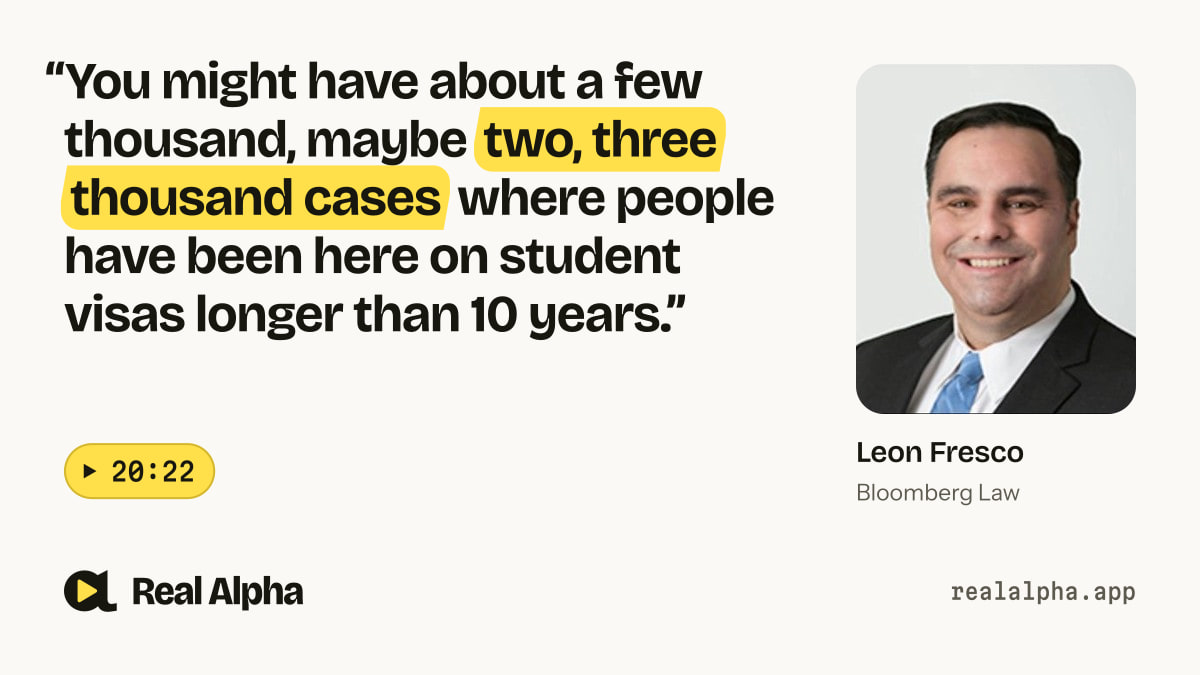
“You might have about a few thousand, maybe two, three thousand cases where people have been here on student visas longer than 10 years.”
 Leon Frescoat 20:22 · Bloomberg Law
Takeaways
- About one million foreign students come to the U.S. each year.
- Fresco estimates a few thousand stay on student visas beyond 10 years.
- The proposed cap would require government approval to stay longer than four years.
About this segment
Leon Fresco estimates that a few thousand of roughly one million foreign students stay beyond 10 years. He explains the proposed four-year cap and why he expects it could survive Supreme Court review.

Partner, Holland & Knight
Drafted the Senate’s 2013 immigration reform bill and oversaw federal civil immigration litigation at DOJ.
- JG
June Grasso, Host
From “Crisis at Chicago US Attorney's Office & ICE Warrantless Arrests | Bloomberg Law”, Nov 19, 2026. Watch the full episode
Thanks. We'll look at and fix what's off.
Transcript
From the transcript Bloomberg Law publishes with the episode.
- 19:00
and the colleges and universities that they attend. A federal judge set aside new Trump administration restrictions on foreign students' admission to the U.S. So this is about a new DHS rule that would limit students to four years in the country. Tell us about the DHS regulations. You talked once before about how students can come to this country and stay here for years and years and years. They go from one degree to the next.
- 19:32
Correct. If you're a foreign student at the moment, you get a visa for one program, whatever that program is. You're coming to study at a high school or at a college or at a master's degree program or a PhD program, whatever it is. But once you're here, you're allowed to transfer students You're allowed to change programs. You're allowed to graduate and go to a new program. You don't ever have to ask anyone in the government for permission to do any of those things. You're allowed to move from one approved program to another approved program. And that's it.
- 20:06
As long as one school lets you in and gives you the paperwork that you need, the government doesn't have to approve any of these moves. And so the Trump administration became very concerned about that because there are outlier cases. I would say there's about a million foreign students a year. You might have about a few thousand, maybe two, three thousand cases where people have been here on student visas longer than 10 years. just transferring from one program to another.
- 20:36
And they're essentially using the student visa program to camp out in the United States. And so the Trump administration tried to implement a regulation ending this thing, which is known as duration of status, that you can stay here as long as you maintain the status of a student. and capping it at four years, and then saying that if you want to be here longer than four years, you have to reapply for approval to the United States government, to the Department of Homeland Security, and tell them, what are you doing? Are you getting a higher degree? Are you moving from college to master's? Are you moving from master's to PhD? Whatever it is. And they're certainly allowed to approve it, but you have to check in and you have to get an approval. Well, A bunch of the presidents of different universities filed a lawsuit in the
- 21:24
District Court of Massachusetts, and just earlier this week, the District Court of Massachusetts ruled on a permanent injunction, summary judgment, vacator of the rule, has said this rule is illegal, the one that the federal government has just drafted, trying to replace the system that allows you to keep changing universities to this four-year cap. The court says that the Department of Homeland Security didn't properly weigh the costs and the benefits of doing this new rule and that its concerns about fraud and national security didn't support the rule because what they should just do is use the current database to track students in a better way to make sure that there aren't students that are committing fraud. And also they're saying that Some programs are just longer than four years. So by limiting them to four years, the
- 22:15
rule isn't reasonably related to allowing a person to have the program for the length of time that it's supposed to be.
- 22:23
Leon, I'm sure this ruling is going to be appealed by the Department of Homeland Security. The Trump administration always appeals when they lose. What do you think will happen on appeal?
- 22:36
So I think the First Circuit will probably agree because the First Circuit has been the choice of plaintiffs now because the First Circuit doesn't have any Trump-appointed judges. So people used to file in the Ninth Circuit against President Trump. Now they don't. Now they file in the First Circuit because the Ninth Circuit has become a much more balanced court in terms of Trump appointees versus Democratic appointees. But They file in the First Circuit and the First Circuit usually upholds these decisions by the lower courts in the First Circuit, whether they're in Massachusetts or Rhode Island or wherever.
- 23:11
And then we're going to have to see if the Supreme Court. I think the Supreme Court in these student visa cases has been very, very deferential to the administration. There was a case recently in the Biden administration about whether students could work after receiving a student visa, whether they could work still on their student visa status. And the challengers that said that's ridiculous, that makes a mockery of the statute that you could work on a student visa.
- 23:41
And the Biden administration position was, look, we have very broad regulatory power as to what students can and can't do. And the Supreme Court agreed. And so it's very hard to think that the Supreme Court wouldn't agree here, too, that the Trump administration would have broad authority to regulate how students come here and for how long and what can they do. But we'll have to wait and see.
- 24:02
I mean, I have to say that it doesn't sound unreasonable to want students to check in after four years. I mean, it doesn't sound like some of the other regulations that the Trump administration has put forward in immigration seem on their face to be ridiculous, this doesn't seem that way.
- 24:20
Correct. Of the many rules that have been established, this is one of the stronger ones. It's also one of the ones that they didn't rush through. They took a year and a half to really look at all the comments and respond to them. And I do think at the end of the day, probably the Supreme Court will affirm the rule, but it's just a matter of how long it's taking. And the administration is not moving this on a fast track. They're moving it on a slow track because they don't want to go back and forth in terms of having the rule affirmed and then taken away and then affirmed and then taken away because there's a whole infrastructure of how you track students that would have to be changed depending on which rule applies and you can't really go back and forth. That creates massive chaos because some students will be under the old system
- 25:07
and some will be on the new system and nobody will know what their exact amount of time is that they can be in the country for. So you have to do this very clearly and I think They will only want to implement this rule after the Supreme Court has their say here.