The alpha, twice a week
That was 3 min.
Get the best new moments in your inbox every Wednesday and Saturday. It's free.
Check your inbox
We sent a link to your address. Click it to finish signing up. Not there in a minute? Look in spam.
or
Latent Space · 3 min · Nov 10, 2026
Domain Connect turns DNS setup into an OAuth-style flow
 Zeno Rocha
Resend adopted Domain Connect so customers could authorize DNS changes instead of copying records by hand.
In this episode
Full analysis- 7:01Email delivery depends on pacing and reputationPro pick 5 min
- 38:02An MCP should cover the whole product6 min
- 58:26Markdown pages can correct AI pricing answers7 min
- 32:23SES's low price can hide the surrounding infrastructure cost4 min
- 13:24Shared tracking domains expose senders to a neighbor's abuse3 min
- 17:19Support replies became documentation before they reached customers2 min
- 19:55Domain Connect turns DNS setup into an OAuth-style flow3 min
- 23:51React Email gave Resend a path from templates to sending3 min
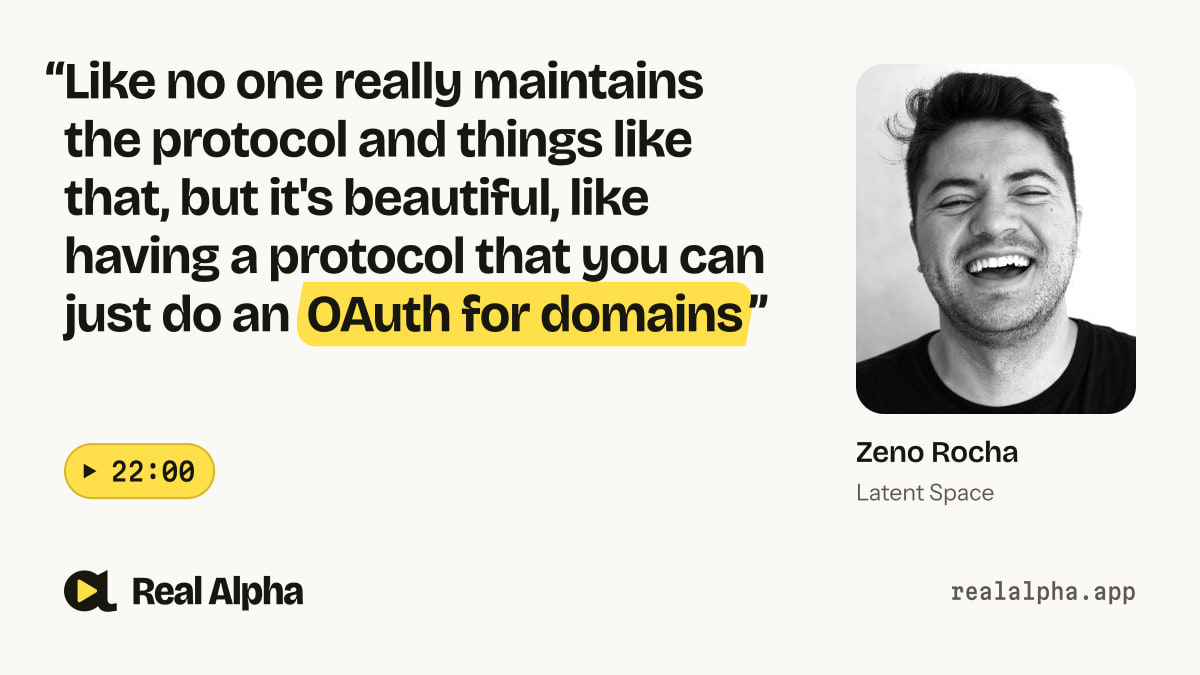
“Like no one really maintains the protocol and things like that, but it's beautiful, like having a protocol that you can just do an OAuth for domains”
 Zeno Rochaat 22:00 · Latent Space
Takeaways
- DNS setup is a major support burden for new users.
- Domain Connect lets users authorize DNS changes in a few steps.
- Resend helped recruit DNS and service providers to the protocol.
About this segment
Resend adopted Domain Connect so customers could authorize DNS changes instead of copying records by hand. The team helped recruit providers such as Vercel, though protocol maintenance remains uneven.

Zeno Rocha is cofounder and CEO of Resend.
Co-founded Resend, an email platform for developers, and launched React Email, open-source components for building email templates.

Shawn Wang (swyx), Host · Co-founder, AI Engineer
Wrote “The Rise of the AI Engineer” and founded Smol AI, maker of AI News.

Alessio Fanelli, Host · Founder, Kernel Labs
Partner at Decibel, backing technical founders who build developer tools.
From “Designing for Agents — Zeno Rocha, Resend”, Nov 10, 2026. Watch the full episode
Thanks. We'll look at and fix what's off.
Transcript
From the transcript Latent Space publishes with the episode.
- 20:00
I think right now is much better. The... There are few things where, man, there's, there's so much friction. DNS, oh my gosh. Like that's- It's always DNS. [laughs] Oh, it's always DNS, right? Like the majority of the questions we get today is just like people not able to set that up. And it's fascinating because we're serving a new audience, right? It's an audience that doesn't even know how to troubleshoot.
- 20:25
Like I remember, uh, last year when Lovable came and Bolt and V0, I could tell these are different users. The-- Like they don't know when they have a problem, they are stuck. They don't know how to go past that. And with DNS, that was always the case of like, yeah, they just simply don't know what is a CNAME, what is an A record, TXT, where do I put those things? So they, they would paste- Yeah...
- 20:49
the wrong value or silly things. By the way, right now I use computer use like Codex or CloudCode, uh, and it just completely manages my DNS records. It's great. [laughs] It's beautiful, right? It debugs it, it like digs, you know, and tries all the DNS stuff. Yeah. Like I don't have to worry about it. [laughs] Yeah. One, one thing that we did, like I found this super obscure protocol that like very few people in the industry were like investing on. It's called Domain Connect. And it's super interesting, by the way.
- 21:18
And it's something that started like from some domain providers and it- Oh. Uh, yeah, yeah, yeah, yeah. This is like the OAuth for domains, right? Exactly that. I... Yeah. This is like Cloudflare oriented? Yeah. So some people have, like Cloudflare is there. Ver- Then we, we convinced Vercel to be there as well, and we started like getting more people. So you have the, the two sides, right? The DNS providers, the service providers. Uh, we are the service providers, for example, and then the DNS providers are implementing. But it's a crazy, crazy industry.
- 21:51
Like GoDaddy charges like just a lot of money for that. It's so weird. Like Ionos, it took us, like the, uh, first one, it took us like months to get after that person to- Yeah. Like no one really maintains the protocol and things like that, but it's beautiful, like having a protocol that you can just do an OAuth for domains is- Yeah, yeah... amazing. So, so for listeners, if you're not familiar, if you haven't tried it, something like that, uh, it's literally like you do use Plaid or use like OAuth. Mm-hmm. You j- only click buttons. You don't type in anything.
- 22:23
Mm-hmm. You-- There's nothing to get wrong. You basically just like sign in as long as you trust this thing called Domain Connect, which- Yeah... you have confirmed that it is legit. Mm-hmm. Then like it's trusted. I, I literally, I, I used it for the first time like two weeks ago. I was like, "What is this? I've never seen this before." [laughs] Yeah. Yeah. Um, so it's really cool.