The alpha, twice a week
That was 4 min.
Get the best new moments in your inbox every Wednesday and Saturday. It's free.
Check your inbox
We sent a link to your address. Click it to finish signing up. Not there in a minute? Look in spam.
or
Training Data · 4 min · Jan 14, 2025
Enterprise AI buyers want control when they move to deployment
 Ion Stoica
 says few enterprises pretrain, while many fine-tune on proprietary business data and deploy in their own VPC.
In this episode
Full analysis- 25:20Databricks bet on Spark partnerships, even with competitors4 min
- 39:28New systems put researchers close to the next problems6 min
- 45:02AI needs software for heterogeneous hardware and autonomy4 min
- 20:05Databricks found its first users needed data engineering first5 min
- 49:25AI research has lost its academia-government-industry partnership4 min
- 9:23Enterprise AI buyers want control when they move to deployment4 min
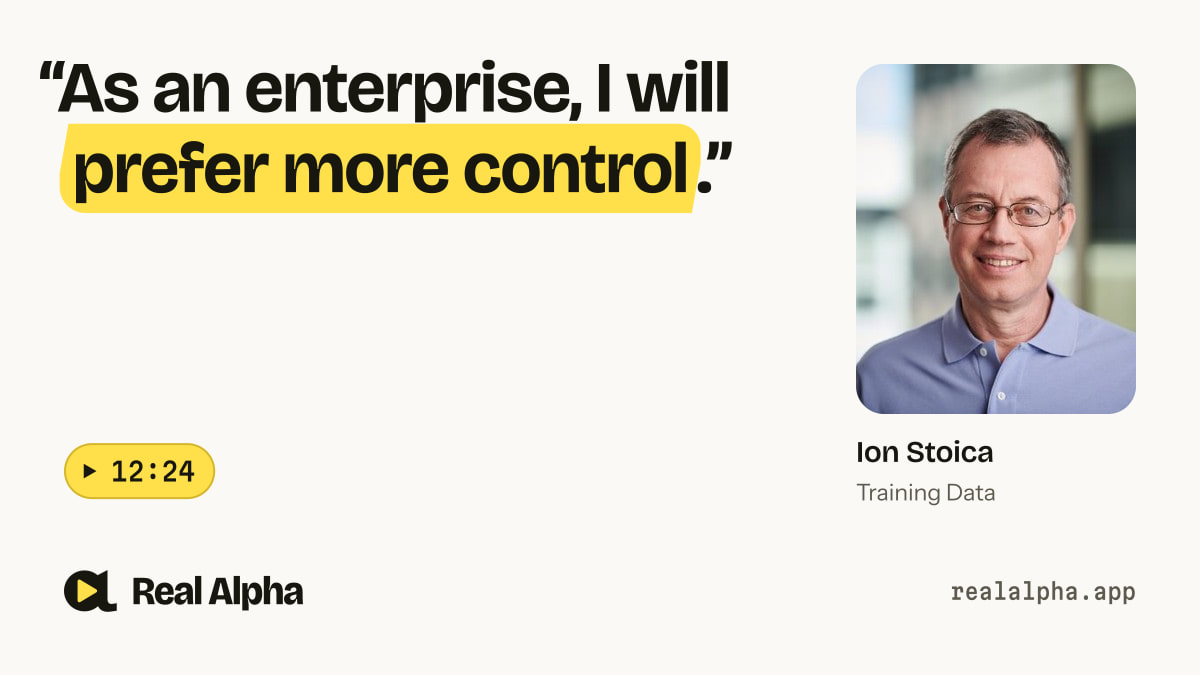
“As an enterprise, I will prefer more control.”
 Ion Stoicaat 12:24 · Training Data
Takeaways
- Most enterprise customers do not need to pretrain from scratch.
- Their proprietary business data is a differentiator.
- Private deployment offers control over security and user data.
About this segment
Ion Stoica says few enterprises pretrain, while many fine-tune on proprietary business data and deploy in their own VPC. For founders, control and privacy become central once a use case is ready to scale.

Ion Stoica is a professor of computer science at UC Berkeley, cofounder of Databricks and Anyscale.
Built Apache Spark and Ray, co-founded Databricks and Anyscale, and helped launch Chatbot Arena for evaluating language models.
- SZ
Stephanie Zhan, Host · Sequoia Capital

Sonya Huang, Host · Partner, Sequoia Capital
Works with OpenAI and Anthropic; co-wrote Sequoia's essay on generative AI.
From “Turning Academic Open Source into Startup Success ft Databricks Founder Ion Stoica”, Jan 14, 2025. Watch the full episode
Thanks. We'll look at and fix what's off.
Transcript
Transcribed by machine (Whisper) from the episode’s audio, so a word may be off here and there.
- 9:25
And, you know, are most of your enterprise customers looking to train their own models? And how does, you know, how does Mosaic and your other acquisitions fit in with your customer needs? Yeah. So I think there are, it's like, there are a few enterprises who would like, so it's again, it's pre-training. And then it's fine-tuning and using the model on your own hardware, in your own VPC, on your own machines, you know, you rent it your own.
- 10:01
So as you may expect, there are a few which are doing pre-training, but there are still a few doing want to pre-training on their data, have enough data. A lot of them, they want to do fine-tuning, right? Because, look, if you are an enterprise, right, and a company, right, and you want to improve your business, right, what do you have? What do you have and which others don't? The thing you have which others don't is the data, the data about your business, about your users, right?
- 10:32
Right. So, therefore, because this is something you have and others do not, you want to take advantage of that, right? So how do you take advantage of that? Again, there are many ways and you try different ways to do it, right? One is about fine-tuning user data and you have an open source model, you fine-tune on that, right? The other one to use a rack, right? And things like that. And so you are going to do any of those, but then you want to do, like I said, in your own VPC, right? To preserve security, to have you know 10 for security perimeter perimeter you want to do it in order to protect confidentiality of your users and obviously right now with gdpr the california consumer privacy act and so forth they're all of regulation and the number of regulation is going to increase so the the fact that you can of having an open source models you can fine tune you can use this drag
- 11:38
in your own VPC, it's a very compelling value proposition. And are you finding that most of your customers want to go that approach versus, you know, OpenAI and the very powerful closed source models in the market? I think enterprises, and still we are still early on, and there are many enterprises obviously using OpenAI for different use cases, different applications. And I'm sure OpenAI and Microsoft Azure will come with new products to provide better confidentiality, better security.
- 12:19
But at the end of the day, what I was saying is that everything being equal, right? As an enterprise, I will prefer more control. security and strategic, right? It's like it's less kind of locking or things like that, right? So I think that's what we are saying. So if as open source models are going to catch up with the proprietary models, in particular in the use cases which matter for the enterprises, it doesn't need to be, you know, perfect, right, for all the particular use cases, you just need to be very competitive where it matters, then, you know, enterprises will prefer these solutions on which they have, you know, more control and more secure.
- 13:15
And how far away do you think we are from that moment? Like, do you think we're there today where all else is equal? Or when do you think we crossed that threshold? In terms of the open source versus proprietary?