The alpha, twice a week
That was 3 min.
Get the best new moments in your inbox every Wednesday and Saturday. It's free.
Check your inbox
We sent a link to your address. Click it to finish signing up. Not there in a minute? Look in spam.
or
Bloomberg Surveillance · 3 min · Oct 30, 2026
Europe needs AI investment to address its productivity gap
 Richard Portes
 says Europe’s productivity gap needs more than central-bank action.
In this episode
Full analysis- 1:00AI debt is running into limits on market capacity2 min
- 8:36AI spending creates risks for markets and the Fed7 min
- 25:50Affordability needs structural fixes, not quick promisesPro pick 4 min
- 18:12Europe needs AI investment to address its productivity gap3 min
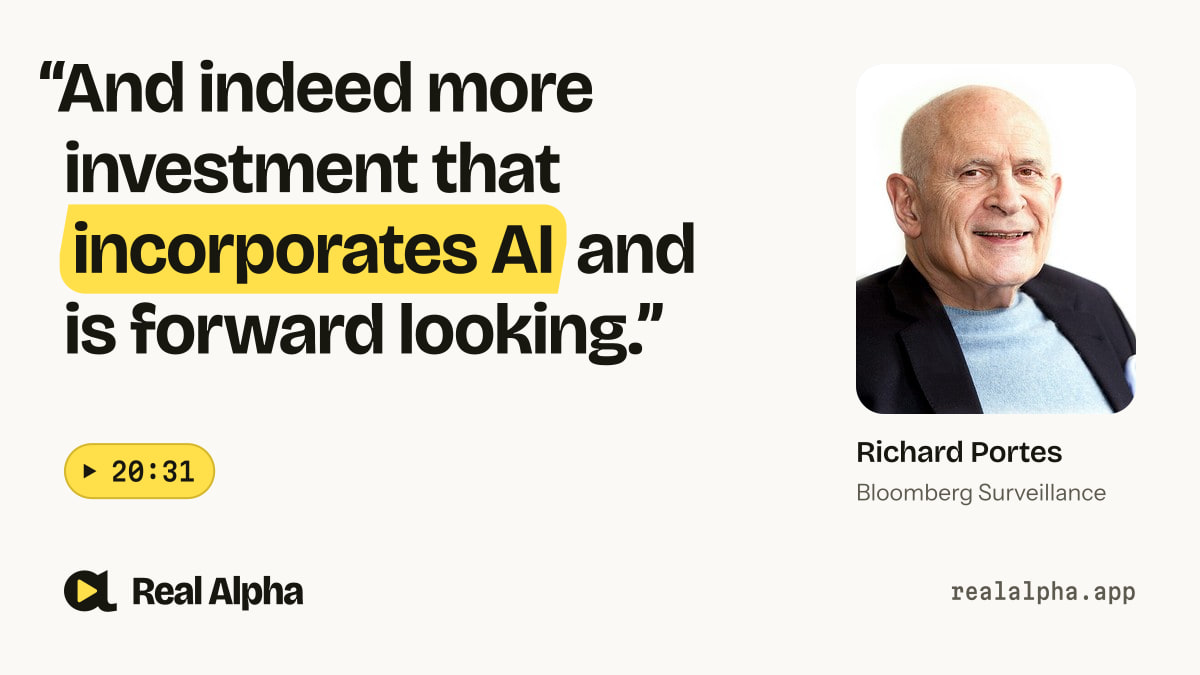
“And indeed more investment that incorporates AI and is forward looking.”
 Richard Portesat 20:31 · Bloomberg Surveillance
Takeaways
- Europe’s productivity problem calls for measures beyond monetary policy.
- Portes says more investment should incorporate AI and look ahead.
- He cites tech activity in Sweden, Finland and France.
About this segment
Richard Portes says Europe’s productivity gap needs more than central-bank action. He points to AI investment and tech hubs in Sweden, Finland and France as priorities.

Professor, London Business School
Founded CEPR and advanced research on international macroeconomics, sovereign debt and European financial markets.
- TK
Tom Keene, Host
- PS
Paul Sweeney, Host
From “Markets Price in Tech Spending and Midterm Elections | Bloomberg Surveillance”, Oct 30, 2026. Watch the full episode
Thanks. We'll look at and fix what's off.
Transcript
From the transcript Bloomberg Surveillance publishes with the episode.
- 18:14
Professor, for our listeners, for our viewers, can you give us kind of your overview of just where the European economy is today? What are some of the challenges here that the EU is dealing with at the moment?
- 18:31
Well, there is the productivity issue. It's a longstanding issue. And productivity growth in the European Union is not as high as it has been in the United States. And that requires measures that central bank has no role in. Otherwise, Europe is hit much harder than the United States by the price of oil we import here. And I'm talking about the UK as well as the European Union.
- 19:06
We import a very substantial amount of our oil. And that has hit so that there are problems there.
- 19:18
Otherwise, there is the usual stuff, as I say, what's happening to productivity.
- 19:24
And it's not a positive verdict, I'm afraid. And that requires a lot of policy measures that governments have been reluctant to take when it's a matter of governments, and that the European Commission has not been particularly aggressive about. So I think there's, are significant problems here.
- 19:55
Professor, is there any sense, just Across Europe in general, I mean, as we morph into this AI-driven economy and technology becomes more and more a part of daily life, is there a sense within Europe that, boy, we need to improve our productivity to solve some of our challenges here? Because it can't just be the state day in and day out bailing folks out.
- 20:21
No, I don't think there's any expectation that the state will bail everybody out or actually contribute significantly to an acceleration of growth. What you need is more investment. And indeed more investment that incorporates AI and is forward looking.
- 20:40
There are some signs, you know, there are some. Areas in Europe which are where innovation is Innovation proceeds very, very well. You have a number of unicorns in Sweden, for example, and I think as well in Finland, where you have tech-based. Activities. You have Mistral in France. But if you look around, there's not enough of that. And that's where the priority should be.