The alpha, twice a week
That was 3 min.
Get the best new moments in your inbox every Wednesday and Saturday. It's free.
Check your inbox
We sent a link to your address. Click it to finish signing up. Not there in a minute? Look in spam.
or
Zero: The Climate Race · 3 min · Oct 29, 2026
European utilities are widening their definition of resilience
 Kristian Ruby
 describes visiting a Ukrainian power plant that had been struck repeatedly, then lays out the risks utilities now plan for.
In this episode
Full analysis- 6:17A diverse power mix can keep European electricity prices low4 min
- 10:48Battery growth depends on better markets for grid servicesPro pick 3 min
- 22:04Efficient electrification can make demand growth look slow2 min
- 17:35Reliable power can attract investment and speed construction3 min
- 14:01European utilities are widening their definition of resilience3 min
- 24:08Heat pump economics vary by temperature and scale2 min
- 26:22Brussels may settle key energy deals before political shifts3 min
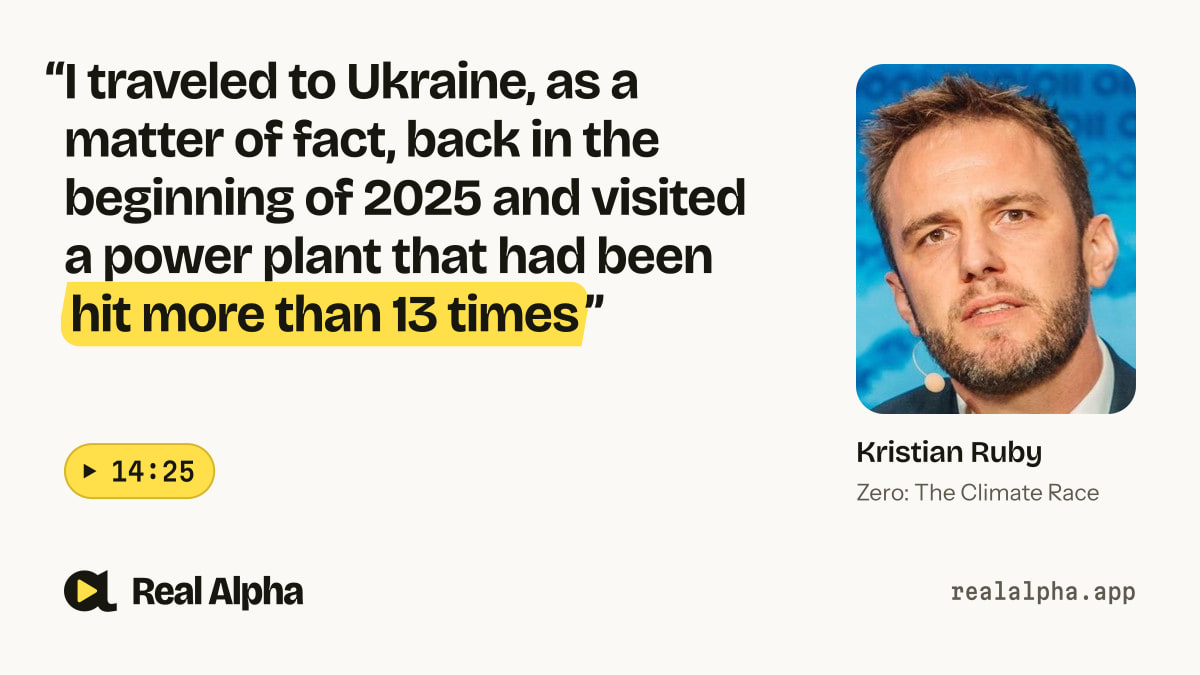
“I traveled to Ukraine, as a matter of fact, back in the beginning of 2025 and visited a power plant that had been hit more than 13 times”
 Kristian Rubyat 14:25 · Zero: The Climate Race
Takeaways
- A plant Ruby visited in Ukraine had been hit more than 13 times.
- Utilities are preparing for both kinetic and cyber attacks.
- Extreme weather remains a leading source of economic impact.
About this segment
Kristian Ruby describes visiting a Ukrainian power plant that had been struck repeatedly, then lays out the risks utilities now plan for. The list includes physical attacks, cyber threats, supply chains and extreme weather.

Kristian Ruby is a secretary general of Eurelectric.
Leads Eurelectric, the federation representing more than 3,500 European utilities across power generation, distribution and supply.
- AR
Akshat Rathi, Host · Reporter, Bloomberg
From “The big questions over European electrification | Zero: The Climate Race”, Oct 29, 2026. Watch the full episode
Thanks. We'll look at and fix what's off.
Transcript
From the transcript Zero: The Climate Race publishes with the episode.
- 14:04
Well, I want to talk about resilience and maybe we start with the sort of cyber attack or even physical attacks as Ukraine has been dealing with a lot of attacks on their energy assets, on power plants. What can Europe do to manage those? Because those are now becoming more and more frequent and it really doesn't matter how far you might be from your enemy anymore.
- 14:28
Indeed. I traveled to Ukraine, as a matter of fact, back in the beginning of 2025 and visited a power plant that had been hit more than 13 times by direct sort of missiles or drone attacks. So there's a real sort of kinetic reality with sort of military attacks on utility assets. And unfortunately, we are seeing sabotage, kinetic attacks on infrastructure beyond Ukraine as well. Our assessment is that we are not yet there where we need to sort of prepare for a full sort of Ukraine scenario, but we need to learn from them when it comes to the way we deal with this type of attacks, the way we prepare for them, the way we respond and the way we rebuild. We are currently in the sector in a situation where there's a completely different mindset emerging around preparedness, around risk assessment, around security. And the
- 15:28
whole equation around security, which used to be a little bit of a sort of sideshow to greening the system, is now becoming very, very central for all operators because the threat landscape has become much more complex, much more immediate and urgent. The way we think of it in big terms is in terms of kinetic attacks, which is now something that everybody needs to deal with. It is cyber attacks. It is supply chain. It is also very much readiness for extreme weather, which continues to be the leading, if you will, source of economic impact on our system.
- 16:09
So in essence, it's really a much broader equation that we need to deal with. And from a political point of view, we need an updated security strategy, which we are expecting from Europe very soon. one that puts electricity at the center of the new energy system and essentially defines the way we need to operate such a system and make it ready and resilient for a much more complex future.