The alpha, twice a week
That was 2 min.
Get the best new moments in your inbox every Wednesday and Saturday. It's free.
Check your inbox
We sent a link to your address. Click it to finish signing up. Not there in a minute? Look in spam.
or
MTS · 2 min · Nov 20, 2026
FedEx used AI to structure campaign requests
 Arnab Bose
A FedEx team found its campaign bottleneck in unstructured requests, then used AI to turn longer descriptions into projects and tasks.
In this episode
Full analysis- 1:14Enterprise AI delivers gains when it coordinates full workflows3 min
- 3:46Organizational alignment is the AI bottleneck3 min
- 11:15Self-driving organizations could arrive by 2027Pro pick 4 min
- 8:51FedEx used AI to structure campaign requests2 min
- 14:37Asana plans to grow R&D as AI expands its ambitions3 min
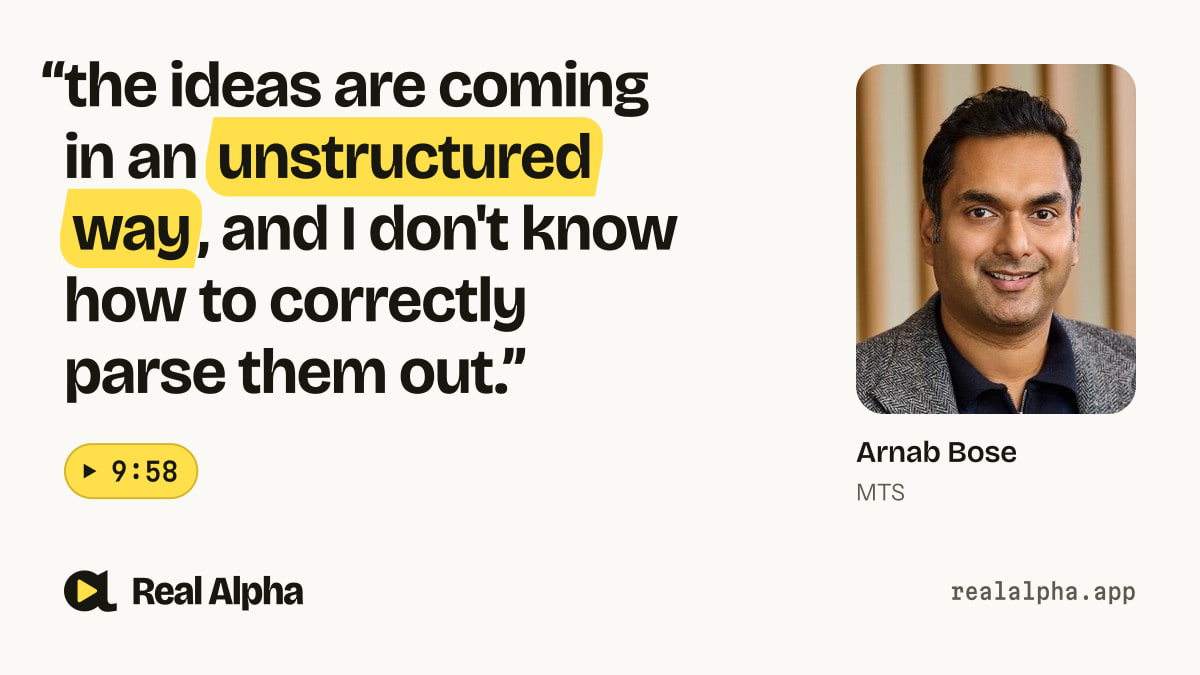
“the ideas are coming in an unstructured way, and I don't know how to correctly parse them out.”
 Arnab Boseat 9:58 · MTS
Takeaways
- Set the key result before redesigning the workflow.
- FedEx used AI to turn free-form campaign requests into tasks.
- Find the intake bottleneck, then iterate on it.
About this segment
A FedEx team found its campaign bottleneck in unstructured requests, then used AI to turn longer descriptions into projects and tasks. Arnab Bose says to start with the outcome and improve the process where work stalls.

Arnab Bose is chief product officer at Asana.
Built enterprise products reaching billions of users, and leads Asana’s product strategy with a focus on AI.

Theo Jaffee, Host · Co-founder & host, MTS
One of the first members of a16z's new media team; earlier hosted the Emergent Ventures-backed Theo Jaffee Podcast.

Sophia Dew, Host · Host, MTS
From “Self-Driving Enterprises Will Happen in 2027 | Arnab Bose”, Nov 20, 2026. Watch the full episode
Thanks. We'll look at and fix what's off.
Transcript
Transcribed by machine (Whisper) from the episode’s audio, so a word may be off here and there.
- 8:57
How, from just maybe a macro perspective, how have you seen companies and teams become smarter recently? So let's take a look at one of these examples like FedEx. So again, like this, there was a process that we're using to go ahead and run their marketing operations and launch campaigns. The process involved like aligning on the campaign, talking about it with a team of human beings and setting it into process by codifying who does what in Asana. Now, the big challenges were getting intake from the sales or other teams who were downstream of them who wanted them to run the campaigns in a format that would make it easy for them to then get that alignment.
- 9:40
So when you start codifying these systems and you think about your workflow and how do you make that business-critical workflow work, you actually drive yourself further up to the top of the pyramid of clarity, right? You ask yourself the question about, what do I really want to drive over here? Maybe what my key result is, is reducing the time from idea to the campaign launching. And the bottleneck I'm facing right now is that the ideas are coming in an unstructured way, and I don't know how to correctly parse them out.
- 10:10
So the thing that they did was they really focused on their intake process and how would they leverage AI to take a longer form content that wasn't just a form, was something where the person requesting it could be more detailed in their description. And AI would help them split that up into the right projects and tasks, et cetera, to get them going. It's a fairly simple use case. There's way more complicated ones that we've encountered where people are designing like manufacturing processes for complex, like suspension parts for German automobiles. Like there's a customer of ours called KW Automotive who does that. They're a supplier. Those get into like hundreds and thousands of different sub projects and streams. But the macro concept is the same in terms of efficiency. Like thinking about the outcome helps them find the real
- 10:56
bottleneck and then iterate on it and hill climb and get better as a group. Yeah, no, I love that