The alpha, twice a week
That was 5 min.
Get the best new moments in your inbox every Wednesday and Saturday. It's free.
Check your inbox
We sent a link to your address. Click it to finish signing up. Not there in a minute? Look in spam.
or
Unsupervised Learning · 5 min · Jun 17, 2025
Free model access cost LMArena close to $2 million
 Ion Stoica
 says free access to powerful models cost close to $2 million over a year, with credits and grants offsetting some expense.
In this episode
Full analysis- 13:43LLM judges have biases that need to be measured4 min
- 18:52China's open-source advantage comes from collaboration5 min
- 30:00AI infrastructure must handle hardware diversity and rapid changePro pick 6 min
- 1:02Vicuna's launch exposed the limits of static evaluations6 min
- 9:08Free model access cost LMArena close to $2 million5 min
- 27:07AI data centers are likely to be overbuilt3 min
- 42:25AI advances fastest when results have ground truth6 min
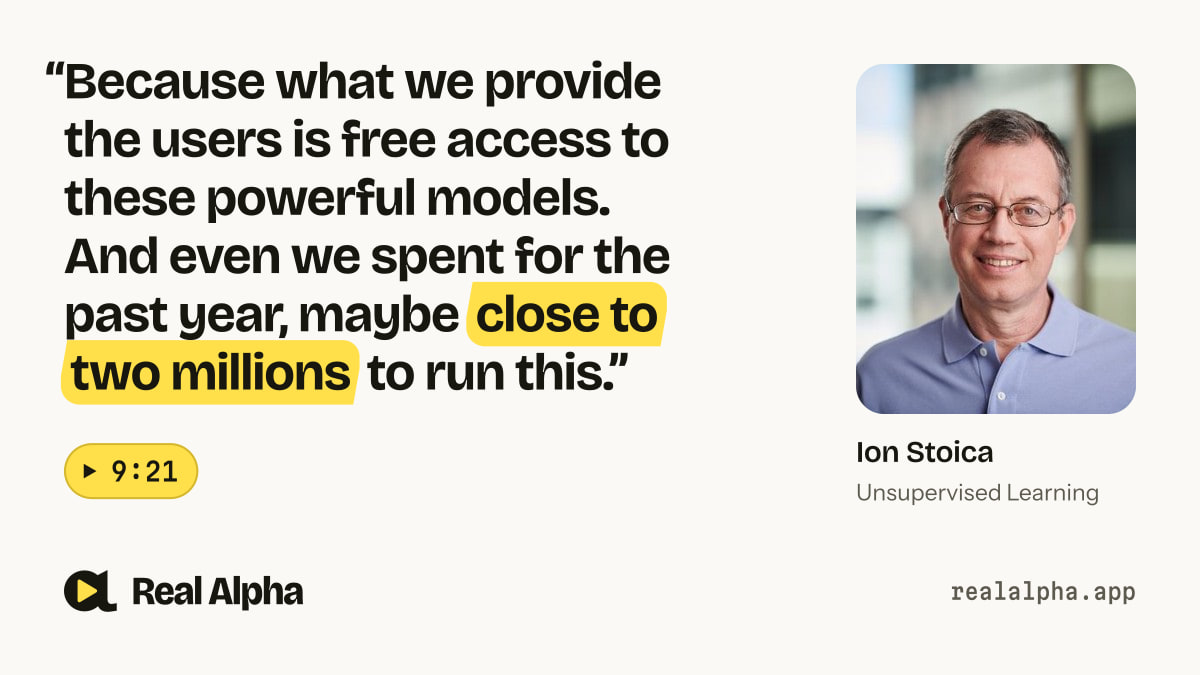
“Because what we provide the users is free access to these powerful models. And even we spent for the past year, maybe close to two millions to run this.”
 Ion Stoicaat 9:21 · Unsupervised Learning
Takeaways
- Free model access cost close to $2 million in a year.
- Credits, gifts and grants covered part of the bill.
- Scaling evaluations required a larger backend and product team.
About this segment
Ion Stoica says free access to powerful models cost close to $2 million over a year, with credits and grants offsetting some expense. Scaling evaluations also required a larger backend and product team.

Ion Stoica is cofounder of Databricks and Anyscale; LMArena founder and Berkeley professor.
Built Apache Spark and Ray, co-founded Databricks and Anyscale, and helped launch Chatbot Arena for evaluating language models.

Jacob Effron, Host · Managing director, Redpoint Ventures
Growth investor in Abridge, Ramp and Physical Intelligence; ex-Flatiron Health.
From “Databricks Co-Founder: Eval Limitations, Why China is Winning Open Source and Future of AI Infra”, Jun 17, 2025. Watch the full episode
Thanks. We'll look at and fix what's off.
Transcript
Transcribed by machine (Whisper) from the episode’s audio, so a word may be off here and there.
- 9:14
You know, that's kind of exciting, and there are many other questions. You know, when you start realizing there is a potential here, so first of all, it did a company because there is no way to scale what we are doing. It's costly. Because what we provide the users is free access to these powerful models. And even we spent for the past year, maybe close to two millions to run this. Of course, a lot of money comes in terms of credits, in terms of some gifts, grants, things like that.
- 9:52
But if you think about right now, you know, want to scale 10x or something like that, it's clearly it's a lot of, you know, it's not going to be cheap. The other thing it is was that, like I mentioned to you, it's a lot of request to do more of kind of evaluations. Right now you have agents and you have all of this. We have a search now, you know, the search engines, not the search, you know, yeah, like perplexity and OpenAI search and things like that.
- 10:26
And then you need to build really a scalable backend and you need to build something new, you know, a much more responsive UI, UX, you know, all of these things. Right. You know, there is no way you can do that with a few people. and then you have a model and other providers and other people both open source and proprietary asking for evaluations right and there is no way you know you have a student basically you know he's like doing that he's a back end so all of these things and then you see that again once you have this kind of data there are a lot of questions you can answer, right?
- 11:10
Like I mentioned, prompt leaderboard, maybe you can answer questions about which many people have. I build my application on a particular model and now I want to swap the model. You know, maybe it's a new one, it's available, maybe something cheaper, but what will be the impact of swapping the model on my application? Many, many of these questions. And then, but what convinced me about its potential here and us in general, maybe not only me, is that if you look at AI, I think that one of the main challenges today with AI, it's reliability, right?
- 11:53
That's a key question and it's very hard to see how AI will really achieve its potential. without figuring out how to build more reliable application, right? Now, if you look about software, a lot of things we do, it's about reliability, right? It's actually most of the energy we put in software development is about reliability because it doesn't take a lot of time to write the code to provide a feature or a service, but you spend a lot of more time in order to test it, debug it, and so forth.
- 12:29
and there's a lot of innovation there. You have a CICD all of these things. And that in some sense is an easier problem because the software is pretty white box. This is the instruction, you change the instruction, you can see what is the state of the program after each instruction. If you don't use a debugger you can do printf and things like that. But models are more black box. So if you look at the analogy and we still want reliable application and because even if you look now, the most successful AI applications are the one which you have a human in the loop for the same reason, to validate the answer like code assistance, customer support, and many others.
- 13:12
So then if you think kind of the analogy, you have to have ways to test and validate and build more reliable AI applications. Again, a big problem. And it seems like, obviously, there are many things you need to do, but also something like LMArena will help. It's super interesting, Jan. It makes a lot of sense.