The alpha, twice a week
That was 5 min.
Get the best new moments in your inbox every Wednesday and Saturday. It's free.
Check your inbox
We sent a link to your address. Click it to finish signing up. Not there in a minute? Look in spam.
or
Lightcone · 5 min · Nov 18, 2026
Glass turns company knowledge into usable workflows
 Eric Glyman
 explains how Glass connects company systems, permissions and shared skills, then gives an example: an AI agent reviews expenses against policy.
The episode’s best minutes
Full analysis- 20:19Ramp paused hiring to make AI a core skill6 min
- 29:23Glass turns company knowledge into usable workflowsPro pick 5 min
- 44:36Non-engineers shipped 7,000 pull requests in one quarterPro pick 4 min
- 4 more moments in the full episode
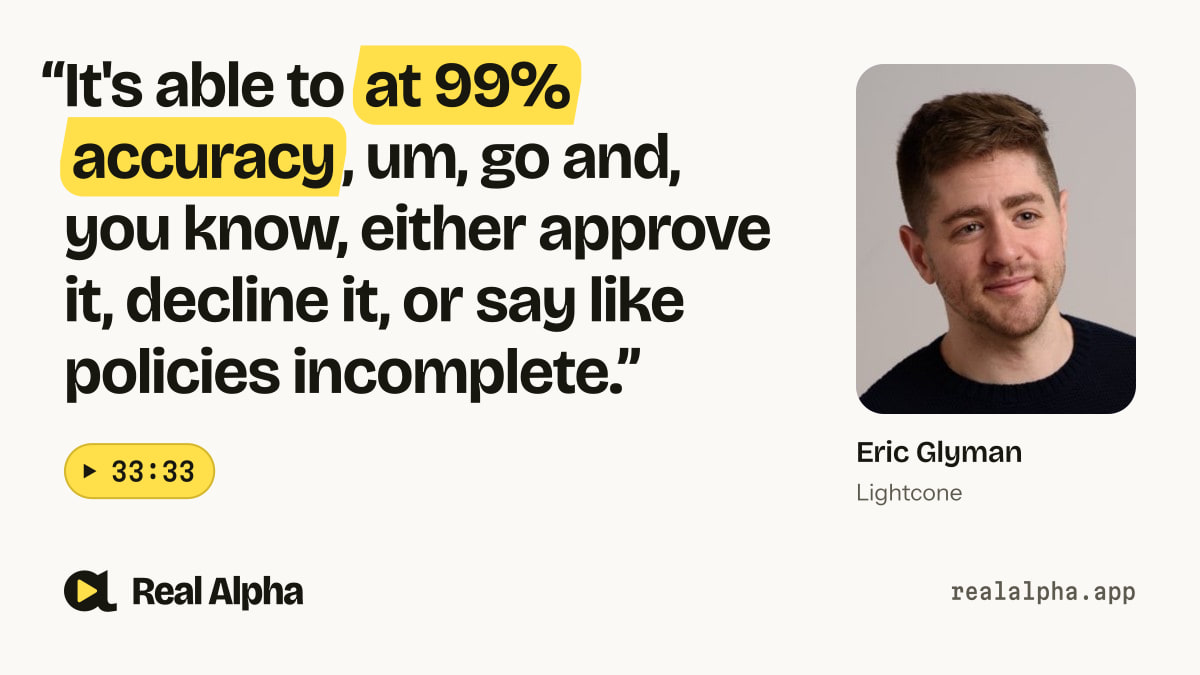
“It's able to at 99% accuracy, um, go and, you know, either approve it, decline it, or say like policies incomplete.”
 Eric Glymanat 33:33 · Lightcone
Takeaways Pro pick
- Glass connects company data while respecting individual permissions.
- Shared skills let useful workflows spread across teams.
- A policy agent can approve, decline or flag expenses.
One of Pro's picks, open to you here. Try Pro free for 7 days
One of Pro's picks. The rest of the summary and the 3 takeaways are in Real Alpha Pro; the video, the quote and the transcript stay free.
Read it with Pro, 7 days freeAbout this segment
Eric Glyman explains how Glass connects company systems, permissions and shared skills, then gives an example: an AI agent reviews expenses against policy. It can reduce busywork while preserving how decisions are made.

Eric Glyman is co-founder and CEO of Ramp.
Co-founded Ramp, now used by 85,000 businesses and building AI tools to automate finance and manage company spend.

Garry Tan, Host · President & CEO, Y Combinator
Co-founded Posterous and Initialized Capital, an early Coinbase backer.
From “Ramp’s Bet on the 100x Employee”, Nov 18, 2026. Watch the full episode
Answers “Are AI agents ready for real work?” See all 210 answers
Thanks. We'll look at and fix what's off.
Transcript
Transcribed by machine (Whisper) from the episode’s audio, so a word may be off here and there.
- 29:27
that's it sounds like it's kind of your um other people might just throw people at codex or cloud code with and it's like you figure out how to hook hook up the systems whereas glass is your company brain like it you know you can use a frontier model with it but it's got all the integrations and then is it like all info about the company like uh analytics like finance you know customer support like all the things about um running ramp are like all in there and then who gets access and you know how does it work you know we're 1930 people i was looking here last 24 hours 1925 used it so people use it to do their work you know to do their whole work to know what's going on and exactly and there's a lot of design decisions that went into to this first of all to your point it connects automatically to all of the core systems that a company uses, right? So whether
- 30:25
it's your data warehouses, your analytics suites, maybe using Zendesk for customer support, that all that data is getting pulled into it. And so at a company level, there is much more of a complete view of what actually is occurring and you can make connections between datasets. But for an individual, you have the access permissions that you should have, and that can vary by company. There are shared skills.
- 30:47
So if someone from the sales team figures out like a better way to do research and a scene conversion, it shows up and pops up, becomes the default for others. There's model selection. So if an open model series is better or, you know, Claude or OpenAI, you can use anyone that you want. There's smarter defaults. You know, I would venture to say that maybe the majority of spend on frontier models could be done by, you know, a simpler model.
- 31:16
there's smart trade-offs built into it. For example, our background coding agent, sometimes we are happy to have the process and reasoning take 10% longer for a 50% cut in price, and so there's better defaults. I think when you start to get all this data, not only are you paying, you're not paying 10 times for everyone to keep relearning the same lesson, but you're actually able to develop and start to see at the organizational level, what is the decision-making?
- 31:45
what is the reasoning that makes this company different not just like what is an individual person doing but like what is the unique viewpoint uh and way that ramp operates and functionally you're teaching your system to do that so even if someone great It does great work and leaves. It's in a skill file. It's in the skill files. Yeah. It's there. I guess some of this is, it's not just for everyone to be able to do their work better.
- 32:09
It's actually really useful for you and Kareem as co-CEOs. You're able to actually dive in and see like, well, what is that process? Is there something in Glass that says like, okay, well, there's one process for, you know, refunding a customer for this or whatever workflow. When you have, you know, people just cobbling things together, like you might not get that visibility. And there might be like five different ways to do something.
- 32:32
Yeah, that is exactly right. I mean, you functionally are able to understand, like, what are the standard operating procedures? What are the reasons of how something is able to get done? But you also can start to see, like, there are discrepancies. You know, maybe to speak to how Glass helped us develop a great product that has come to life, maybe on the finance side of the house. I'll give you an example.
- 32:55
So every company, RAMP does, YC, unfortunately needs to have expense policies. It kind of falls out of Sarbanes-Oxley and audit requirements and all kinds of things. But it functionally means that every time that someone makes a purchase, someone is supposed to review it. That's not you. And this culminates in large organizations where you have highly paid people just reviewing the expenses for everybody.
- 33:19
And it kind of makes no sense. And these people aren't thinking about expenses or what the policy says or where it's incomplete or wrong. um, and are actually wrong quite often. Um, either they'll just submit and approve everything or waste their time doing it. And we had built a similar product for the policy agent where functionally it knows your full expense policy. It's able to at 99% accuracy, um, go and, you know, either approve it, decline it, or say like policies incomplete. And every time that things are approved or change or overridden, uh, it learns. And if things are in conflict or things incomplete, it writes and adjusts the policy as the company changes. And so to your point, companies are not discrete rule engines. They evolve. The style of thinking and the reasoning can evolve, but you can trace the lineage and understand the decision-making in a way where
- 34:11
sometimes large companies are bureaucratic, inscrutable organizations. Yeah. I guess this is a very interesting moment for transparency inside all organizations that