The alpha, twice a week
That was 6 min.
Get the best new moments in your inbox every Wednesday and Saturday. It's free.
Check your inbox
We sent a link to your address. Click it to finish signing up. Not there in a minute? Look in spam.
or
Lightcone · 6 min · Nov 18, 2026
Ramp paused hiring to make AI a core skill
 Eric Glyman
 describes how uneven AI adoption created productivity gaps, then explains why Ramp paused hiring for a quarter.
The episode’s best minutes
Full analysis- 20:19Ramp paused hiring to make AI a core skill6 min
- 29:23Glass turns company knowledge into usable workflowsPro pick 5 min
- 44:36Non-engineers shipped 7,000 pull requests in one quarterPro pick 4 min
- 4 more moments in the full episode
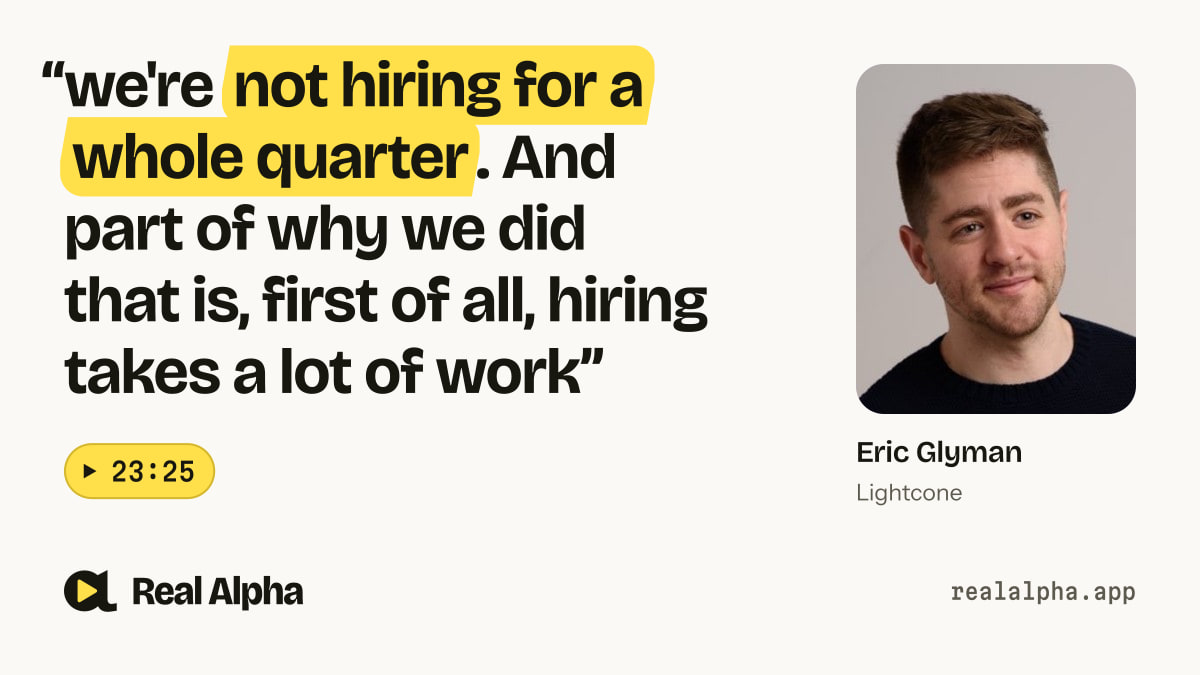
“we're not hiring for a whole quarter. And part of why we did that is, first of all, hiring takes a lot of work”
 Eric Glymanat 23:25 · Lightcone
Takeaways
- AI adoption can create big productivity gaps between teams.
- Ramp paused hiring for a quarter so AI learning could take priority.
- Integrated agents can fix customer bugs in minutes.
About this segment
Eric Glyman describes how uneven AI adoption created productivity gaps, then explains why Ramp paused hiring for a quarter. The move gave employees room to learn AI and rethink how work gets done.

Eric Glyman is co-founder and CEO of Ramp.
Co-founded Ramp, now used by 85,000 businesses and building AI tools to automate finance and manage company spend.

Garry Tan, Host · President & CEO, Y Combinator
Co-founded Posterous and Initialized Capital, an early Coinbase backer.
From “Ramp’s Bet on the 100x Employee”, Nov 18, 2026. Watch the full episode
Answers “Is AI paying off for companies?” See all 116 answers
Thanks. We'll look at and fix what's off.
Transcript
Transcribed by machine (Whisper) from the episode’s audio, so a word may be off here and there.
- 20:24
Change is very hard for people. And maybe to give an example, we've spent so much time in the finance world. So sometimes we'll hire people outside of an investment bank or a private equity firm, and they'll show up at a company. And one of the ways that finance teams, maybe your finance team, if you're listening to this, will go haze those people is they probably have become just really good at Excel on Windows, and they know all the hotkeys, and they're great at it.
- 20:47
And then you haze them by getting them a Mac, and you give them Excel. And they're like, I don't know how to use this. It's too complicated. And in some sense, it's funny, but it sort of exhibits this basic truth of, like, even learning how to use the tool that you've maybe used for multiple years in, like, a slightly different operating system can be, like, hard for people to make that change. And that's why many finance orgs still, they're, like, the only team still operating on, like, a Windows machine inside of a startup.
- 21:15
and so in some sense to go to any member of your team or life family and say like hey i know you've been doing work this way for 20 years you should just use ai now yeah it's like a really big ask it's like a lot bigger than just same program different os it is really hard uh and so in some sense like actually thinking through and giving some people the the grace to figure out like how do you actually relearn everything that you you kind of know did you have to do that like at the team level you know okay we're gonna start with i mean engineering is an obvious place to start you've always had like incredible you know imo gold like you know the best of the best engineers they were like hey actually we're just gonna start doing this probably what what happened inside of the company is what happened is what is happening in the world where 1% of the people
- 22:09
were using 80% of the tokens who were also like becoming the most extraordinarily productive people like you'd have you know not exaggerating 100x engineers people who were just so radically productive and they're being faster and others who are behind and some functions moving fast and it would start breaking parts of the organization for example you'd have engineers who maybe were 10 or 100x is productive. You have designers who are 2x is productive, product people who maybe got with the program and they were 5x is productive. And companies traditionally have these ratios, right? Like six to eight engineers to one product manager to one designer. And it's a big problem if the productivity of one function or another doesn't get there. And so you'd start having like all these pain points where engineers were out running other parts of the company.
- 22:56
fascinating you'd have people who suddenly were growing faster and for our capacity models like we had to go hire all these people and you'd get these hiring requests where there was this inverse correlation the more ai you used uh often you were radically more efficient so you didn't need as many people and if you weren't using it at all maybe you would say that you were yeah and you would request a lot of people and so it got to this point where earlier this year we just said like, and by the way, this business is growing more than 100% per year. We said, we're not hiring for a whole quarter. And part of why we did that is, first of all, hiring takes a lot of work to find people, interview people, onboard people. You get less productive before you get more productive. But two, I didn't want learning AI to be in 5% of your time. It needs to be your
- 23:46
core competency. And the cool question was, how do you get people to this aha moment where finally you see it and you understand it and you never want to go back and so part of it was how do we create the conditions to do that another side of it is actually just it you don't encounter these problems much in small startups where you're just getting going and your whole environment maybe is on your your local device but inside of large organizations what happens is you say go use cloud code then someone from your sales team says fine i'll do it and then they download it and then they have to open terminal and they're like what's terminal and i have to install these packages and they finally get it done and then they have to ask it or someone of can i connect it to databricks or snowflake or google or slack or stripe and you can't do anything it's like i think most people's
- 24:31
experience with ai is it's this unbelievable alien intelligence and there's a wall and like a little slip and you can write a note chat and you can pass a note to it and then it can pass a note back to you which is so far from when you looked at how these unbelievable engineers who were getting 100x productivity gains where you know i think about inspect what makes it so useful and it's 85% plus of how of all the pull requests that we have at RAMP, the number of pull requests for engineers still growing like 40% every month, roughly. And so it's a radical velocity improvement. It can see all the data that the engineer can see. It has access to the code.
- 25:14
It has its own virtual machines, its browser, it's everything. It's not just a great until it's it's merged with your team i always remember that scene in matrix where you know uh keanu wakes up and he's like i know kung fu or if you've watched like avatar uh you know the whole premise was like the main character knows all the things that like his ancestors uh know uh and so it has this almost like super vision this super insight there was almost this desire to say actually how do we make it easy for everyone to do these things, to know all the things that the company knows.
- 25:50
When you get a complaint from a customer about a bug, you know, Inspect can go and read that email. It knows all of the recent code changes. It can locate it. It can go write the change and it can email the customer back. And so instead of back to where we started of like these capacity models, you have to go hire, you know, 30 other people, you can just fix it in 15 minutes. And