The alpha, twice a week
That was 2 min.
Get the best new moments in your inbox every Wednesday and Saturday. It's free.
Check your inbox
We sent a link to your address. Click it to finish signing up. Not there in a minute? Look in spam.
or
Bloomberg Surveillance · 2 min · Oct 28, 2026
Higher debt could constrain the Fed’s crisis response
 Gita Gopinath
 says the Fed can tolerate a slow return to 2%, even if inflation settles near 2.5%. Higher debt and limited fiscal room could make long yields and crisis support harder to manage.
In this episode
Full analysis- 3:07AI buildout leaves the Fed weighing inflation and crash risksPro pick 3 min
- 17:05AI spending is shifting its bottleneck from chips to power4 min
- 0:57Warsh is stepping back from forward guidance2 min
- 5:51Higher debt could constrain the Fed’s crisis response2 min
- 9:59Gardner puts Democrats’ Senate chances below prediction markets2 min
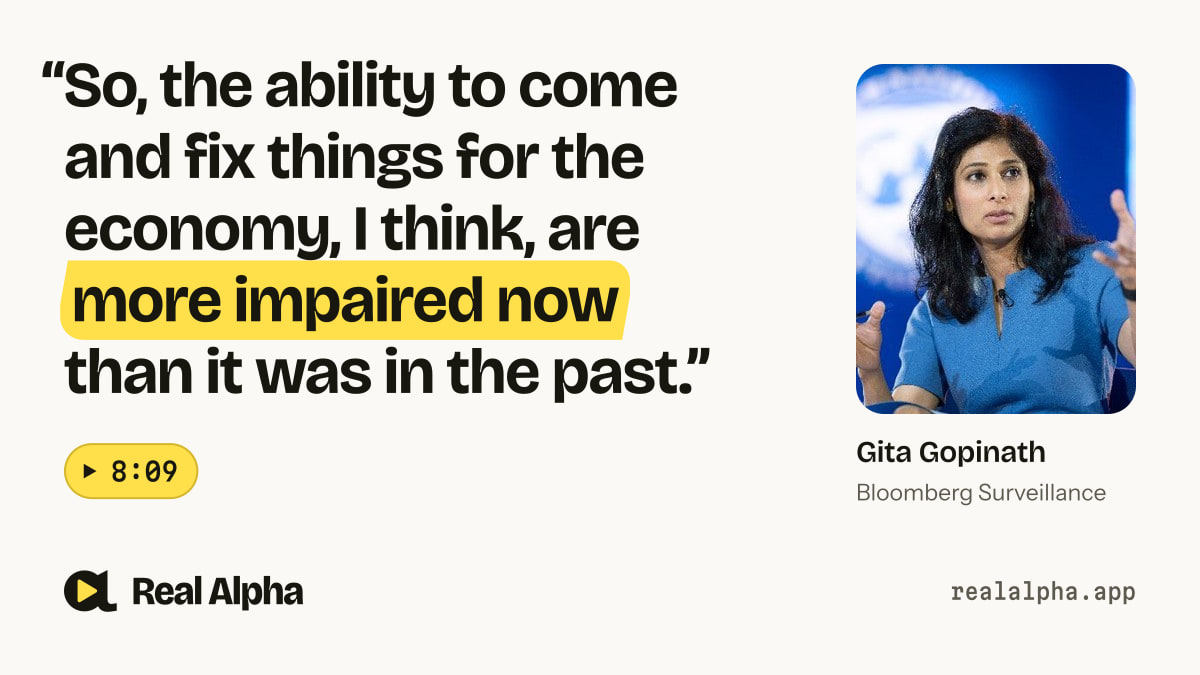
“So, the ability to come and fix things for the economy, I think, are more impaired now than it was in the past.”
 Gita Gopinathat 8:09 · Bloomberg Surveillance
Takeaways
- She says inflation near 2.5% could be acceptable.
- Long-term yields may fall less than in past crises.
- High debt leaves fiscal policy with little room to respond.
About this segment
Gita Gopinath says the Fed can tolerate a slow return to 2%, even if inflation settles near 2.5%. Higher debt and limited fiscal room could make long yields and crisis support harder to manage.

Former Deputy Managing Director, IMF
Led IMF surveillance and programs as deputy managing director, and steered the World Economic Outlook as chief economist.
- TK
Tom Keene, Host
- PS
Paul Sweeney, Host
- LM
Lisa Mateo, Host
- MB
Michael Barr, Host
From “Bloomberg Surveillance TV: October 28th, 2026 | Bloomberg Surveillance”, Oct 28, 2026. Watch the full episode
Thanks. We'll look at and fix what's off.
Transcript
From the transcript Bloomberg Surveillance publishes with the episode.
- 5:54
Well, let's deal with the baseline. Do you see a path back to 2% without containing the build-out that's happening right now from major tech companies?
- 6:03
If you really want to push the inflation rate very quickly back to 2%, then you would be, I think, we would be in a much tighter hiking mode at this moment. We're not going to do that, and I don't think that's the right thing to do. So inflation is hovering around 3%. It's not drifting further up. That's important, and that should give some confidence. And so you take the time to try and bring it down to 2%, but I don't think there's a big rush to make that happen. It's going to be slow. My sense is that if inflation settles at like 2.5%, It's okay. It's not 2 percent. Yes, I know, war says that we are— it' s just a 2 percent target. But, hey, if it hovers around 2.5 percent, you know, you take that.
- 6:43
If there was a serious correction, how much room does the Fed have to cut rates, and how much ability does the U.S. have to issue more debt in order to help its economy, given what we've seen in places like France, given how. Much of U.S. Economic growth seems to be hinged to the AI trade?
- 7:01
I mean, the Fed can cut interest rates very quickly. Absolutely, they can do that. So that brings the short end down. The question is, what happens to the long end of the yield curve? And I think that is the question mark. My personal view is that it's still the case that we will see long-term yields go down, maybe not as much as has happened in the past, because of all these sources of demand for capital, including from the government to the large fiscal situation, and also the potential risk of inflation, which I think is much more salient these days than it was in the past. I expect the long yield will come down, but it is true. The two things that have changed since the last crisis that we had is one, that the monetary transmission mechanism to the long yield is somewhat, I would say, a little
- 7:41
more impaired given the fiscal environment that we have right now. And fiscal policy doesn't have any space left. I mean, at least it should not have that much more space left. Its debts around the world are very, very high. The U.S., I think, is still in somewhat of a privileged position, the way markets are treating it. But still, we're not in the situation where, if you remember pre-GFC, debt-to-GDP in the U.S. was 60%, and now we're at 100%. So, this is a completely different place. So, the ability to come and fix things for the economy, I think, are more impaired now than it was in the past.