The alpha, twice a week
That was 2 min.
Get the best new moments in your inbox every Wednesday and Saturday. It's free.
Check your inbox
We sent a link to your address. Click it to finish signing up. Not there in a minute? Look in spam.
or
Bloomberg Surveillance · 2 min · Oct 28, 2026
Warsh is stepping back from forward guidance
 Gita Gopinath
 says Warsh wants to avoid boxing the Fed in with forward guidance, accepting some transition uncertainty.
In this episode
Full analysis- 3:07AI buildout leaves the Fed weighing inflation and crash risksPro pick 3 min
- 17:05AI spending is shifting its bottleneck from chips to power4 min
- 0:57Warsh is stepping back from forward guidance2 min
- 5:51Higher debt could constrain the Fed’s crisis response2 min
- 9:59Gardner puts Democrats’ Senate chances below prediction markets2 min
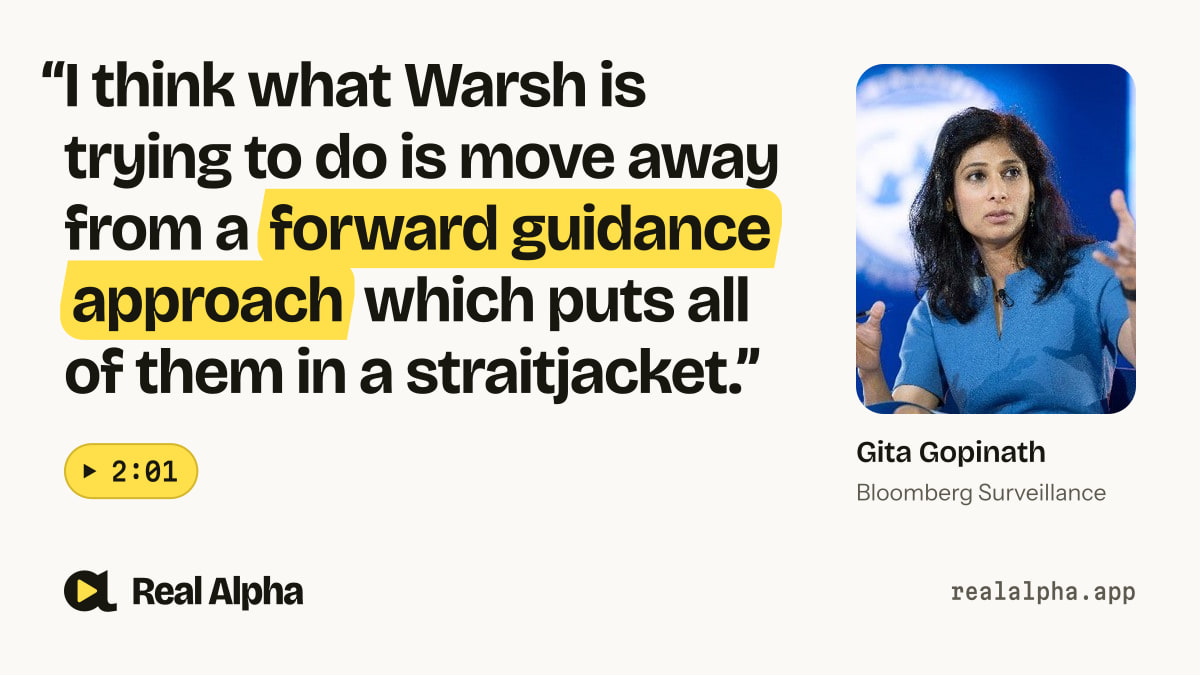
“I think what Warsh is trying to do is move away from a forward guidance approach which puts all of them in a straitjacket.”
 Gita Gopinathat 2:01 · Bloomberg Surveillance
Takeaways
- Warsh wants more flexibility than forward guidance allows.
- The shift itself brings some added uncertainty.
- Gopinath expects that uncertainty to fade with more Fed communication.
About this segment
Gita Gopinath says Warsh wants to avoid boxing the Fed in with forward guidance, accepting some transition uncertainty. She sees that uncertainty premium as limited and likely to fade.

Former Deputy Managing Director, IMF
Led IMF surveillance and programs as deputy managing director, and steered the World Economic Outlook as chief economist.
- TK
Tom Keene, Host
- PS
Paul Sweeney, Host
- LM
Lisa Mateo, Host
- MB
Michael Barr, Host
From “Bloomberg Surveillance TV: October 28th, 2026 | Bloomberg Surveillance”, Oct 28, 2026. Watch the full episode
Thanks. We'll look at and fix what's off.
Transcript
From the transcript Bloomberg Surveillance publishes with the episode.
- 0:59
been looking forward to catching up with you. Does this Fed have the luxury of skipping this meeting?
- 1:06
I think it does. I think there is still tremendous uncertainty about the outlook. You know, they could have done a hike, but given where we are right now in terms of market expectations, I don't expect that they're going to have a huge disruptive announcement today. So, there's December. December is where everybody expects there's going to be a 25 bps hike. It's okay. I think it doesn't—one 25 bps delay for a couple of months doesn't make that big a difference to financing conditions or to tightening monetary conditions. So, I think it's okay.
- 1:41
Do you think, though, that the uncertainty premium that's been injected into the market over the lack of an understanding of the reaction function has been a very expensive policy at the very least, a mistake at worst, given the fact that the market doesn't have a sense of where Kevin Warsh's ballast really is, what his North Star is, to decide whether to hike or to hold?
- 2:03
I think what Warsh is trying to do is move away from a forward guidance approach which puts all of them in a straitjacket. And that was the case for a few years ago. He wants to move away from that. So any such transition is going to generate some increase in uncertainty. So I think we can give him that. I don't think it's a huge increase in premium associated with that uncertainty, and that will go away with more and more of these conferences and these conversations that are had.
- 2:34
I think the bottom line is that the Fed is working under a lot of uncertainty. What's going to happen to energy prices? It's It's still very troubling at this moment. It could go down, though, relatively rapidly. Financial conditions are still actually highly accommodative. You know, maybe some of the high yields have gone up, but mostly generally accommodative financial conditions. But again, with every news we're hearing questions about, you know, could we have this AI bubble back? Could we have a big change? I think there's too much of uncertainty to provide clear forward guidance at this moment.