The alpha, twice a week
That was 2 min.
Get the best new moments in your inbox every Wednesday and Saturday. It's free.
Check your inbox
We sent a link to your address. Click it to finish signing up. Not there in a minute? Look in spam.
or
Bloomberg Surveillance · 2 min · Oct 30, 2026
Higher rates matter more to households making large purchases
 Nela Richardson
 says many lower-income households are shut out of buying homes, cars and investments.
In this episode
Full analysis- 0:48AI spending is hard to value when its returns are unclearPro pick 3 min
- 8:13Lower-income workers are earning more by working more hoursPro pick 2 min
- 15:18High-yield bonds offer income as a way to diversify3 min
- 10:28Higher rates matter more to households making large purchases2 min
- 12:29AI employment effects are concentrated in early-career roles2 min
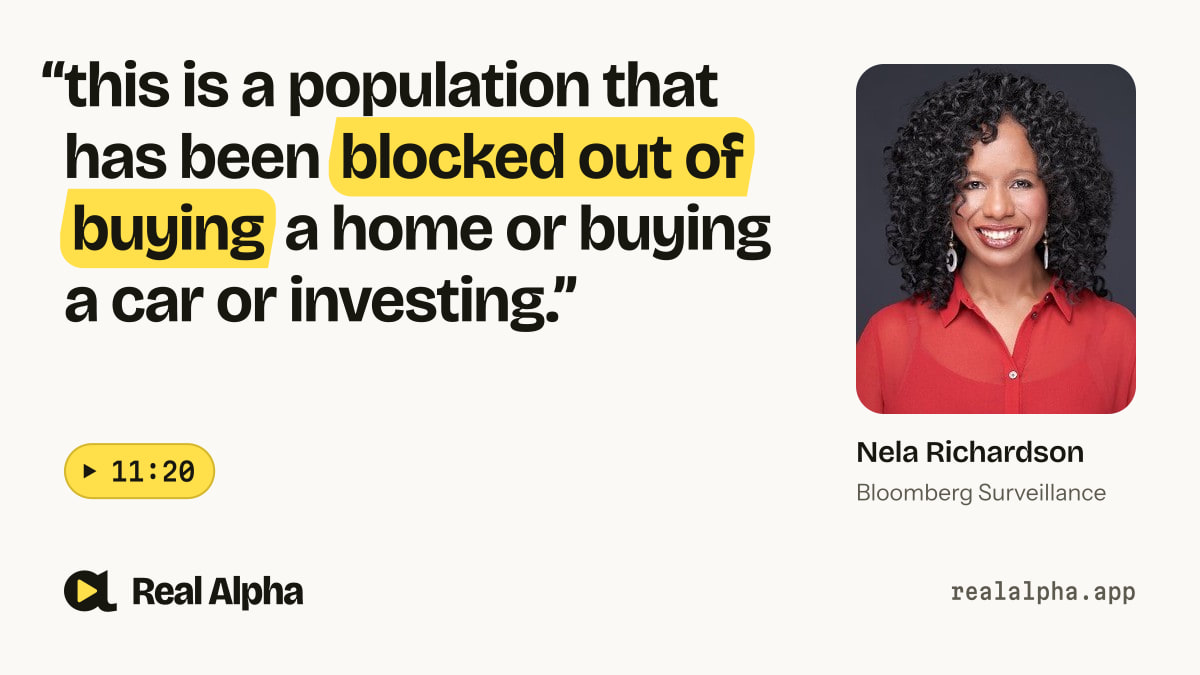
“this is a population that has been blocked out of buying a home or buying a car or investing.”
 Nela Richardsonat 11:20 · Bloomberg Surveillance
Takeaways
- The bottom income quartile is largely priced out of homes and cars.
- Rate changes matter more to households able to make large purchases.
- Richardson says wages are not the source of inflation.
About this segment
Nela Richardson says many lower-income households are shut out of buying homes, cars and investments. That leaves rate changes more consequential for households able to make those purchases.

Chief Economist & ESG Officer, ADP
Revamped ADP’s National Employment Report and launched wage-growth tracking using payroll data from nearly 10 million workers.
- TK
Tom Keene, Host
- PS
Paul Sweeney, Host
- LM
Lisa Mateo, Host
- MB
Michael Barr, Host
From “Bloomberg Surveillance TV: October 30th, 2026 | Bloomberg Surveillance”, Oct 30, 2026. Watch the full episode
Thanks. We'll look at and fix what's off.
Transcript
From the transcript Bloomberg Surveillance publishes with the episode.
- 10:30
When it comes to a lower cohort, and you're talking about potentially this over time, do you see them picking up also part-time jobs? Is it trying to get multiple jobs at once just to keep up with where prices are? Right.
- 10:42
So it's overtime. It's more hours. It's another job. It's an active gig economy. And what we don't talk about a lot, it's the non-traditional sector. Where you don't see it in official statistics, but it's mowing the lawn, it's doing babysitting, it's house cleaning that may not show up in our aggregate numbers. All of that is on the table as people try to deal with the affordability pressures that we're seeing.
- 11:07
Especially this group. How are they going to deal with potentially higher interest rates if the Fed continues on a hiking cycle?
- 11:15
Well, we are not looking at the purchases of our economy right now. If you're looking at the bottom quartile of the income distribution, this is a population that has been blocked out of buying a home or buying a car or investing. We don't have the same housing programs that allowed... people to move to homeownership. And you can see that in the numbers. So it's really, the interest rate is going to be more meaningful for higher income households who actually have the wherewithal to make those big purchases.
- 11:46
What are you expecting for December based off what we saw from the Fed this week?
- 11:51
In terms of the action to move or not? Well, I think it's anyone's guess at this point. I'm going to be listening really carefully to the Fed speak that we hear next week. I hope to hear a reaction function in that Fed speak. So maybe not forward guidance, but past guidance. Why we did what we did, why we held the way we did. But the key thing coming from the jobs market is wages are not a source of inflation. And that's the bottom line. You see that in the ECI. You see that in the numbers, whether you're looking at the BLS or ADP numbers. Wages are not the thing.
- 12:30
That is going to trigger inflation.