The alpha, twice a week
That was 2 min.
Get the best new moments in your inbox every Wednesday and Saturday. It's free.
Check your inbox
We sent a link to your address. Click it to finish signing up. Not there in a minute? Look in spam.
or
Wall Street Week · 2 min · Nov 21, 2026
Higher use and provider prices are pushing premiums up
 Matthew Rae
 attributes premium growth to both more care and higher prices, including new drugs and provider consolidation.
In this episode
Full analysis- 15:59Gaming is splitting between dominant publishers and lean indies3 min
- 28:18Employers are using plan design to contain health-cost increasesPro pick 7 min
- 39:23AI makes cybersecurity a governance problem as well as a technical onePro pick 7 min
- 1:24Short-term Treasury debt offers limited savings and adds rate risk3 min
- 25:51Higher use and provider prices are pushing premiums up2 min
- 36:38A card-testing attack sent 460,000 payments through a small shop2 min
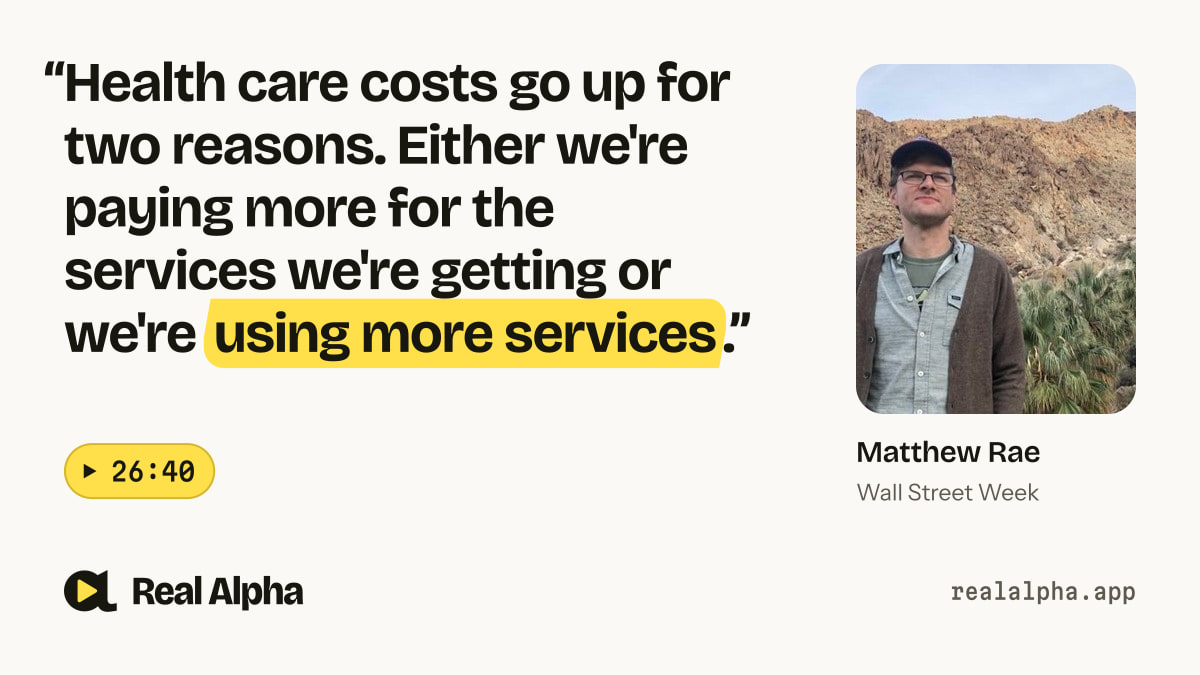
“Health care costs go up for two reasons. Either we're paying more for the services we're getting or we're using more services.”
 Matthew Raeat 26:40 · Wall Street Week
Takeaways
- New services and drugs raise utilization and costs.
- Provider consolidation gives hospital systems room to charge more.
- Workers paid $7,000 toward family coverage in 2026, up 9%.
About this segment
Matthew Rae attributes premium growth to both more care and higher prices, including new drugs and provider consolidation. He says workers' rising contributions may mark a shift in who bears the bill.

Associate director, Health Care Marketplace Program, KFF
Analyzes private insurance markets and reform proposals; has managed KFF’s Employer Health Benefits Survey since 2011.
- DW
David Westin, Host
From “Gaming Blockbuster, Healthcare Costs, Cybersecurity Meets AIGaming Blockbuster, Healthcare...”, Nov 21, 2026. Watch the full episode
Thanks. We'll look at and fix what's off.
Transcript
From the transcript Wall Street Week publishes with the episode.
- 25:53
An average employer-sponsored family health plan now costs more than $ 28, 000 a year, up 5% since last year, more than wages and inflation.
- 26:05
It's an astronomical amount of money. We've seen bigger increases sort of in the early 2000s. But $ 28, 000 is still a lot of money, and that's a lot of money that both workers and employers have to chip in to cover just one family. It sums up to be about just the cost of a new car every year just to insure four people.
- 26:20
Matthew Ray, one of the authors of KFF's annual survey of employer health plans, says the reach of these costs is hard to overstate.
- 26:29
The majority of non-elderly working-age people are covered by job-based plans. So it speaks to sort of the robustness of the system.
- 26:36
Is health insurance costs going up because health care costs are going up? And if so, what's driving those?
- 26:42
Health care costs go up for two reasons. Either we're paying more for the services we're getting or we're using more services. And over a long run, both things are happening. When we see spikes in healthcare premiums, that's typically driven by higher utilization. We have new services that we weren't paying for before. All of these are new drugs that didn't exist several years ago, but have the radical ability to change people's lives for the better. but they come with saving price tags. Prices have also increased over time.
- 27:07
We know that increased provider consolidation, there are fewer, more hospital systems have a bigger footprint in many markets leading to higher prices.
- 27:14
And with costs rising sharply, the balance of who pays may be approaching a tipping point. Does the increase get distributed in a set percentage or is an employer starting to take on more or an employee starting to take on more?
- 27:28
It's an absolutely critical question. So over a long period of time, the share that workers have paid has stayed roughly the same. This year, we saw sort of a big increase in the share that workers are spending. So the worker contribution to the premium is $ 7, 000 in 2026 for family coverage. It's 9% more than last year. If we continue to see sort of 9% increases in the worker contribution, that could be the beginning of a shift of the premium cost onto workers. workers, and that would really mean something in the sort of affordability debates over how sustainable our system is. There are signs that many employers feel they are feeling a real cost pressure, and employers have limited ways to sort of bear that cost pressure other than share it with workers.