The alpha, twice a week
That was 4 min.
Get the best new moments in your inbox every Wednesday and Saturday. It's free.
Check your inbox
We sent a link to your address. Click it to finish signing up. Not there in a minute? Look in spam.
or
TBPN · 4 min · Oct 2, 2026
Human-facing AI can hand off work to specialist models
 Hassaan Raza
 explains how Tavis is developing natural AI interactions while limiting Griffin’s early release and requiring disclosure.
The episode’s best minutes
Full analysis- 46:42Varda is scaling reentry with parallel mission operations4 min
- 1:05:24Winning data center approvals requires listening to communitiesPro pick 4 min
- 1:20:10Human-facing AI can hand off work to specialist models4 min
- 5 more moments in the full episode
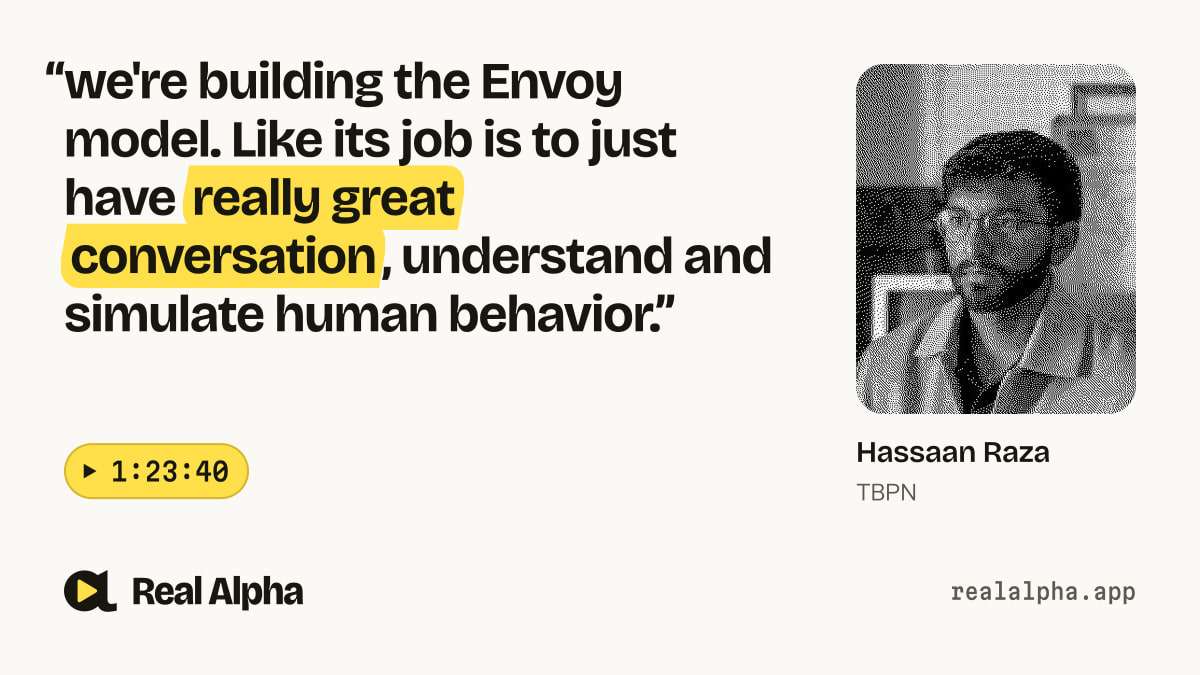
“we're building the Envoy model. Like its job is to just have really great conversation, understand and simulate human behavior.”
 Hassaan Razaat 1:23:40 · TBPN
Takeaways
- Griffin is being tested selectively with disclosure safeguards.
- Natural conversation is distinct from the model's task-execution ability.
- An Envoy model can hand off work to tools and other models.
About this segment
Hassaan Raza explains how Tavis is developing natural AI interactions while limiting Griffin’s early release and requiring disclosure. The conversational model can delegate tasks to other models and tools.

Co-founder & CEO, Tavis
Co-founded Tavus, an AI research lab focused on human computing, and leads it as CEO.

John Coogan, Host · Co-host, TBPN
Co-founded Soylent and Lucy; OpenAI bought his show TBPN in April 2026.

Jordi Hays, Host · Co-host, TBPN
Founded Branded Native; co-founded fintech Capital, which Rho bought.
From “Timeline Mud Wrestling, Apple Play Coming to Old Porsches, SI Domain Debate”, Oct 2, 2026. Watch the full episode
Thanks. We'll look at and fix what's off.
Transcript
From the transcript TBPN publishes with the episode.
- 1:20:17
Mhmm. Walk me through how you're grappling with the various debates of how this technology gets rolled out, the potential downsides. I imagine you're not going open wait but is there a process to onboard a customer so that you know it's not literally just a scammer who's trying to get grandma to send a gift card or something?
- 1:20:38
Yeah. Yeah. No. So with Griffin, we're doing an early research preview. So we're only releasing it to select testers. Yeah. And it's exactly for that. Right? It is the first model and by far the largest sort of leap ahead in passing Turing tests. So we're like, we know we have to do more AI safety work, but we want to do, like, proper disclosure work, make sure that the model always says that it's an AI and not a human.
- 1:21:01
Yep. And so we're working through those safety sort of testing and do like safe releases. So we're probably gonna be releasing over the next couple months.
- 1:21:09
And then on the actual, like, you know, jobs not finished, like, where this goes, it feels like Turing test passed on, you know, basic Zoom call. Where do you What want like what capabilities do you want to unlock next? I I I can imagine like it's nice to be able to talk to somebody and it looks like they're on a video but occasionally you'll want that person to like stand up and go get an object and show it to you. And I don't know if the model can do that yet. And there's like other things that happen in the course of a Zoom call.
- 1:21:41
Where do you see this all going? Yeah. I mean I mean, I think what's really special about this model is that it is actually capable of doing a lot of these movements. Like, it won't get up and walk away just yet, though technically it's capable of it. But, like, it's a small things. Like, it should, like, shift around her chair. It can, like, it can do gestures. It can, like, touch its face because it feels nervous. Like, all these things that humans would naturally do, and it builds all this trust. But really, what we're trying to go with this is, like, how do we make these more capable? Like, how do we make them more capable employees, more capable assistants, more capable, sort of coworkers? And then how do we make it so that the interface sort of disappears?
- 1:22:15
Like, you don't think about it, and you're just asking it to do its work and it does it just goes and does it. So that's like intelligence and then there's like the Turing test naturalness.
- 1:22:23
Yeah. I can imagine virtual guitar tutor being a really hard benchmark. I think I think that's really good. So one of my... That actually one of my sort of use cases that I wanna unlock is like teaching me piano. Yeah. Because it it can see. It can already... It has perception. So it can see and people are already using it to do sorts of training. You can hold things up. You can... Yep. People are like our team and others, like, they'll play tests with it, and it's telling... It's like, play Yeah. Against So those are all things you can do. But like piano and guitar are definitely difficult, because it can't tell the difference between like different, like...
- 1:22:55
It doesn't doesn't know the difference between different keys and stuff yet, but it'll get there. Like Yeah. All these things will get there. And so being able to have like a personal tutor, personal trainer for every single person is like that's the dream. Yeah. No. Makes a ton of sense.
- 1:23:08
How how are you... Like, am I right to assume that when... If somebody's like talking to a pal, like a virtual coworker, and then that pal is gonna go off and like do work in the background. Let's say you have like, let's jump on a quick call, talk about the thing we wanna do, and then the pal decides to go do work. Will that workflow be model agnostic because there are a bunch of specialized models and frontier models that you can use to just run-in the background and you don't need to really focus there.
- 1:23:38
You need to focus on like the interaction collaboration. Exactly. Exactly. So like the way we like to talk about it is like the Oracle and the Envoy. Like we're building the Envoy model. Like its job is to just have really great conversation, understand and simulate human behavior. And then whenever it needs to do something that it can't do in conversation, it goes off to the big the big model in the sky and goes, hey, let's let's work together on this. Let's do this in the background. And so it can reach out to any tool, any model, and go do that work rather than this model doing everything. Absolutely.
- 1:24:08
Yeah. Well, congratulations on the progress. Very impressive stuff.