The alpha, twice a week
That was 4 min.
Get the best new moments in your inbox every Wednesday and Saturday. It's free.
Check your inbox
We sent a link to your address. Click it to finish signing up. Not there in a minute? Look in spam.
or
TBPN · 4 min · Oct 2, 2026
Winning data center approvals requires listening to communities
 Christophe Beck
 says opposition and project delays grow when companies talk past local residents.
The episode’s best minutes
Full analysis- 46:42Varda is scaling reentry with parallel mission operations4 min
- 1:05:24Winning data center approvals requires listening to communitiesPro pick 4 min
- 1:20:10Human-facing AI can hand off work to specialist models4 min
- 5 more moments in the full episode
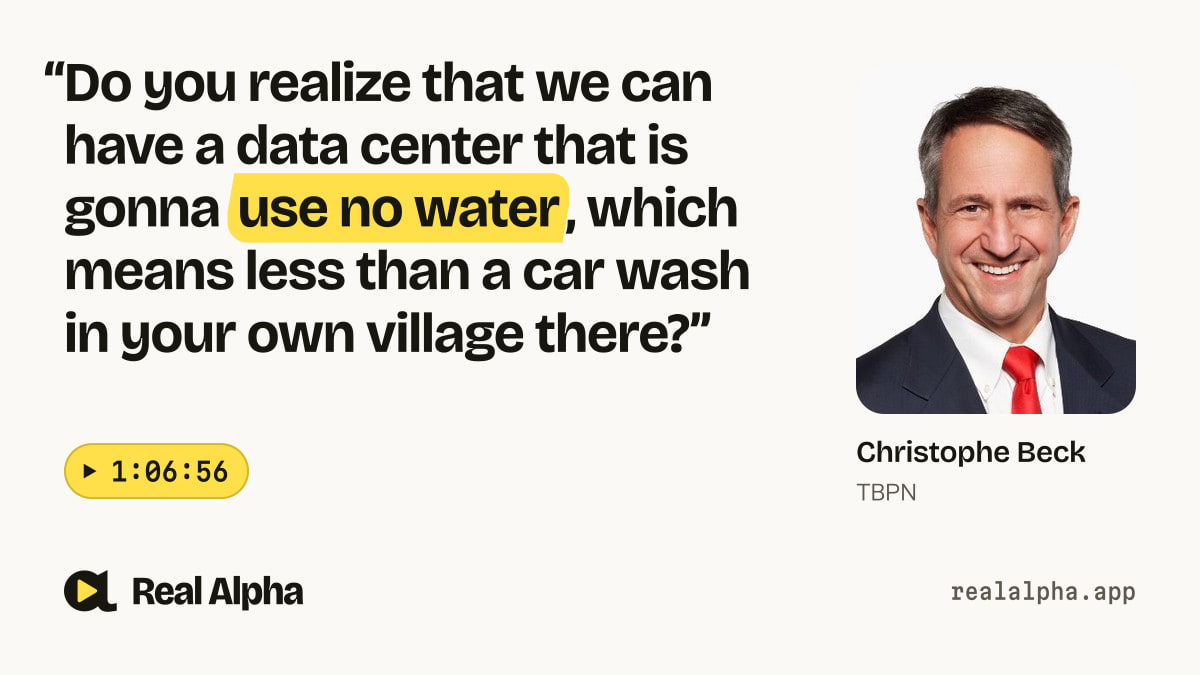
“Do you realize that we can have a data center that is gonna use no water, which means less than a car wash in your own village there?”
 Christophe Beckat 1:06:56 · TBPN
Takeaways Pro pick
- Beck says 60% of projects are paused or delayed.
- Go to local officials, neighbors and community groups directly.
- Loud persuasion can deepen resistance instead of resolving it.
One of Pro's picks, open to you here. Try Pro free for 7 days
One of Pro's picks. The rest of the summary and the 3 takeaways are in Real Alpha Pro; the video, the quote and the transcript stay free.
Read it with Pro, 7 days freeAbout this segment
Christophe Beck says opposition and project delays grow when companies talk past local residents. He argues for direct engagement and clear answers about water, power and community concerns.

Chairman, President & CEO, Ecolab
Leads Ecolab's water, hygiene and infection-prevention work, including closed-loop cooling solutions for AI data centers.

John Coogan, Host · Co-host, TBPN
Co-founded Soylent and Lucy; OpenAI bought his show TBPN in April 2026.

Jordi Hays, Host · Co-host, TBPN
Founded Branded Native; co-founded fintech Capital, which Rho bought.
From “Timeline Mud Wrestling, Apple Play Coming to Old Porsches, SI Domain Debate”, Oct 2, 2026. Watch the full episode
Thanks. We'll look at and fix what's off.
Transcript
From the transcript TBPN publishes with the episode.
- 1:05:30
Well, it's the number one problem if we look at the two political parties today. So they don't agree on much, But on that, they agree that they don't like data centers Mhmm. Which is a problem for everything that we're talking about here. When you think about it, while investments go through the roof and all that, but 60% of the projects are being either paused or delayed. Yeah. Well, that's a problem. So on one hand, so you have huge demand, and on the other hand, so you have huge slowdown politically for the for the most part. And it's really unfortunate unfortunate what's happening here because in our country right now, so there is this way of talking about technology and AI in negative ways. It's gonna kill all of us. It's gonna eliminate all the jobs.
- 1:06:14
It's gonna be impacting our power bills. I mean, all the stuff that are really dramatic, which is really unfortunate, but that's where it's going. And at the same time, locally in a community, in a village, in a city, nobody wants to have a data center. So what's happening in our country right now, so we think that speaking louder will solve the problem. Well, that makes it just worse because the whole negativity is getting more prominent, which is a problem.
- 1:06:42
What we do, and we've done that in many industries, is basically so to get much closer to the community. It's to go to a city council. It's to call the neighbors. It's to be with the local politicians, the NGOs, all the people who really hates what's being done, and to listen to them and to share with them. Okay. Do you realize that we can have a data center that is gonna use no water, which means less than a car wash in your own village there? Your power bill might go down because you have the same infrastructure and you use more power through the same infrastructure. Okay. You know, you need to be a genius to understand so how the cost is gonna go down as well. And that's how we're making some progress.
- 1:07:26
And one example is Minnesota and Texas. We've been working with the two states. I took those two because they're kind of extreme, most liberal, most conservative. Mhmm. One way to simplify it, and interestingly enough, Minnesota hasn't gotten to a pause while access went up. In a way, I think we're finding ways, but it's hard. Have you
- 1:07:47
been surprised that the sort of tech industry saw that data centers were unpopular and decided to start calling them AI factories because I'm sure you work with like thousands of factories globally that are actually producing, you know, wastewater
- 1:08:06
or They're not the most aesthetic things. I would think you want to not go towards that. That's the last thing you wanna be. Yes. Thank you.
- 1:08:15
Oh my god. Yeah. Well, I don't think it's the right thing. And it's going... Both sides are going so kind of against each other in crazy ways and thinking, well, if I spend more money so against you, I'm going to convince you that you're wrong and that you're going to say yes to my stuff. That's where we are right now. That's the exact wrong way. And we're talking with the hyperscalers, the collocators as well, and to say, calm down. Get closer to the folks, in your communities, the schools, the churches, the NGOs, the communities. They're they're good people.
- 1:08:54
They're like us. They're Americans. They wanna have a good life in front of them. Speak less loud, try to listen, come with solutions. I think that technology is gonna help all those things there. And for whatever reason, we start... Spent two weeks in China a week ago. Well, 90% love it. Yeah. Well, that's exactly what the Chinese want us to slow down. They said, well, are we doing the right thing here? Well, maybe not.