The alpha, twice a week
That was 4 min.
Get the best new moments in your inbox every Wednesday and Saturday. It's free.
Check your inbox
We sent a link to your address. Click it to finish signing up. Not there in a minute? Look in spam.
or
No Priors · 4 min · Apr 3, 2026
Intelligence is spiky and self-improvement stays domain-specific
 Liam Fedus
 argues that model capability is uneven and that progress in software does not automatically transfer to science.
The episode’s best minutes
Full analysis- 6:28Materials models need experimental data in a closed loop3 min
- 21:35Intelligence is spiky and self-improvement stays domain-specific4 min
- 25:36Robots can accelerate lab data generation, but are not required2 min
- 3 more moments in the full episode
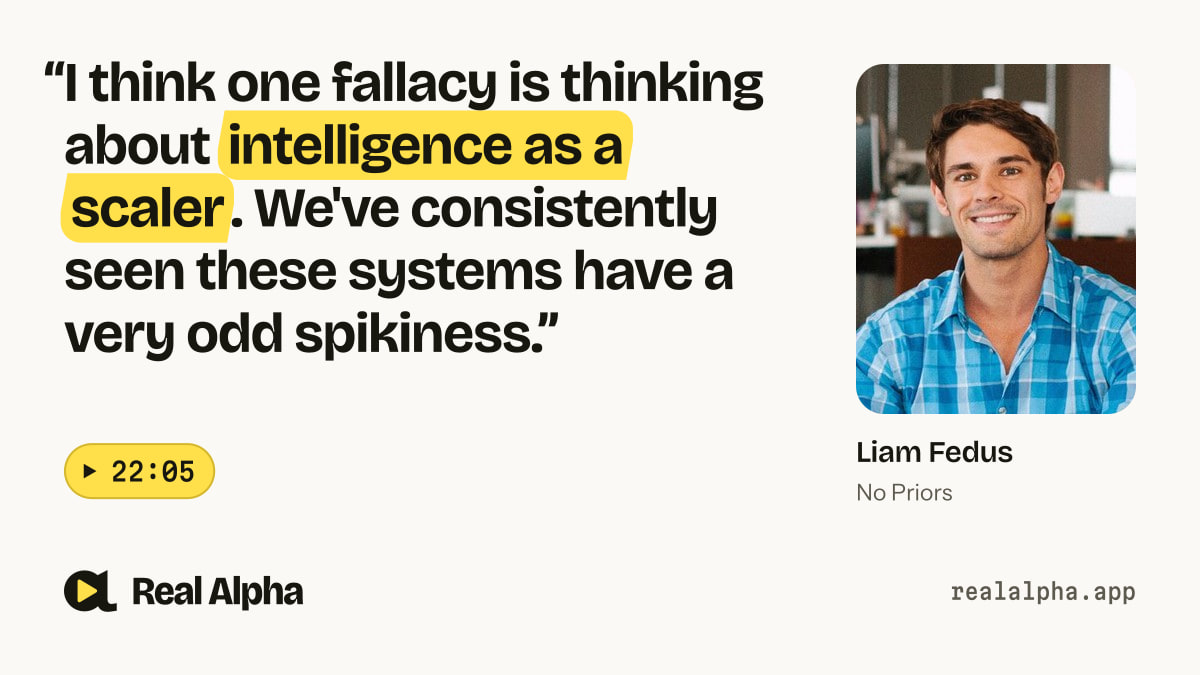
“I think one fallacy is thinking about intelligence as a scaler. We've consistently seen these systems have a very odd spikiness.”
 Liam Fedusat 22:05 · No Priors
Takeaways
- Capability is not a single score; systems can be strong in one area and weak in another.
- Software benefits from cheap, verifiable feedback loops.
- Scientific self-improvement needs slower experiments and domain-specific knowledge.
About this segment
Liam Fedus argues that model capability is uneven and that progress in software does not automatically transfer to science. He expects machine-led improvement first in domains with fast, verifiable feedback.

Liam Fedus is co-founder of Periodic Labs.
Co-founded Periodic Labs, which raised a $300M seed round, after work as one of OpenAI's most respected researchers.

Elad Gil, Host · CEO, Gil & Co
Investor in Airbnb, Stripe, Coinbase and Anthropic; co-founded Color.
From “AI for Atoms: How Periodic Labs is Revolutionizing Materials Engineering with Co-Founder Liam Fedus”, Apr 3, 2026. Watch the full episode
Thanks. We'll look at and fix what's off.
Transcript
Transcribed by machine (Whisper) from the episode’s audio, so a word may be off here and there.
- 21:40
So yeah, a lot of active roles. Yeah, that's really cool. So I think one of the things that everybody's really thinking deeply about or is excited about right now is AGI, ASI, sort of these advanced systems that are as good as humans or better than humans at different things or are very generalizable in terms of their abilities to do a broad swath of things. How do you think about that, both in the context of what's happening over the overall foundation model curve?
- 22:03
Because obviously you were very integral in terms of the development of some of these systems. And then how do you think about that applied specifically to some of the areas you're working in? I think one fallacy is thinking about intelligence as a scaler. We've consistently seen these systems have a very odd spikiness. And it's actually possible to architect a system that is world-class on some math domain.
- 22:26
But then you could do some perturbations to the questions. and actually degrade it substantially. So it's like a bad high school student. And so there's this like odd spikiness to these systems. So basically you can make a system that's like a genius at one thing and not very good at a bunch of other stuff. And I guess the point I was making is those fields can actually be quite adjacent. So like sometimes a generalization can be non-intuitive.
- 22:49
But one way I think about recursive self-improvement is really kind of akin to neural architecture search from roughly 10 years ago. And I think there's a very clear path for software engineering. So these systems have become so incredibly impressive on this domain as a result of huge amounts of data, really cheap, verifiable environments. Like, you know, you can check Unitesco from failing to passing with just a few CPUs.
- 23:16
It's basically instantaneous. There's no domain expertise gap between an AI researcher or software engineer. and obviously this will become and is becoming a larger contributor to the next generation of the system when do you think it just flips into we just uh everything is machine self-improvement versus human directed or needs a lot of human intervention so do you think that's two years away do you think that's five years away do you think that's 10 years away well i guess like building on what i was saying is i think there's a domain caveat to that sure so rolling forward that software engineering self-improvement, I think you're going to have a system that can write complete repositories, identify bugs, refactor code, but it doesn't suddenly understand biology, right?
- 24:02
It's just like there's a domain gap there in knowledge. But even beyond that, there's sets of strategies done in software engineering that differ from scientific or engineering strategies. So it's, you're not operating under, it's not like decision making under uncertainty to the same degree. It's like very verifiable. And that's driven so much of our work. So in that domain, I think it's happening now-ish. And I think we'll see the same thing too for AI research.
- 24:35
Uh-huh. That's a slower outer loop because now the experiment isn't just checking some unit tests passing, but it's checking what was the scaling property? Did this model converge? What's the generalization of the system? That requires GPUs, that requires many hours of experiments, but I think that will also will- And those are all evals that people use today as they're looking at existing models and so they do have that.
- 25:00
utility function, that feedback loop that can be just driven by self-learning. That's right. That's right. But again, the connection of these things to the physical world is going to be so critical because both of those systems are being trained in a closed loop against that domain. So it's a closed loop for doing software engineering, a closed loop for doing AI research. And that's the premise of periodic. We need to have these closed loops of actually doing science, of actually doing engineering. And these two domains are how I think the rest of the world will go with some delay. And this is, again, the foundational technology that we're going to go. Super interesting. Do you think you need