The alpha, twice a week
That was 2 min.
Get the best new moments in your inbox every Wednesday and Saturday. It's free.
Check your inbox
We sent a link to your address. Click it to finish signing up. Not there in a minute? Look in spam.
or
No Priors · 2 min · Apr 3, 2026
Robots can accelerate lab data generation, but are not required
 Liam Fedus
 says Periodic can generate data with people and reliable automation already.
The episode’s best minutes
Full analysis- 6:28Materials models need experimental data in a closed loop3 min
- 21:35Intelligence is spiky and self-improvement stays domain-specific4 min
- 25:36Robots can accelerate lab data generation, but are not required2 min
- 3 more moments in the full episode
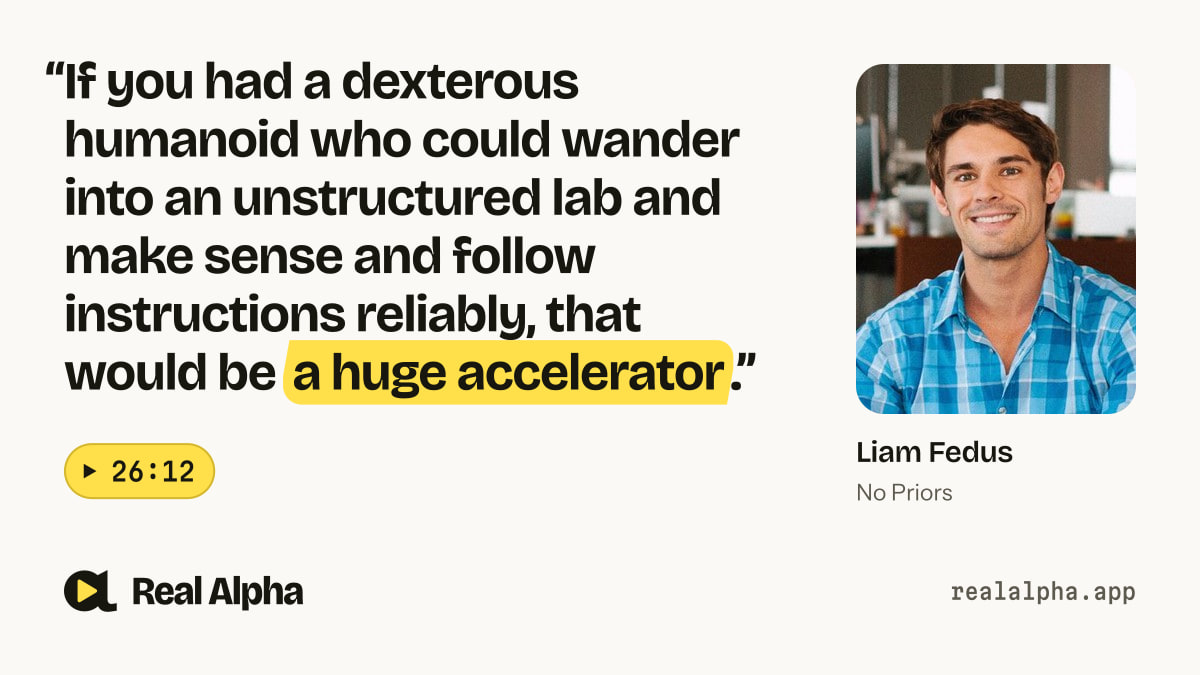
“If you had a dexterous humanoid who could wander into an unstructured lab and make sense and follow instructions reliably, that would be a huge accelerator.”
 Liam Fedusat 26:12 · No Priors
Takeaways
- The goal is high-quality, high-volume, diverse data.
- People and reliable automated systems can already run experiments.
- Dexterous robots could accelerate lab work and lab setup.
About this segment
Liam Fedus says Periodic can generate data with people and reliable automation already. More capable robots could speed up experiments and make new labs easier to set up.

Liam Fedus is co-founder of Periodic Labs.
Co-founded Periodic Labs, which raised a $300M seed round, after work as one of OpenAI's most respected researchers.

Elad Gil, Host · CEO, Gil & Co
Investor in Airbnb, Stripe, Coinbase and Anthropic; co-founded Color.
From “AI for Atoms: How Periodic Labs is Revolutionizing Materials Engineering with Co-Founder Liam Fedus”, Apr 3, 2026. Watch the full episode
Thanks. We'll look at and fix what's off.
Transcript
Transcribed by machine (Whisper) from the episode’s audio, so a word may be off here and there.
- 25:42
sufficiently good robotic systems in order to have that closed loop for what you're doing? In other words, do you need something like Pi or Skills or something else to work in order for periodic to hit that escape velocity in terms of a closed loop system no but it's a huge accelerator the goal for periodic is to generate high quantity high quality data diverse data and automation is assistance to that so right now we employ people as well and we have autonomous parts that are just very reliable. If you had a dexterous humanoid who could wander into an unstructured lab and make sense and follow instructions reliably, that would be a huge accelerator. Right now, the automation of physical systems requires a very careful design and it's slow. But I think with improvements in robotics, that's just going to accelerate this. But already
- 26:41
The reliability of these sort of like hybrid systems is sufficient to produce huge amounts of reliable data, but it's just going to accelerate us forever. Yeah, one of the reasons I ask is I used to run this company, Color, and we built our own liquid handling robotic systems, right? We'd buy liquid handling robots, but then we'd have to adjust them dramatically. We had cameras that would use ML to monitor the system and sort of make adjustments.
- 27:04
We had to 3D print parts to decrease vibrations on the platform because we were dealing with such small volumes of liquid. And so there's enormous amounts of customization versus just having... And the firmware for it was awful and writing against that was painful versus just having a robotic system that would work like a modern system in all the ways that you'd conceive that. And that's the reason that I was asking is if you really want to do high-throughput experiments, you need these underlying systems.
- 27:30
to be able to do all the liquid handling and to do all the titration of stuff and all the rest of it. Yeah, that's right. I mean, I think right now we're using almost more like off-the-shelf robotics. It's very simple, very commoditized, not doing a huge amount of innovation on that front. But again, as these more general robotic systems come to hit this reliability threshold, it's going to be a massive accelerator for spinning up new labs as well.