The alpha, twice a week
That was 3 min.
Get the best new moments in your inbox every Wednesday and Saturday. It's free.
Check your inbox
We sent a link to your address. Click it to finish signing up. Not there in a minute? Look in spam.
or
No Priors · 3 min · Apr 3, 2026
Materials models need experimental data in a closed loop
 Liam Fedus
 explains how broad pretrained models provide a starting point, but literature alone can be inconsistent.
The episode’s best minutes
Full analysis- 6:28Materials models need experimental data in a closed loop3 min
- 21:35Intelligence is spiky and self-improvement stays domain-specific4 min
- 25:36Robots can accelerate lab data generation, but are not required2 min
- 3 more moments in the full episode
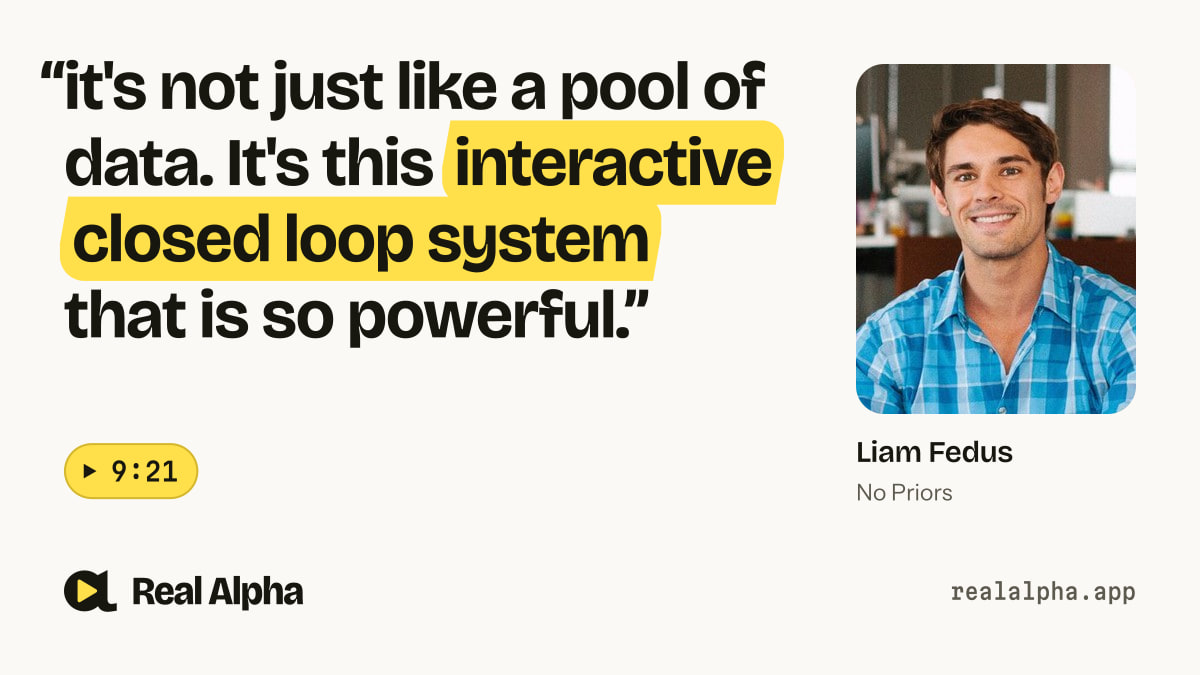
“it's not just like a pool of data. It's this interactive closed loop system that is so powerful.”
 Liam Fedusat 9:21 · No Priors
Takeaways
- Existing models provide a strong prior from vast text data.
- Reported material properties can vary by orders of magnitude.
- Use experiments to find patterns and drive the next tests.
About this segment
Liam Fedus explains how broad pretrained models provide a starting point, but literature alone can be inconsistent. Experiments ground the data and guide what to test next.

Liam Fedus is co-founder of Periodic Labs.
Co-founded Periodic Labs, which raised a $300M seed round, after work as one of OpenAI's most respected researchers.

Elad Gil, Host · CEO, Gil & Co
Investor in Airbnb, Stripe, Coinbase and Anthropic; co-founded Color.
From “AI for Atoms: How Periodic Labs is Revolutionizing Materials Engineering with Co-Founder Liam Fedus”, Apr 3, 2026. Watch the full episode
Thanks. We'll look at and fix what's off.
Transcript
Transcribed by machine (Whisper) from the episode’s audio, so a word may be off here and there.
- 6:34
I guess the other thing that's missing from the physical world is data, or at least data that's easily accessible. So you look at something like the big foundation models on the language side, and they're basically trained on the internet as a major corpus. It's augmented in all sorts of ways with other data sources. How do you think about that for what you're doing where you're trying to model atoms in the physical world and how all that stuff kind of works?
- 6:52
Yeah, so experiment. I mean, so we have physics simulations and we have experiment. And I think exactly as you're pointing out, ML systems are good on the data you've trained them on, on the tasks you've trained them to do. I think sometimes there's like this mythology of AGI, ASI, RSI, and I think we see increasingly powerful systems, but they do become limited if they don't have access to the raw data to actually make informed decisions.
- 7:23
How much data do you need? And so I know that there's some data scale related research and other things. things in terms of how you kind of hill climb towards like a really good model, how many experiments do you need to run? Or how many data points do you need? Or how do you think about the diversity of data points you need to generate? I'm a little bit curious, like, what does that actually look like tangibly? So there is some generalization from the existing models. So we don't need to reproduce a system that can understand and write English or write code. So we're kind of like leveraging. And are you using open source for that or close source models or we use a combination uh-huh yeah so for example like periodic spends zero effort on improving coding models um we're you know incredibly impressed by codex cloud code and so that's
- 8:09
been a huge accelerator for the company um but focused our machine learning efforts where um you know the existing frontiers is not sufficiently good for us i think going back to the data question we're leveraging call it order tens of trillions of tokens that went into open source models and that's given this like very like foundational understanding but once we start moving into specific discovery areas chemical spaces we can see a very high level of sample efficiency so the system isn't starting as like a randomly initialized neural net it has a strong prior on the world and so where does that prior come from what data just like informs that just general just just like you know papers yeah the internet as you're pointing out yeah um however that's insufficient um one of the engineers on our team was looking at a reported material um
- 9:04
property and it was just sort of extracted values from literature and it was really interesting to see the reported value spanned many orders of magnitude and so you train an ml system on that and it's like well the best you can do is model this distribution but you're no closer to like a ground truth. And that's where experimental data comes in, where you now have a grounding in this. But really important, it's not just like a pool of data. It's this interactive closed loop system that is so powerful. Once you have the experimental data, you can look through it. You can look for aberrations. You can look for patterns. You can look for consistency with simulation data, with literature. And then that helps drive the next set of experiments. So it's not just a pool of data, it's this very active loop.