The alpha, twice a week
That was 5 min.
Get the best new moments in your inbox every Wednesday and Saturday. It's free.
Check your inbox
We sent a link to your address. Click it to finish signing up. Not there in a minute? Look in spam.
or
All-In · 5 min · Aug 24, 2026
Kratsios says Fauci-era guidance damaged trust in science
 Michael Kratsios
 links school masking and unequal rules for protests and hospital visits to public distrust of science.
In this episode
Full analysis- 15:49Golden tickets could make science grants less conservative5 min
- 22:11The administration is setting ambitious science targets5 min
- 38:42The U.S. needs a stronger homegrown STEM pipelinePro pick 5 min
- 44:01Kratsios says Fauci-era guidance damaged trust in science5 min
- 13:03More NIH spending has not produced proportionate breakthroughs3 min
- 8:00Kratsios says RCP 8.5 no longer met scientific standards5 min
- 5:36Kratsios says a quarter of NSF grants funded DEI-related work3 min
- 29:39Federal science funding should fill gaps private capital leaves5 min
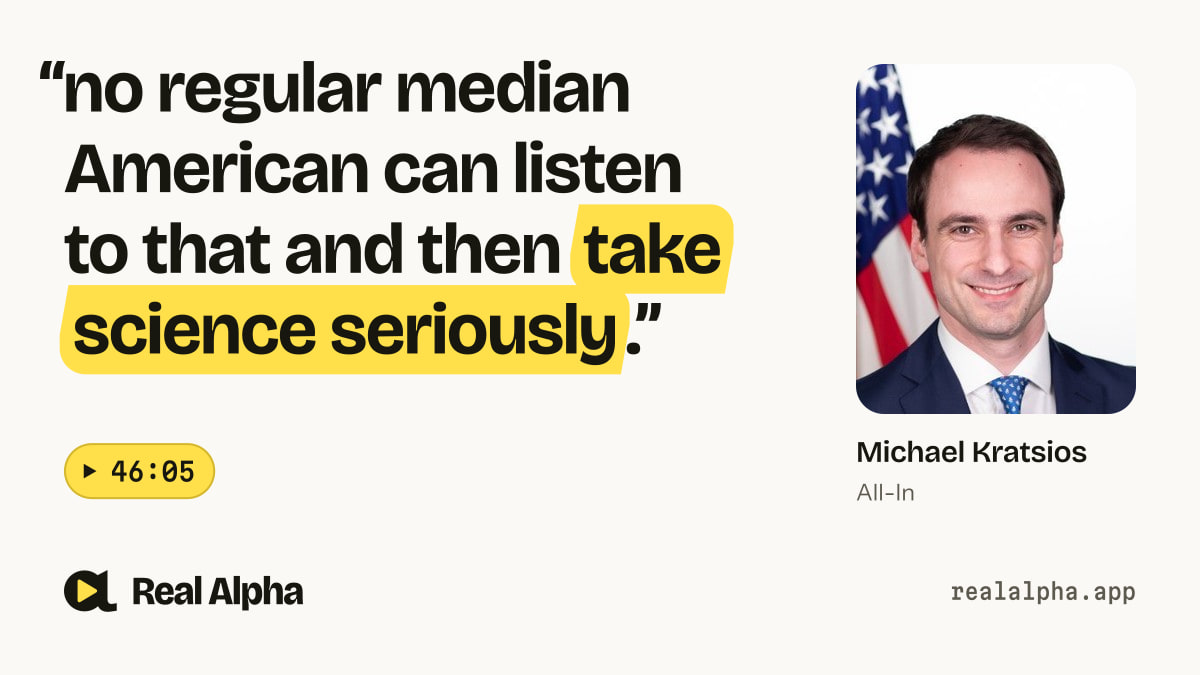
“no regular median American can listen to that and then take science seriously.”
 Michael Kratsiosat 46:05 · All-In
Takeaways
- He cites school masking as an example of guidance that hurt trust.
- He contrasts protest allowances with restrictions on visiting dying relatives.
- He says dismissing questions as anti-science made repair harder.
About this segment
Michael Kratsios links school masking and unequal rules for protests and hospital visits to public distrust of science. He argues that treating questions as anti-science made the trust problem harder to repair.

Michael Kratsios is a director of the White House Office of Science and Technology Policy.
Led the American AI Initiative as U.S. CTO and now directs the White House science and technology agenda.

Chamath Palihapitiya, Host · Founder & CEO, Social Capital
Led Facebook's growth team; his firm backed Slack and AI chipmaker Groq.

Jason Calacanis, Host · Founder & CEO, LAUNCH
Early Uber angel; sold Weblogs Inc. to AOL; hosts This Week in Startups.

David Sacks, Host · Co-founder & partner, Craft Ventures
PayPal's first COO, founded Yammer; White House AI & crypto czar 2025–26.

David Friedberg, Host · CEO, Ohalo
Founded The Climate Corporation, sold to Monsanto for about $1.1B in 2013.
From “Inside Trump's Science Agenda: Anti-Science Claims, Fauci's Damage, DEI & China w/ Michael Kratsios”, Aug 24, 2026. Watch the full episode
Thanks. We'll look at and fix what's off.
Transcript
Transcribed by machine (Whisper) from the episode’s audio, so a word may be off here and there.
- 44:13
I mean, in the 20th century, scientists in the post-World War II, particularly, were celebrities, were rock stars. They were kind of featured in magazines, and newspapers, and television shows. and, you know, they were rewarded economically with fame and notoriety. Did we lose it or did it lead to moments where you have like Fauci? That's a great question. I do feel like there are a few sort of names in today's time that kind of meet that moment. If you think of someone like Demis, for example, at Google that, you know, has won a Nobel Prize. 90% of people hate AI.
- 44:49
That is true. That is true. Maybe he can turn the tide on that one. I'm not sure. He's probably the best qualified, but I think it's an uphill battle at this point. It is true. I mean, there's this deep anti-science, anti-technology sentiment, not just in the U.S., but in the West. Do you think it's bred locally because people feel left behind? Scientists and technologists, if you look historically through great cycles, they're often scapegoats.
- 45:13
They're often viewed as the elitist because they know stuff. They have stuff that others don't. Yep. There's knowledge. there's access, there's control, there's power, because when you have a new technology, you have power that others don't have. When you have understanding, you have something that others don't have. Are we in this moment, this populist moment right now in the West where science and technology is viewed as a tool of the elite, and therefore it must be broken and destroyed?
- 45:36
I don't know about that. But what I think about is, is I really do oftentimes think about kind of what happened during COVID and kind of what Fauci represented. And I think, you know, he did more disservice to science than than anyone in in modern history you know when he is advocating for positions like you know students need to be masked in schools when um societies you know you know the pediatric societies are putting out letters saying you know um it's okay for people to go out um and and uh collectively protest but they're not allowed to you know go see their dying grandmother in a hospital, you know, no regular median American can listen to that and then take science seriously. So I think there's a lot of healing that needs to be done. And that's why I think our approach to going back to the roots of goal-centered science is so important. We have to
- 46:33
allow people to understand and trust what science is about and see that it's an inspiring and a good thing and can change our way of life. And it's not some sort of like dogma or rule or some edict that comes from on high, but it's a process that all of us are part of, that we're all experimenting and learning about the world and the universe that we live in. And I try to be more optimistic, but I think we really, really hit a low point during COVID. And I think we're going to have to take, it's going to take quite a while to dig ourselves out. Yeah. My observation during that era is like, I always assume that if everyone thinks something, it's probably wrong. Yes.
- 47:05
Yes. But if some percent of people argue viciously against it, and some people argue for something, there's some objective truth to be found in that. But if everyone aligns behind something in a very kind of uniform way, there's something really off about that. But what was scary to me was how so many people without empiricism, the whole fundamental basis of science is you gather empirical data, you ask questions, you inquire, and then you go gather data and you use that data to inform your conclusion. And there wasn't a lot of empirical data that was being used to make conclusions and everyone lined up behind these conclusions and these assumptions and it was told trust the science and as a result not only did it kind of destroy trust in science but I think it brings to light questions what happened to the scientists
- 47:53
why did they all kind of line up like this and why did everyone feel it was okay to put down people that ask questions when the basis of science is to ask questions. And it's okay if people ask dumb questions, if they ask wrong questions. But there was this breakdown on the scientific basis of scientists being capable of asking questions without being shunned. I could not agree more. And anyone who asked questions were criticized by the scientific community as being anti-science. Outcast. Yeah. It's crazy. Anti-vaxxers.
- 48:29
You're anti this, anti that, anti science. You ask one question, you're anti science. If you question some of the conclusions in the IPCC reports on climate change, you can agree with some things, disagree with other things, but if you don't agree with it all, you're anti science. Well, no, but the idea that you would push back on the RCP 8.5, if I would have pushed back on that publicly three or four years ago, I would have been criticized dramatically by everyone.
- 48:54
It's being anti science. You're a Trumper anti science MAGA guy. But now PCC says we can't even talk about that anymore. So I think if you stay the course and continue to stick to sort of gold standard science ideals of being inquisitive, asking questions, following the scientific method, I think ultimately would be proven right.