The alpha, twice a week
That was 3 min.
Get the best new moments in your inbox every Wednesday and Saturday. It's free.
Check your inbox
We sent a link to your address. Click it to finish signing up. Not there in a minute? Look in spam.
or
MD MEETS · 3 min · Nov 25, 2026
Kushner negotiates by solving problems alongside his counterparts
 Jared Kushner
 says he first tries to understand leaders’ motives, then shapes options around their incentives.
The episode’s best minutes
Full analysis- 14:57Putin rejects a ceasefire because he doubts a settlement will hold4 min
- 51:55Kushner says Gaza must be rebuilt under a new framework3 min
- 57:30Kushner negotiates by solving problems alongside his counterparts3 min
- 4 more moments in the full episode
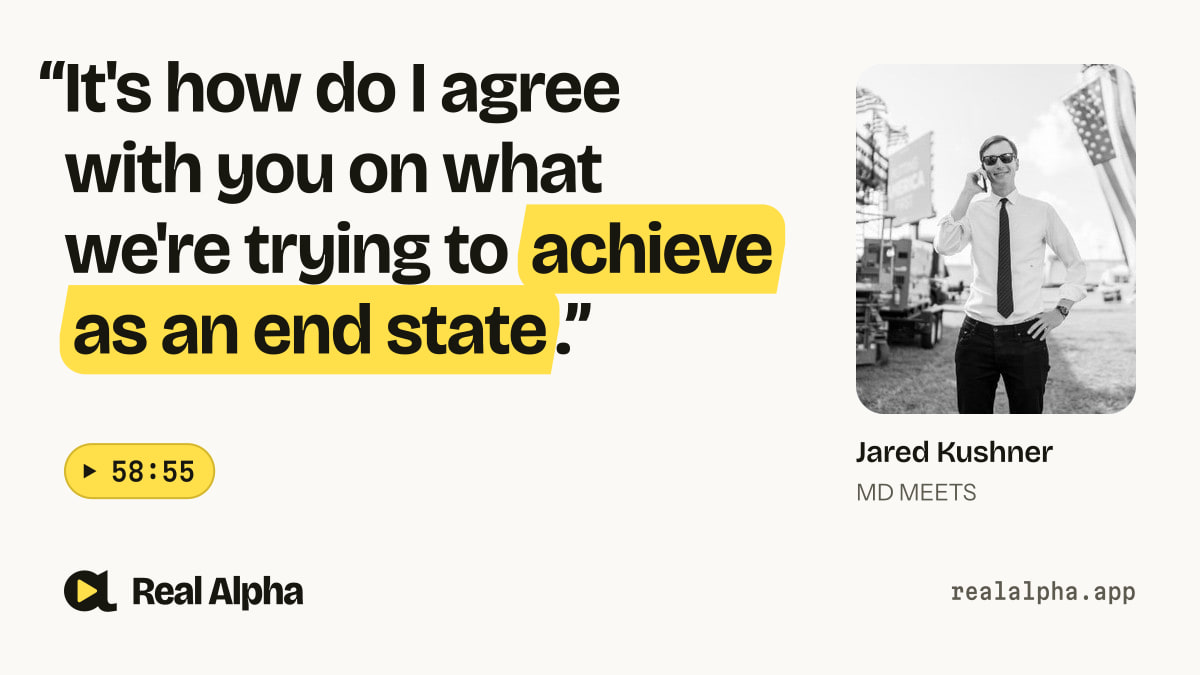
“It's how do I agree with you on what we're trying to achieve as an end state.”
 Jared Kushnerat 58:55 · MD MEETS
Takeaways
- Understand what drives the other side before proposing a solution.
- Help counterparts navigate their local political constraints.
- Look for shared end goals and incentives.
About this segment
Jared Kushner says he first tries to understand leaders’ motives, then shapes options around their incentives. He frames negotiations as joint problem-solving rather than pressure across a table.

Jared Kushner is a businessman, investor and negotiator for the Trump administration.
Led Middle East peace efforts that produced the Abraham Accords and co-led negotiations for the USMCA.
- MD
Mathias Döpfner, Host
From “Jared Kushner: Inside the Negotiations with Putin and Zelensky”, Nov 25, 2026. Watch the full episode
Thanks. We'll look at and fix what's off.
Transcript
Transcribed by machine (Whisper) from the episode’s audio, so a word may be off here and there.
- 57:37
most? I would say they all impress me, right? Because I think everyone, to get to become a leader of an organization or a country, you have to have certain skills and certain capabilities. And, you know, what I try to do is just listen. I think they, I don't think any of them think they're bad people. I think all of them think that they're doing what they're doing for a reason. I think they're thinking what they're doing is justified.
- 58:02
And my job is to listen and understand, you know, what they believe, what they're trying to achieve, and then see if I can help find a way to get that. achieve. You know, if I'm in there, you know, judging them or trying to lecture them, I don't think that's going to be very productive towards achieving an outcome. So I try to find the best in everyone I meet. And I try to, I always try to kind of learn from all of them.
- 58:24
I try to understand what their skill sets are, you know, what are their superpowers that allow them to become a leader and then try to figure out how do you play into those things? You know, like, so for example, you know, there's certain leaders, I don't want to mention the name, who most of their decisions are motivated by short-term politics. So if you have a long-term strategic objective, you need to help that person navigate how to navigate their local politics. And so once you understand the motivations and what's kind of pushing them, then you can try to reframe or you can try to design a solution that allows you to get to your outcome while also managing some of their risks. And the way I always think about negotiations is not, I'm going to sit across from you from the table and negotiate. It's how do I agree with you on what we're trying to achieve
- 59:06
as an end state. And let's sit next to each other on the side and let's problem solve together. And that's how I view all these conflicts is that they're essentially puzzles and they're puzzles that need to be solved. But you're not going to do it by beating somebody up or pressuring them. It's really about, you know, doing something. I believe that people should do things because it's in their incentives and interest to do that. And I think that, you know, there's a lot of people who say, well, we have a rules-based order and the rules are the rules. But, you know, rules between nations are things that, you know, they change, you know, over time. They're good to have but I really believe more in incentives and interests and then I try to create win-win opportunities for people.
- 59:41
So that's really how I try to approach these different conversations and negotiations and problem-solving sessions. Jared, you are a businessman, you are an investor, you are running your fund, and at the same time you are basically working in politics,