The alpha, twice a week
That was 4 min.
Get the best new moments in your inbox every Wednesday and Saturday. It's free.
Check your inbox
We sent a link to your address. Click it to finish signing up. Not there in a minute? Look in spam.
or
MD MEETS · 4 min · Nov 25, 2026
Putin rejects a ceasefire because he doubts a settlement will hold
 Jared Kushner
 says Putin appears to fear that stopping the war would not prevent another one.
The episode’s best minutes
Full analysis- 14:57Putin rejects a ceasefire because he doubts a settlement will hold4 min
- 51:55Kushner says Gaza must be rebuilt under a new framework3 min
- 57:30Kushner negotiates by solving problems alongside his counterparts3 min
- 4 more moments in the full episode
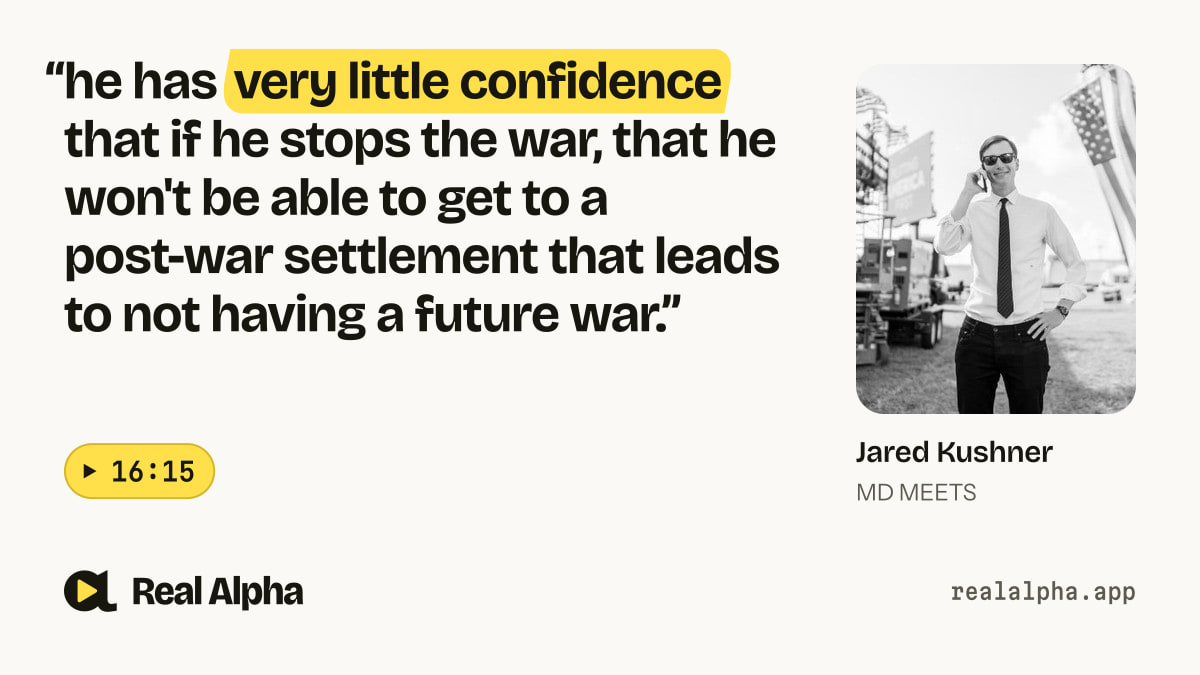
“he has very little confidence that if he stops the war, that he won't be able to get to a post-war settlement that leads to not having a future war.”
 Jared Kushnerat 16:15 · MD MEETS
Takeaways
- Putin's reluctance is tied to doubts about a durable settlement.
- Kushner says both sides are weighing the risk of a future war.
- He sees escalation and miscalculation as growing risks.
About this segment
Jared Kushner says Putin appears to fear that stopping the war would not prevent another one. He argues that postwar security arrangements may be needed before a ceasefire can stick.

Jared Kushner is a businessman, investor and negotiator for the Trump administration.
Led Middle East peace efforts that produced the Abraham Accords and co-led negotiations for the USMCA.
- MD
Mathias Döpfner, Host
From “Jared Kushner: Inside the Negotiations with Putin and Zelensky”, Nov 25, 2026. Watch the full episode
Thanks. We'll look at and fix what's off.
Transcript
Transcribed by machine (Whisper) from the episode’s audio, so a word may be off here and there.
- 15:04
Before we get to Europe, I mean, if President Putin really wants peace, why then doesn't he agree, let's say, on a ceasefire as a first step and then sort out the details of a deal? Why is the situation still that he is constantly provoking Europe and the West with kind of very likely actions from the Russian side, from bombs that are dropping on Polish territory to experiments in orbit with nuclear satellites?
- 15:40
So it doesn't look like after this tremendous kind of success that he had in this meeting in Shenzhen, where he spoke to the two most relevant world leaders, President Trump and Xi, and basically his people were carrying the nuclear suitcase around, aren't these all gestures of provocation? testing the West how far he can go? So that's a very important question because that's a question that we've asked President Putin as well. You know, can we do a ceasefire and work things out after? But I believe what we've seen, and this is not from his words, but from our interpretation of his words, is that he has very little confidence that if he stops the war, that he won't be able to get to a post-war settlement that leads to not having a future war. And I think that that's consideration of his. And I think it's a consideration of ours as well. So we understand
- 16:37
that. I think in terms of these provocations, we're living in an incredibly dangerous time where, you know, this war is somewhat contained to Ukraine, but it's effectively become a proxy war where Europe is funding and arming Ukraine against Russia. And it won't take a lot of miscalculation for this thing to escalate massively. Now, so far, Putin has showed restraint. He's agreed not to use nuclear weapons, which obviously is a big thing. And he's reassured us that that's not his intention. But even so, you know, the firing on the cities from both sides, I mean, there's a lot of, you know, deep strikes now happening in both countries, which is hurting the way of life and civilian infrastructure and has civilian, you know, casualties. I mean, that's a horrific, you know, cost of this war for both sides, in addition to, obviously, what's happening
- 17:20
on the front lines. And so we've been pushing very, very hard for that. But it doesn't seem that President Putin is interested in that. So with that being said, what we should do is focus on the post-war, which, again, I think makes sense for us because you want to get to a peace that's going to last. So there's no reason why we can't be talking and designing and coming up with proposals, which we have been doing simultaneously.
- 17:39
And hopefully by designing this, we'll be able to get to that ceasefire. And I think that that's really the only way that we've seen. You know, we've asked, you know, the Europeans or the Ukrainians if they have a better idea on how to get there, but nobody's presented us with one so far. Do you believe the theory that the more strength the West shows with regard to defense and solidarity with Ukraine, the higher the likelihood of a Russian escalation gets? Or could it be the other way around? I think there's, it's very, very hard to find what's the right calibration and which steps you take lead to an escalation that's unintended, that you can't put back in the box. You know, wars are horrible, very, very anti-war. You know, when you do a war, you open Pandora's box. They never quite go the way you think. You know, people find ways of
- 18:28
survival, they find capabilities, they find leverage points that many people didn't think about beforehand. So wars are horrible. And I think that the longer it goes on, the more there's risk of, you know, greater escalation and miscalculation. And that's why it's such an urgent focus as far as to try and find the way to end this. And again, not just end it to get a ceasefire, but end it in a way that won't just lead to another conflict. I think you've seen these hot and cold, you know, periods in Europe over the last 30 years. And I do think we have a good understanding now of the root causes. And I think we're working incredibly well with Europe in an organized fashion to try and come up with a framework. If we get it right, that could be enduring. But again, this is a very, very hard war to end. And it's very, very hard to come up with the right framework that hopefully
- 19:08
will be enduring because nobody's been able to achieve either of those things so far. Why did President Trump put so much pressure on President Zelensky? And why did he do a diesel