The alpha, twice a week
That was 3 min.
Get the best new moments in your inbox every Wednesday and Saturday. It's free.
Check your inbox
We sent a link to your address. Click it to finish signing up. Not there in a minute? Look in spam.
or
MD MEETS · 3 min · Nov 25, 2026
Kushner says Gaza must be rebuilt under a new framework
 Jared Kushner
 argues that past aid efforts failed because they worked within the old system.
The episode’s best minutes
Full analysis- 14:57Putin rejects a ceasefire because he doubts a settlement will hold4 min
- 51:55Kushner says Gaza must be rebuilt under a new framework3 min
- 57:30Kushner negotiates by solving problems alongside his counterparts3 min
- 4 more moments in the full episode
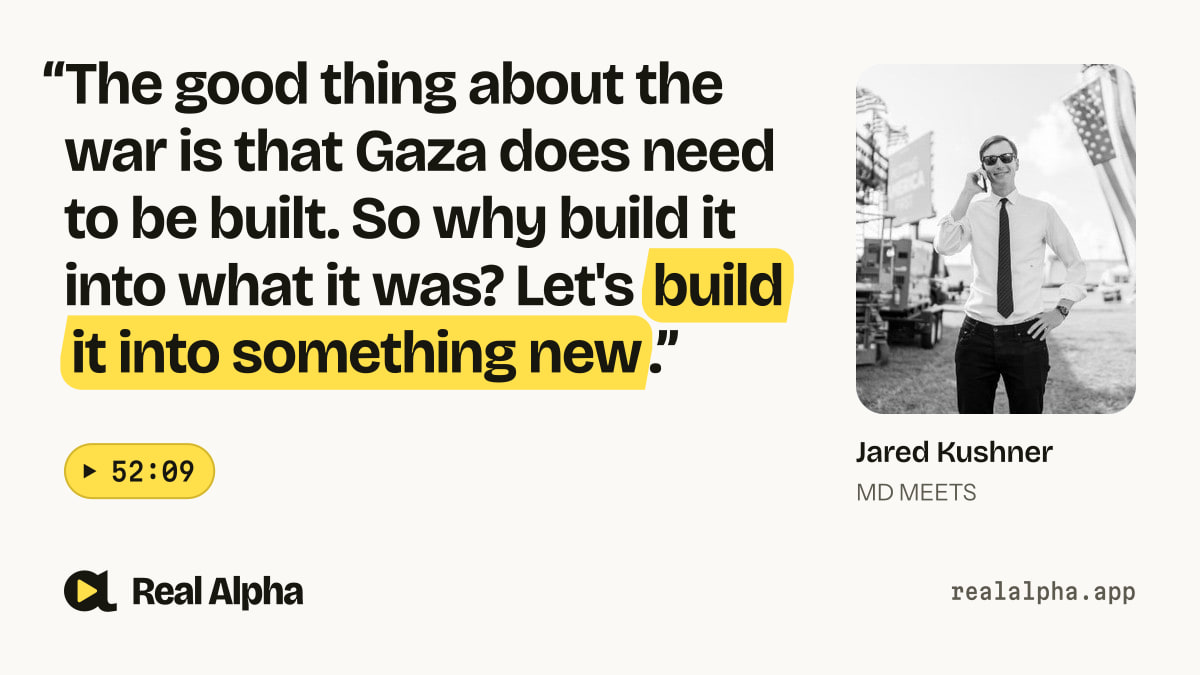
“The good thing about the war is that Gaza does need to be built. So why build it into what it was? Let's build it into something new.”
 Jared Kushnerat 52:09 · MD MEETS
Takeaways
- He says previous efforts were limited by the existing framework.
- The plan depends on removing weapons and establishing new governance.
- Kushner sees investment and education as routes to opportunity.
About this segment
Jared Kushner argues that past aid efforts failed because they worked within the old system. His proposed approach pairs disarmament and new governance with investment, education and healthcare.

Jared Kushner is a businessman, investor and negotiator for the Trump administration.
Led Middle East peace efforts that produced the Abraham Accords and co-led negotiations for the USMCA.
- MD
Mathias Döpfner, Host
From “Jared Kushner: Inside the Negotiations with Putin and Zelensky”, Nov 25, 2026. Watch the full episode
Thanks. We'll look at and fix what's off.
Transcript
Transcribed by machine (Whisper) from the episode’s audio, so a word may be off here and there.
- 52:03
Yeah. So I think all those attempts were well-intended. And I think we've studied all of them and we hope to learn from them. But they were limited by wanting to do something well with the current framework. Again, the bad thing about the war is that it was horrific. It caused a lot of suffering. The good thing about the war is that Gaza does need to be built. So why build it into what it was? Let's build it into something new. And then we have a United Nations resolution that we got passed unanimous that gives the Board of Peace the authority to govern Gaza. And we got Hamas to sign an agreement saying they're going to give up the weapons. So, you know, getting, you know, from an agreement signed to collecting the weapons is a step, but we have a plan to do that. We're building the International Stabilization Force. And it's led by General
- 52:42
Jeffers, who's incredible. We have a whole plan on how to do it. And we have to try. I'm not saying this is easy. Like, again, we're taking on an impossible task. But if we can get the weapons out of Gaza, and then we can create a new government in place and put in new rules and laws that actually attract capital, you know, make it free, that gives the people a chance. Like, let's unleash the people. I see the, I've spent a lot of time, you know, studying like small businesses in Gaza and how do you, you know, provide the right education in Gaza. There are so many people, there's a lot of people who just, you know, like to post and, you know, say crazy things and they keep flags in their like Twitter handles. But there's a lot of people who have really come and say, I want to contribute my personal money. I want to roll up my sleeves.
- 53:21
I want to help design programs. And the level of entrepreneurialism that you have in Gaza is incredible. The people have just been living under a framework where Hamas is the rule, the goal of them is to destroy their neighbor, and these people don't have the freedom. So if you could put in place a technocratic government that wants to help the people, you take away the threat, Israel can then loosen, allow building materials in and all the things we need. I think we can get Gaza from a place that now I think 80% of their GDP is from aid. And it's a place that basically was built by NGOs and terrorist organization, I think we can actually put in place a plan, which I think we put together a really good plan that will give the people the opportunity to really achieve their full potential. And this is on education, you know, health care.
- 54:06
You know, we've got a really, really good plan. And I really have worked very, very hard on this because. I believe that if we are able to change this, I think that this will show people that, you know, Jews and Muslims, Israel and Palestinians, they can work together. It's not about, you know, state, no state political. It's just about can we coexist peacefully? And I think that that's the desire of most of the people.
- 54:26
There just hasn't been the right environment in order for that to occur. So, you know, maybe just maybe we can do that, but we need very strong cooperation from everyone involved because what we're trying to do is really it's an impossible task. But I think for the first time, it's achievable, and we are very, very committed to it, and we're doing it with a lot of determination and a lot of heart.