The alpha, twice a week
That was 4 min.
Get the best new moments in your inbox every Wednesday and Saturday. It's free.
Check your inbox
We sent a link to your address. Click it to finish signing up. Not there in a minute? Look in spam.
or
Into the Impossible With Brian Keating · 4 min · Dec 29, 2024
LeCun sees five or six years as a best-case AI timeline
 Yann LeCun
 estimates human-like machine intelligence is at least five or six years away, even if planned approaches work.
In this episode
Full analysis- 17:13JEPA predicts useful representations instead of pixels7 min
- 46:59Safe AI needs objectives and engineered guardrails8 min
- 1:03:31AI glasses can answer practical questions for farmers3 min
- 4:11LLMs still lack the physical-world model needed for action5 min
- 8:53Prediction depends on finding the right representation4 min
- 26:20New physics needs manipulable world models, not just more data4 min
- 30:34Self-supervision accounts for more learning than labels or rewards5 min
- 39:12LeCun sees five or six years as a best-case AI timeline4 min
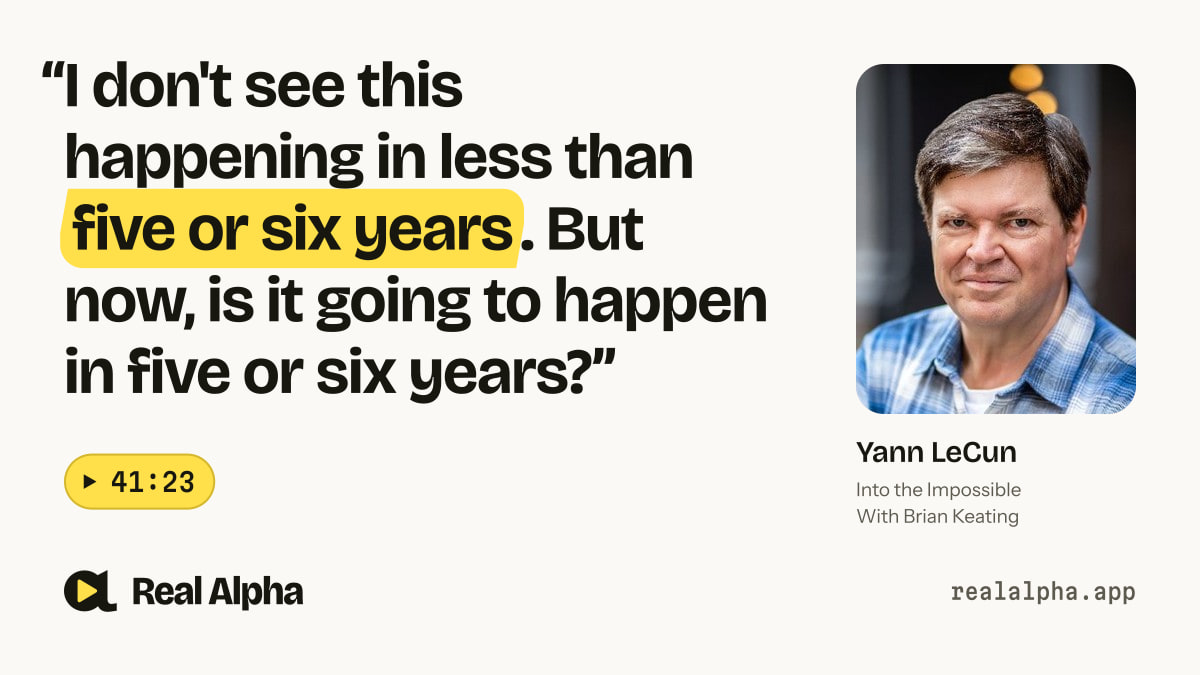
“I don't see this happening in less than five or six years. But now, is it going to happen in five or six years?”
 Yann LeCunat 41:23 · Into the Impossible With Brian Keating
Takeaways
- His five-to-six-year estimate is a best-case scenario.
- It assumes planned architectures and scaling efforts succeed.
- AI timelines carry a long tail of technical uncertainty.
About this segment
Yann LeCun estimates human-like machine intelligence is at least five or six years away, even if planned approaches work. He stresses that this is a best case with many assumptions about progress and scale.

Yann LeCun is chief AI scientist at Meta and professor at NYU.
Founded world-model lab AMI Labs after leaving Meta, where he was chief AI scientist and founded FAIR.

Brian Keating, Host · Host, Into the Impossible With Brian Keating
From “Yann LeCun: AI Doomsday Fears Are Overblown [Ep. 473]”, Dec 29, 2024. Watch the full episode
Answers “When will we get AGI?” See all 40 answers
Answers “What will AI look like in the next few years?” See all 395 answers
Thanks. We'll look at and fix what's off.
Transcript
Transcribed by machine (Whisper) from the episode’s audio, so a word may be off here and there.
- 39:18
He has two questions for you that he texted to me. First one is, when do you, Jan, expect AGI, defined as AI that can do almost all Zoom jobs? Resisted the use of the phrase AGI. And the reason is not that I don't believe in the concept that AI system will eventually become as intelligent as humans. I certainly have no doubt that at some point in the future, we will have machines that are as intelligent as humans in all the domains where humans are intelligent.
- 39:45
There's no question this will happen. Okay, no doubt. It's a matter of time. But calling this AGI is complete nonsense because human intelligence is incredibly specialized. We have a hard time kind of accepting. this concept that human intelligence is specialized, but it is very specialized. That's why I don't like the term. I like, the term I've been using is either human-level AI or AMI. So that stands for advanced machine intelligence.
- 40:14
This is kind of the term that we use internally at Meta. We pronounce it Abby because... Friend. There's a lot of French people. Okay, also means friend, right, in French. But that's the same concept, right? So now, how long is it going to take? Strangely enough, I get asked that question by people like Mark Zuckerberg. And the reason is it's an important thing to know if you want to invest tens of billions in infrastructure to train big AI systems.
- 40:43
If you want to be able to tell people within a few years you're going to be able to wear those smart glasses that you were showing us initially. And in those glasses, there will be an intelligent assistant that you can ask, be with you at all time. You can ask any question. is going to be smarter than you, possibly. And you shouldn't feel threatened by that. It would be like having a smart colleague that you can talk to and ask any questions.
- 41:06
So how long is it going to take? So I think to have possibly a system that, at least to most people, feels like it has cerebral intelligence as humans, if all of the plans that, all of the things that we are imagining will work, okay, so those JEPA architectures and some other ideas that we're playing with succeed. I don't see this happening in less than five or six years. But now, is it going to happen in five or six years?
- 41:39
And I think there's a distribution with a tail that's very long. And the history of AI is that people just keep underestimating how hard it is. I'm probably making the same mistake right now. When I say five, six years, This is if, you know, we don't run into a major obstacle that we didn't foresee, if all the things that we're planning to try out actually work, if things kind of scale, if computers, you know, accelerate and all that stuff.
- 42:07
Like, you know, there's a lot of things, a lot of planets that need to line up for this to happen. So that's the best case, right? It's not going to happen next year. Like you might have heard from, you know, some other folks. Sam Altman, yeah, right. Sam Altman, you know, Elon Musk, you know, various people. Or, you know, Dario Amodei of, yeah, it's going to happen within the next two years or something.
- 42:30
No, what may happen in the next two years is that it's going to be more and more difficult to find cases where common people will be able to ask questions to the latest chatbot that the chatbot would not be able to answer. But like, again, where is my cat? Where is my domestic robot? Where is my level five self-driving car?