The alpha, twice a week
That was 4 min.
Get the best new moments in your inbox every Wednesday and Saturday. It's free.
Check your inbox
We sent a link to your address. Click it to finish signing up. Not there in a minute? Look in spam.
or
Sourcery · 4 min · Nov 5, 2026
Marshall expects signs of life beyond Earth within a decade
 Will Marshall
 predicts that telescopes will find possible signs of life by analyzing exoplanet atmospheres for chemical clues such as oxygen.
The episode’s best minutes
Full analysis- 20:33Space-based compute could offer a cheaper power model4 min
- 4:05Satellite intelligence can give countries an information advantage3 min
- 29:20Marshall expects signs of life beyond Earth within a decadePro pick 4 min
- 5 more moments in the full episode
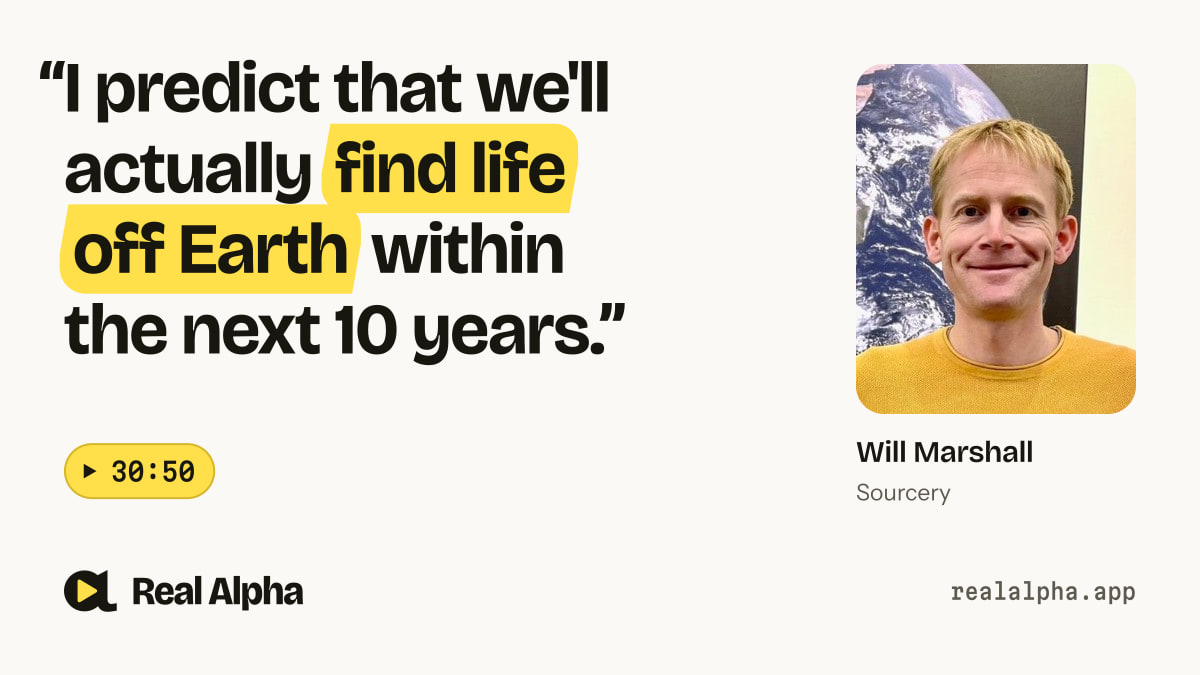
“I predict that we'll actually find life off Earth within the next 10 years.”
 Will Marshallat 30:50 · Sourcery
Takeaways Pro pick
- More than 6,300 nearby planets have been discovered, but none show obvious signs of life.
- Atmospheric oxygen could be a clue because life continually replenishes it.
- Marshall says the universe’s silence makes protecting Earth especially important.
One of Pro's picks, open to you here. Try Pro free for 7 days
One of Pro's picks. The rest of the summary and the 3 takeaways are in Real Alpha Pro; the video, the quote and the transcript stay free.
Read it with Pro, 7 days freeAbout this segment
Will Marshall predicts that telescopes will find possible signs of life by analyzing exoplanet atmospheres for chemical clues such as oxygen. He says the search also highlights humanity’s responsibility to protect Earth.

Will Marshall is cofounder and CEO of Planet Labs.
Co-founded Planet and leads its Earth-imaging satellite network, after developing low-cost spacecraft at NASA/USRA.

Molly O'Shea, Host · Founder, Sourcery
Ex-Upfront Ventures investor; has interviewed Alex Karp and Palmer Luckey.
From “Planet Labs CEO: Why AI Data Centers Will Move to Space”, Nov 5, 2026. Watch the full episode
Thanks. We'll look at and fix what's off.
Transcript
Transcribed by machine (Whisper) from the episode’s audio, so a word may be off here and there.
- 29:26
One, have you seen any... Aliens. Aliens. I knew it. No, in the short answer, we've seen lots of funny things. In fact, the U.S. Air Force Alien Office, whatever it's called, did ask us for imagery, and we did provide. No, I mean, in short answer, there isn't really anything... They move too fast? What's the deal? Yeah, I mean, funny objects, trying to look at flying objects, flying to us, what have you, anomalous stuff.
- 29:56
Now, most of it, there isn't really. I'm sad because actually the interesting backdrop is that the universe is remarkably silent. We haven't seen any aliens yet. And that's shocking. My co-founder worked on a mission called TESS at NASA, which was looking at other planets around nearby star systems. So we've now discovered over 6,300 planets all around in the local galactic neighborhood. And none of them have any obvious signs of life yet.
- 30:34
And now we're still looking, but in many ways the universe is eerily silent. And this is what Enrico Fermi would now call the Fermi paradox after his question, which is basically, what gives? How come there's so many planets, the universe is so big, and we still haven't heard from the aliens? This is a big question. I predict that we'll actually find life off Earth within the next 10 years. Actually, I predicted that a few years ago, so now it's probably more like six or seven.
- 31:05
and the reason is we're going to look at all those planets and look at their atmospheres with the modern best telescopes we have on the earth and the James Webb telescope we can actually tell chemical signatures doing what we do with our tanager satellite about looking out and with that we should be able to see certain signs of the atmosphere that might be indications of life like if you looked at the earth you would see 20% oxygen in the atmosphere that's a dead giveaway because oxygen grabs onto anything it oxidizes iron it oxidizes everything the only reason we have all this abundance is because life is keeps on all the plants keep on pushing all that up if we saw anything like that we would go that planet probably has life we won't be certain we haven't seen the picture of the alien yet but we go that is anomalous we haven't done that yet
- 31:53
but with all that survey i think we'll probably find it but still that that could be life that's We would expect to see radio waves from these things, and we've looked at most of those kind of things, and there isn't. We haven't seen any obvious signs of technology or technological life forms, and so that's rather worrying because one possibility is that we get to technology stages and then we blow ourselves up. You know, people seriously worry about this. Like, we've got nukes. We're sort of getting through that. Now we've got AI. Very scary. Obviously, amazing upside potential like we were talking about but also brings real risks as we saw with recent hacking events and other things AI could help terrorists build bad things and and we've got real risks over AI and then there's the whole control thing can we even control it we don't know that the
- 32:48
reason it's eerily silent is actually because they blow themselves up when they get this stage Hopefully not. But this is why what we do right now, we're taking care of planet Earth, or as I call it, spaceship Earth, because we're all on a spaceship, a billion of us, like Buckminster Fuller observed. And it's the only place that there is life that we know yet. Maybe there's other places, but so far it's the only one. Therefore, our responsibility to take care of it and not blow it up is like not just locally important, it's cosmically important.
- 33:24
It's our cosmic duty to take care of the Earth. And so, in short answer, no, we haven't seen any aliens, but that makes our role here even more important. Question.